Update — 31 August 2026: The independent Lumira/Welon record has grown from 86 to 112 certificates, with identity failures rising from 13 to 20. We also found a vendor-arranged Lumira hGH failure that Peptaura published and recalled, plus two exact-batch HelixBridge passes. This revision separates those testing regimes, corrects the original timeline and treats the price comparison as a 1–2 August publication snapshot.
The price war is real. Peptaura is not leading it.
There is a real race to the bottom in peptides, and for buyers it has been good news. Once Chinese grey-market manufacturers became directly reachable — a Telegram handle and a crypto wallet instead of a Western middleman — the resellers marking the same vials up five and ten times lost their moat. Prices fell. Anyone who dragged those markups down did buyers a favour.
Peptaura casts itself as the champion of that race. Its group bio reads “An open aggregator of peptides suppliers. Health shouldn’t be expensive,” and its founders argue loudly, in public, that they are the ones dragging prices down.
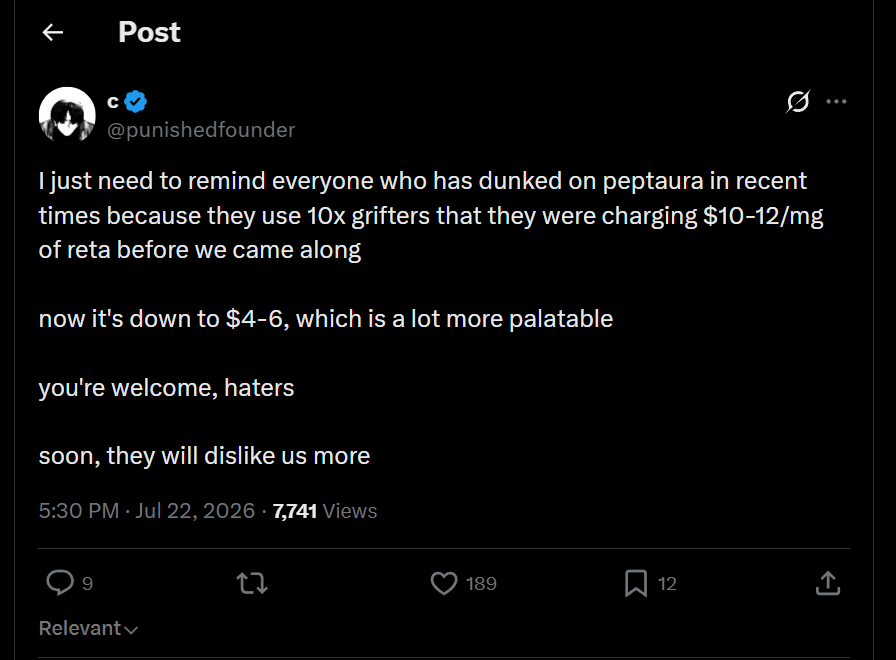
Two things are wrong with that story.
- Their prices were not the low end in our 1 August snapshot. Their vendors advertised a cheap sticker per milligram, then took it back at checkout with flat per-order fees — $72 on Lumira, $84–$86 on Railion Tech and HelixBridge, $60 on Zenove and Peptiva. Count delivery and the advantage evaporated. On the ordinary kit — retatrutide, 10 mg × 10 — TitrateLab’s vendors shipped from US stock for $165 all-in, inside a week. Lumira, the brand Peptaura pushed hardest, was $218, quoted at twelve to fifteen days.
- The race they are actually winning is on quality, not price. A run of vials that tested as the wrong compound entirely, a verification page that passes a batch its own lab failed, and certificates that quietly disappear when they say the wrong thing.
We went looking first for the story Peptaura’s critics tell — secret ownership of the vendors, bought followers, a rug-pull in waiting. We could not stand most of it up, and we say so plainly below. What survives is narrower and more useful to a buyer: a platform that brands its own suppliers, arranges their testing, publishes the results, marks them “verified,” and then races them to the bottom on the one axis that matters — what is actually in the vial.
Everything here comes from records anyone can check: Peptaura’s own site and Telegram, the public certificate libraries of the labs it uses, corporate registries, and certificate transparency logs. Where we could not establish something, we left it unestablished.
Most of the “vendors” are Peptaura’s own brands
Most of the “suppliers” Peptaura aggregates are Peptaura’s own labels, and it says so itself — not on the vendor cards, but in the data its /vendors page ships to every browser: Lumira is the manufacturer Welon; Pepturion is Yimei; Retalux is Reta-Peptide; HelixBridge is Shaanxi Medibridge; NovaVial is “Ningbo Shu You” — eleven house brands over a handful of upstream manufacturers. The batch numbers confirm it. One lot, WL-RT10-000260, went to a lab three times over the summer: twice certified as “Lumira,” once as “Welon Peptide Solutions,” on the same serial counter. Lumira and Welon are one product line under two names.
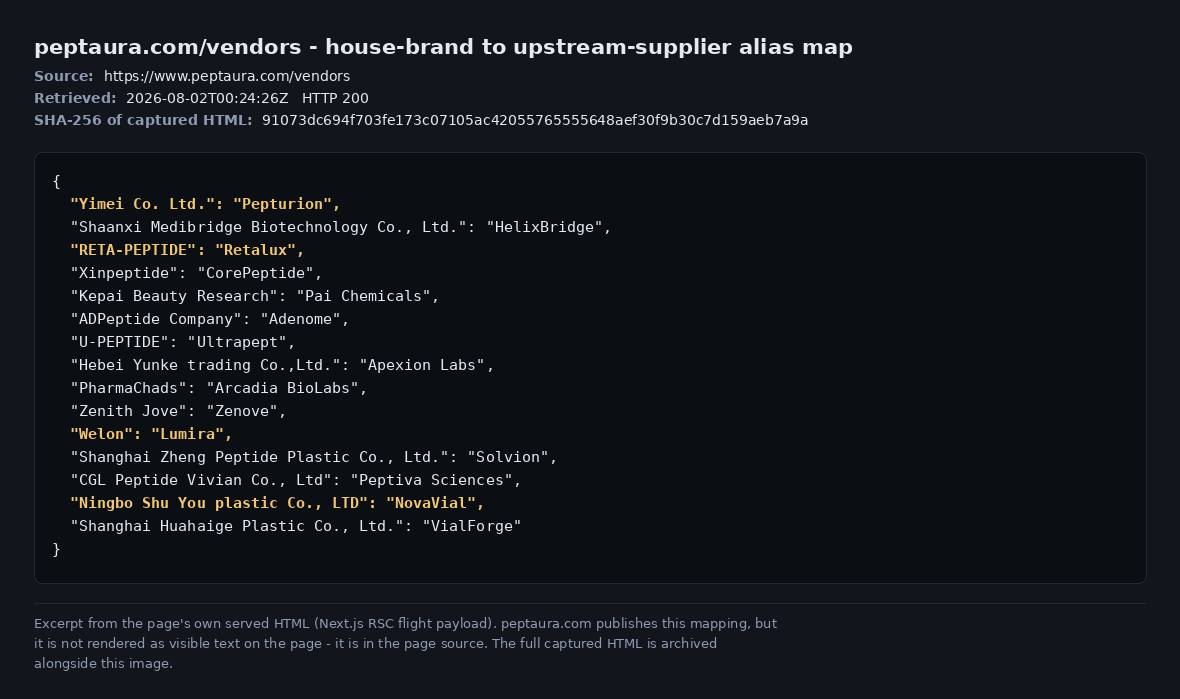
This is disclosed, and on its own it is not wrong — relabelling a factory’s output is ordinary commerce. It becomes a problem because of what Peptaura does next: it also tests those house brands, publishes the certificates, and vouches for them. It is grading its own homework, and every plank of trust points back to the same operator.
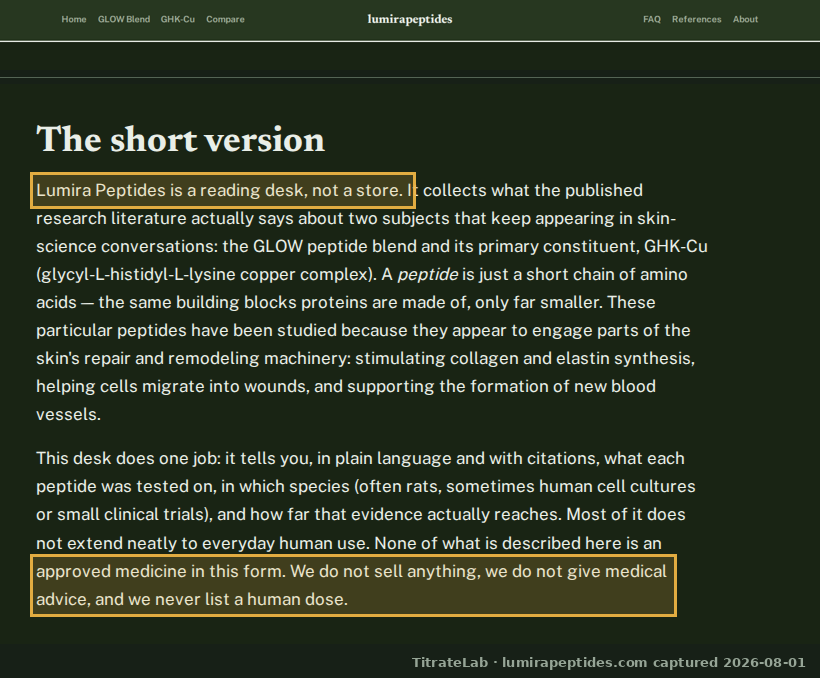
The brands barely exist outside Peptaura’s site. Four of the house-brand domains — helixbridge.com, retalux.com, zenove.com, apexionlabs.com — are third-party resale parking predating Peptaura; three more do not resolve at all. There is no independent Lumira storefront. These are labels, not companies, and a buyer who tries to look one up finds nothing to look at.
We did not have to infer that. We put it to them directly in their own Telegram — how does Peptaura stop people buying from Lumira without going through Peptaura? A founder answered on the record: “how would they do it? lumira websites you see online are fake lmao.” Asked to confirm the obvious reading — so it’s only possible to order through Peptaura? — the same founder replied: “yeah.”
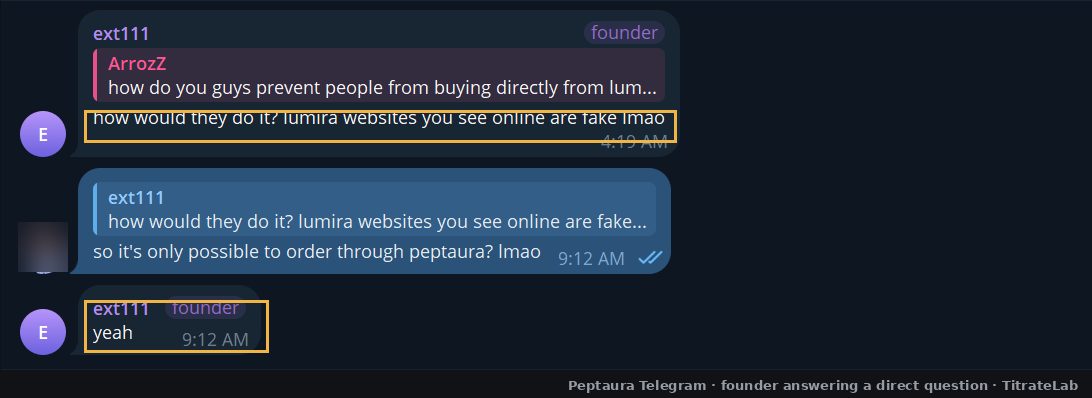
That is the loop closing. Peptaura brands the product, arranges its testing, publishes the certificate, stamps it verified — and is the only place the product can be bought. There is no second seller to price against, no independent storefront to compare, and no way to own a Lumira vial without going through the party that also grades it. “An open aggregator of peptides suppliers” describes a market. This is a private channel with one door.
One thing the critics get wrong: we found no evidence Peptaura secretly owns the upstream Chinese factories, and we cannot rule it in or out. The infrastructure tests that would settle it are inconclusive — our methods cannot even link the founder’s two acknowledged projects to each other, so their silence proves nothing. One document does point at a shared hand behind two “independent” brands, and we come to it below. But secret ownership is not a claim this evidence supports, and we do not make it.
Their verify page passed a batch their own lab failed
Peptaura’s headline feature is a verification page: enter a batch, see a shield and a pass. Here is one it gets wrong.
Lumira lot WL-CU100-P00519, a GHK-Cu product, showed a passing shield on Peptaura’s own /verify page at capture. The BT Labs certificate underneath it recorded a potency of 76.3 mg against a stated specification of 90–110% of 100 mg. The vial held roughly three-quarters of what the label claimed, and the document said so.
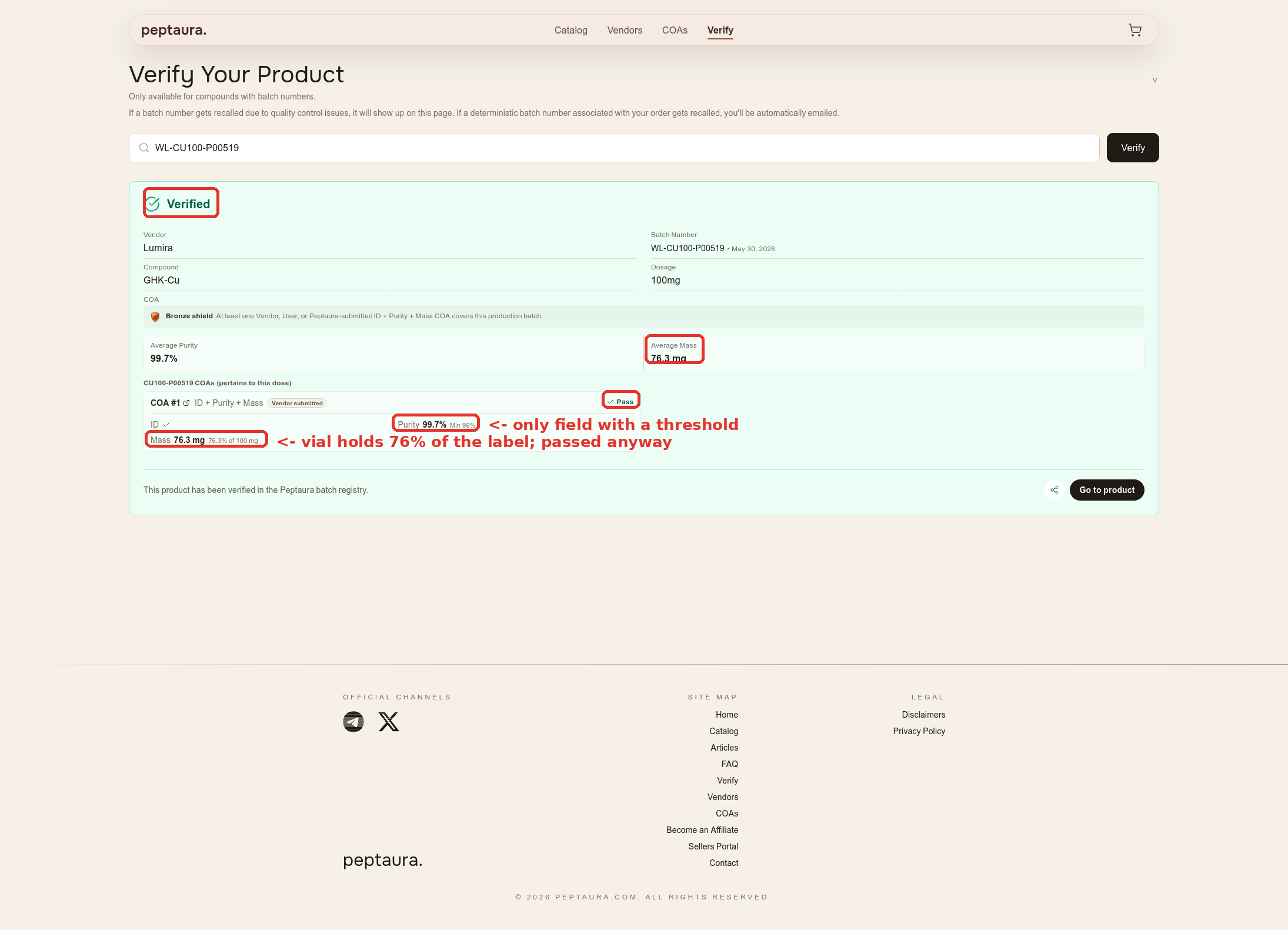
The certificate is worse the closer you read it. The vial’s contents weigh 132.2 mg — 76.3 mg of GHK-Cu plus 55.9 mg of filler, padded out to look full. The lab flagged that too: the 1:0.7 peptide-to-excipient ratio sits outside its own 1:2-to-1:10 range. Two of the three tests on the certificate fail its own specifications.
It passed on Peptaura’s page at the 2 August capture, because that page had one threshold — 99% purity — and printed the mass with no threshold at all. Asked why the batch had not been recalled, a Peptaura administrator said the result “was made known before anyone bought, it’s part of the whole deterministic batch idea.” The product was still in stock, at $70.80.
That is the clearest finding here — not our analysis against their marketing, but their verification product against the lab document underneath it.
The expanded record starts earlier, and the failures continued into August
The 2 August version of this article said the visible failures began in June and stopped at our latest test on 13 July. That was wrong as a description of the expanded record. After recovering additional published tests, the earliest identity failure we hold is dated 6 May 2026 and the latest is dated 18 August 2026. These are dates in the evidence, not a claim about when the factory problem began or ended.
The newest identity failure is a Lumira BPC-157 certificate dated 18 August: the laboratory did not identify BPC-157 in the sample. Identity failure does not mean an empty vial — it means the labelled compound was not identified. A test date can also lag manufacturing, so this result does not by itself prove that a vial was produced after Peptaura’s announced supplier changes.
Across the merged Lumira/Welon record we now hold 112 independent certificates. Twenty — 17.9% — are identity failures, and 39 of 112 — 34.8% — fail on identity, purity, or labelled dose under the thresholds stated below. Among 837 vendor groups with at least twenty certificates, Lumira/Welon ranks fifth worst on identity failures. The rest of that eligible corpus records 315 identity failures in 74,109 certificates, 0.43%; Lumira/Welon’s rate is about 42 times that baseline.
Those are observed rates in a published, non-random sample. They establish a repeated failure pattern; they do not estimate the probability that any untested Peptaura vial will fail.
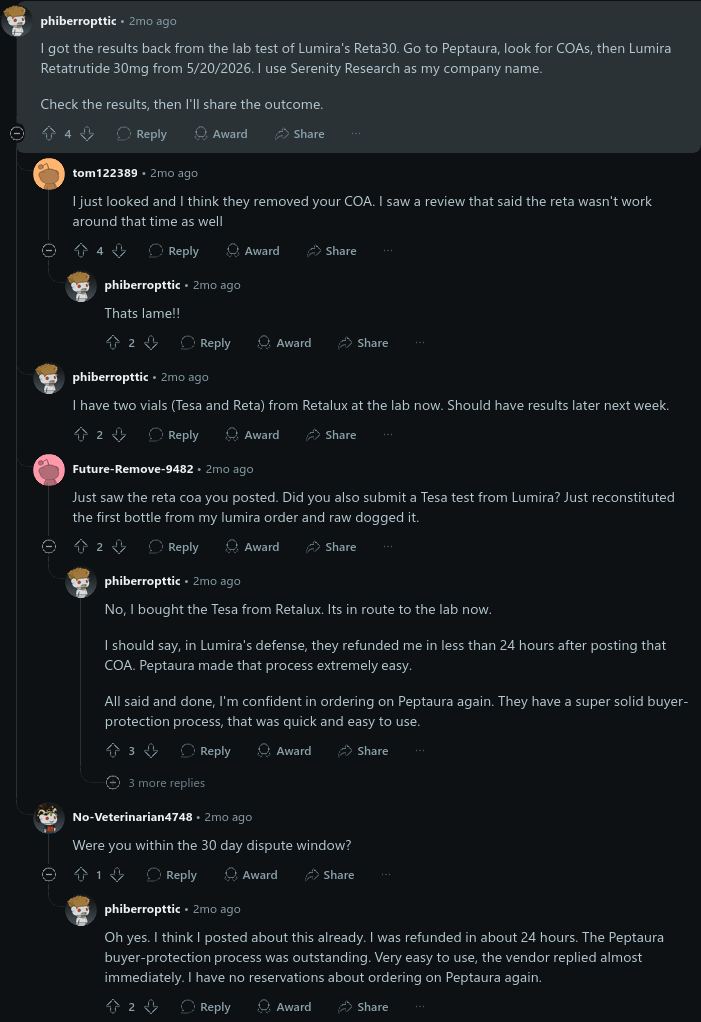
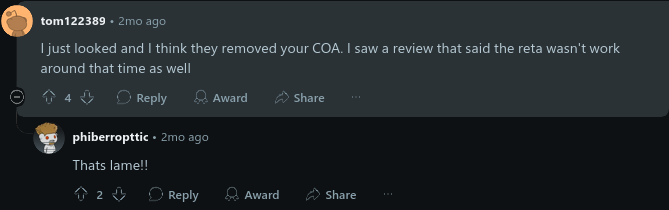
Finnrick’s current Lumira page lists 58 public tests, 38 passing and 20 failing under Finnrick’s own broader pass/fail rule, with a latest test date of 18 August. That is useful corroboration of the continued testing, but it is not the same metric as our 20 identity failures across the merged Lumira/Welon cohort; we no longer present the two counts as interchangeable.
The averages still show the shape of the problem. Counting identity failures as zero, mean purity is 81.5% and the average measured fill is 77.1% of label. Among records with a positive purity result, mean purity is 99.3%. The high-purity centre does not erase the identity-failure tail.
Peptaura announced a fix; the later record is mixed
Peptaura staff said in early August that Lumira had changed manufacturer, reinstated deterministic batch numbers and begun pre-testing its top products before reopening orders (2 August, 4 August, 7 August). Those are first-party descriptions of a remediation plan, not independent proof that it worked.
The Telegram record does show one concrete verification failure and one concrete correction. On 10 August a buyer posted the already-known failed Lumira TB-500 batch WL-TB5-000274; Peptaura’s lookup page still showed a green Verified state (certificate, lookup screenshot). A founder explained that “Verified” meant the batch was issued by Lumira, not that it had passed. After the buyer supplied the report, an administrator recalled it and the lookup page changed (discussion, recalled state). That is a confusing badge definition, but also evidence that the recall mechanism responded when given the certificate.
On 22 August Peptaura’s own group test found Lumira hGH batch PPA-WL-H36-P00714 at 89.133% purity. Its current batch page marks the batch Recalled and tells purchasers to check email for next steps; the Chromate certificate is now in our corpus. We exclude this vendor-arranged group test from the 112-certificate independent rate above, but include it here because it is fair counterevidence: Peptaura published an adverse result and acted on it.
Every failing certificate, in full
This is the independent evidence the warning rests on, so here it is in full. Below is every failing certificate in the 112-report off-the-shelf cohort under three criteria: the lab could not identify the labelled compound, the vial came back more than 15% under its labelled dose, or the material assayed below 96% pure. The strip deliberately excludes Peptaura’s own hGH group test discussed above rather than mixing vendor-arranged testing into the independent denominator — the evidence regime matters.
Read the “not detected” tiles carefully. They do not mean an empty vial: the lab looked for the compound printed on the label and did not find it, and on several the same lab still returned endotoxin and heavy-metal panels. There was material in the vial; it was not what the label said. The strip runs most recent first, is drawn live from our lab-report database, and is the minority of the record — most Lumira certificates pass, and the count line says how many.
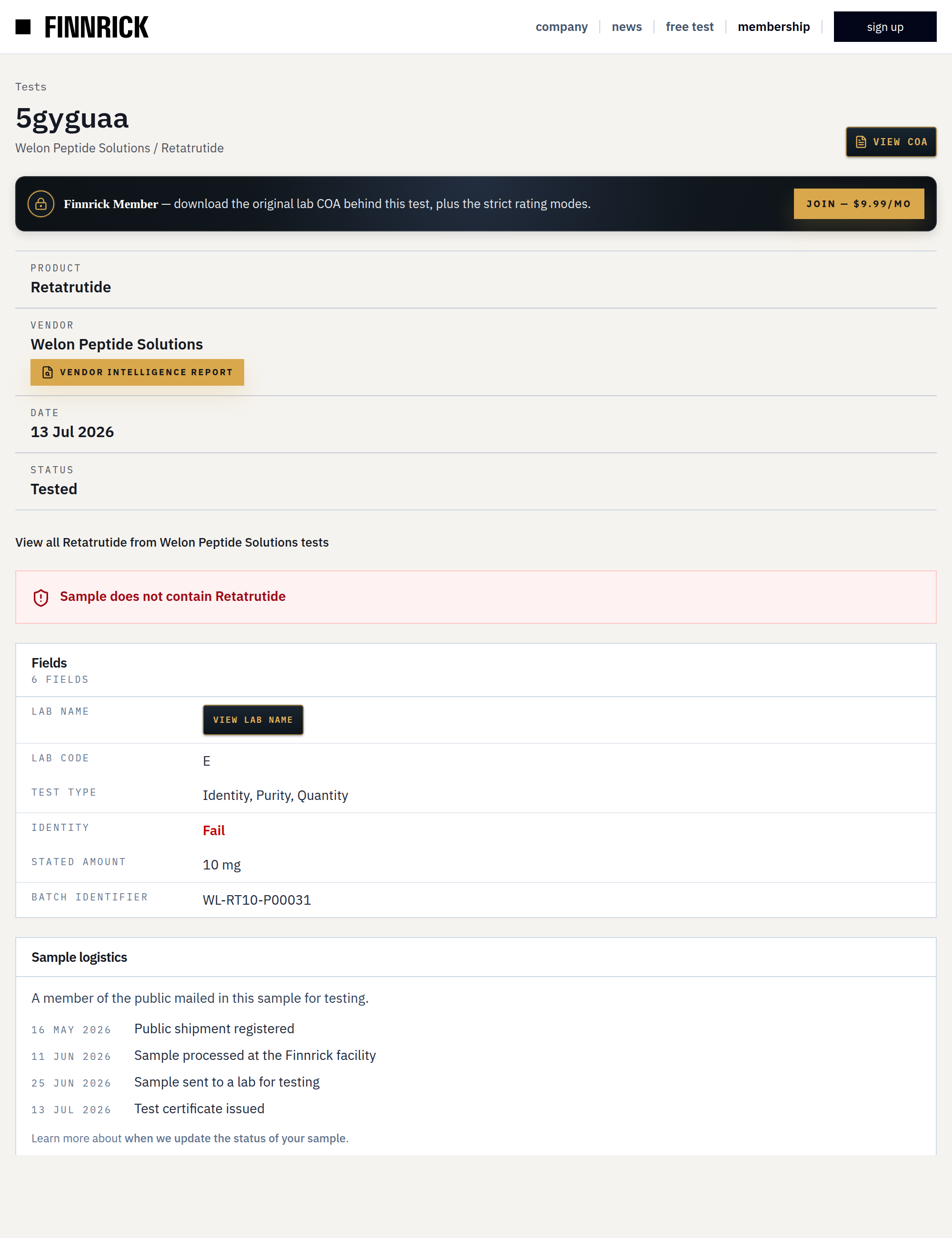 Welon Peptide SolutionsNOT DETECTEDRetatrutideidentity failure — labelled compound not detected2026-07-13
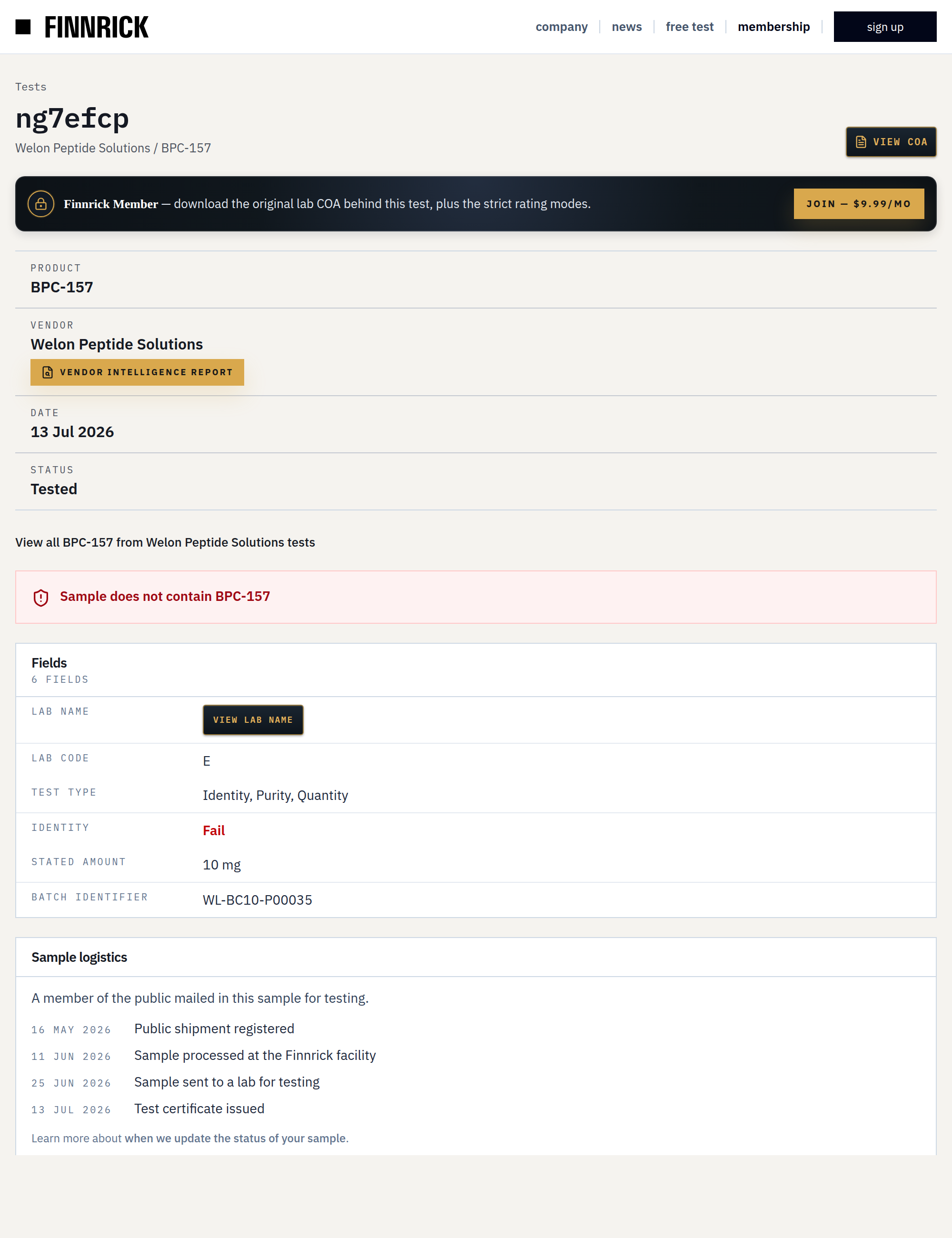 Welon Peptide SolutionsNOT DETECTEDBPC-157identity failure — labelled compound not detected2026-07-13
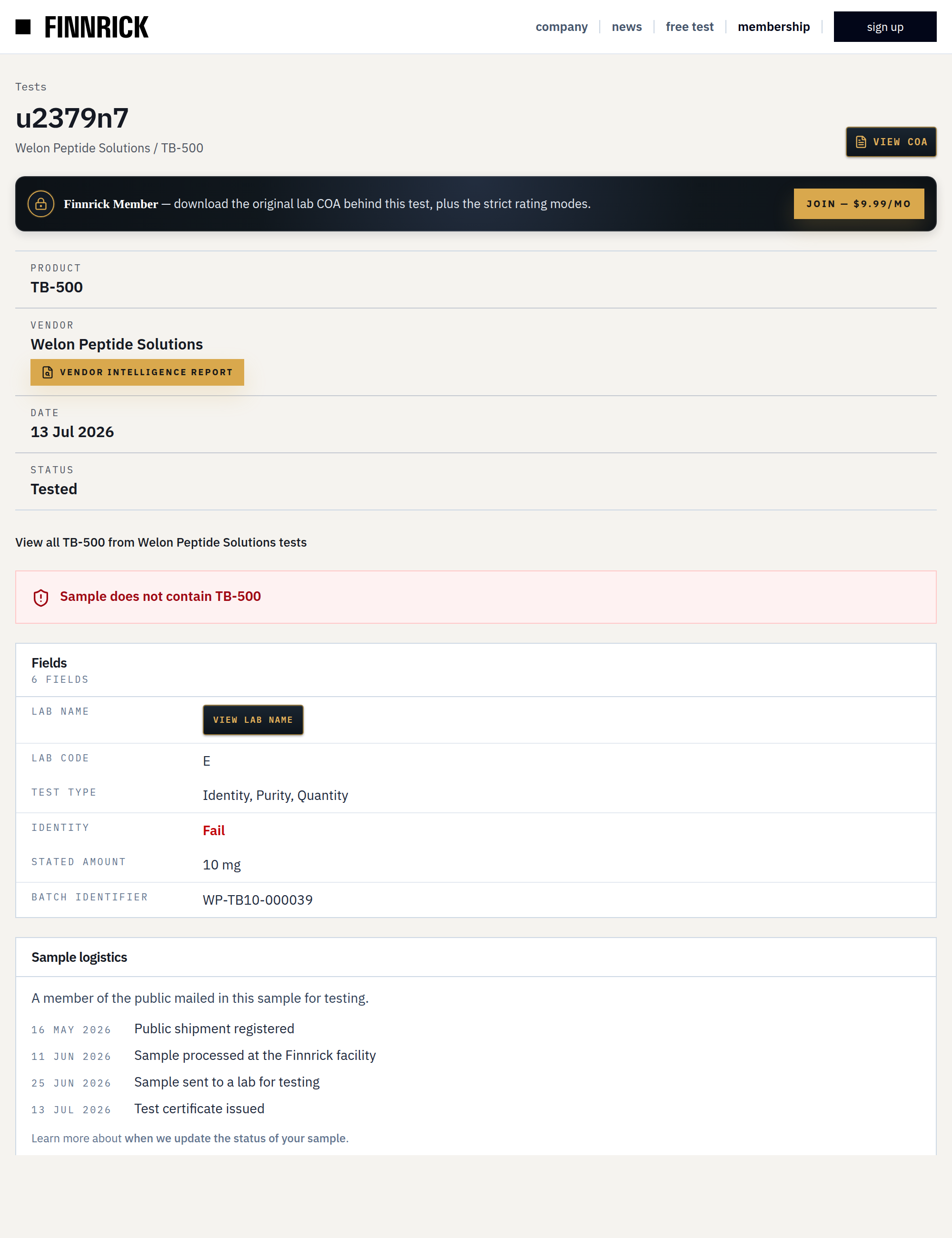 Welon Peptide SolutionsNOT DETECTEDTB-500identity failure — labelled compound not detected2026-07-13
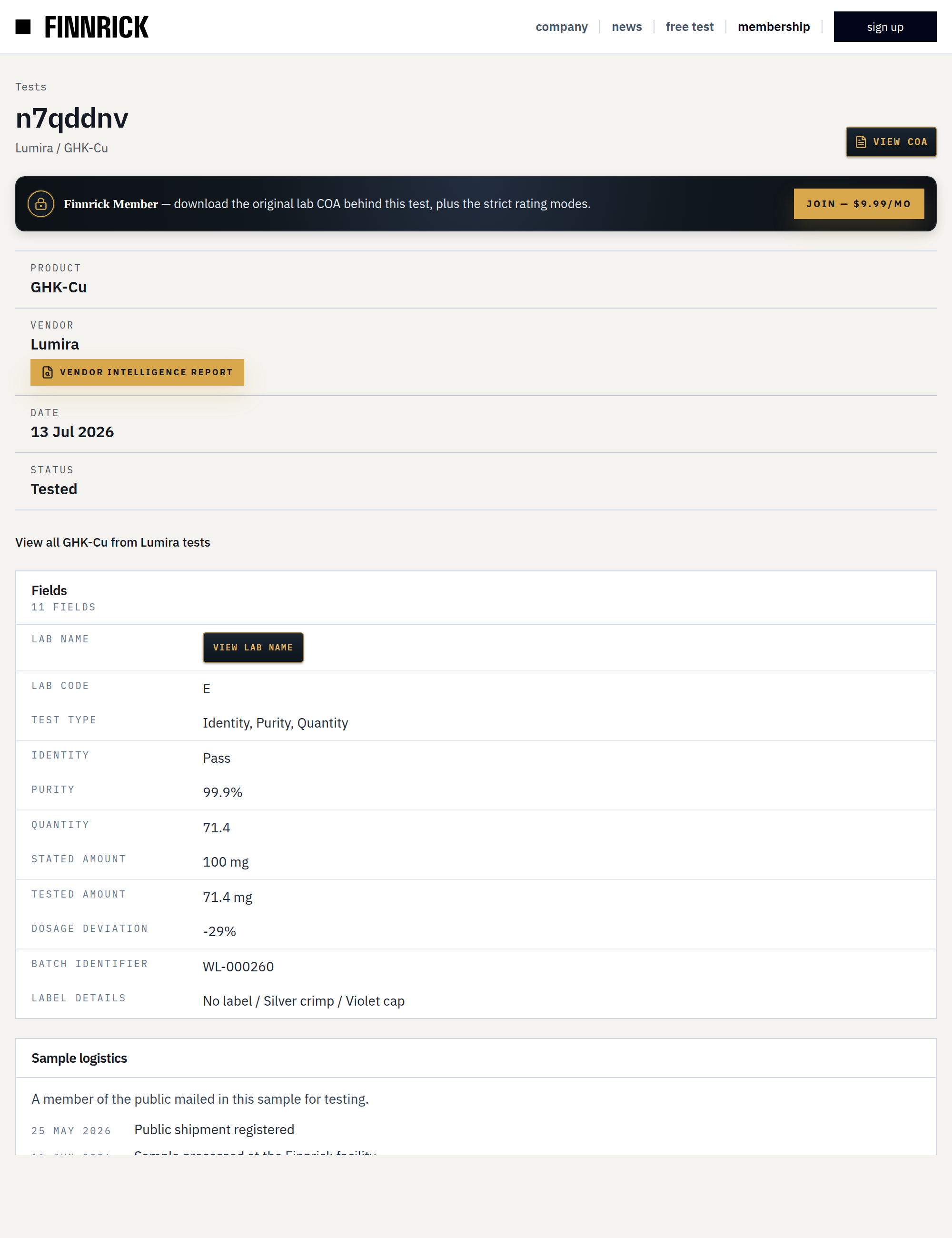 Lumira−29%vs labelGHK-Cu99.9% pure, but short of the labelled dose2026-07-13LumiraNOT DETECTEDBPC-157identity failure — labelled compound not detected2026-07-01
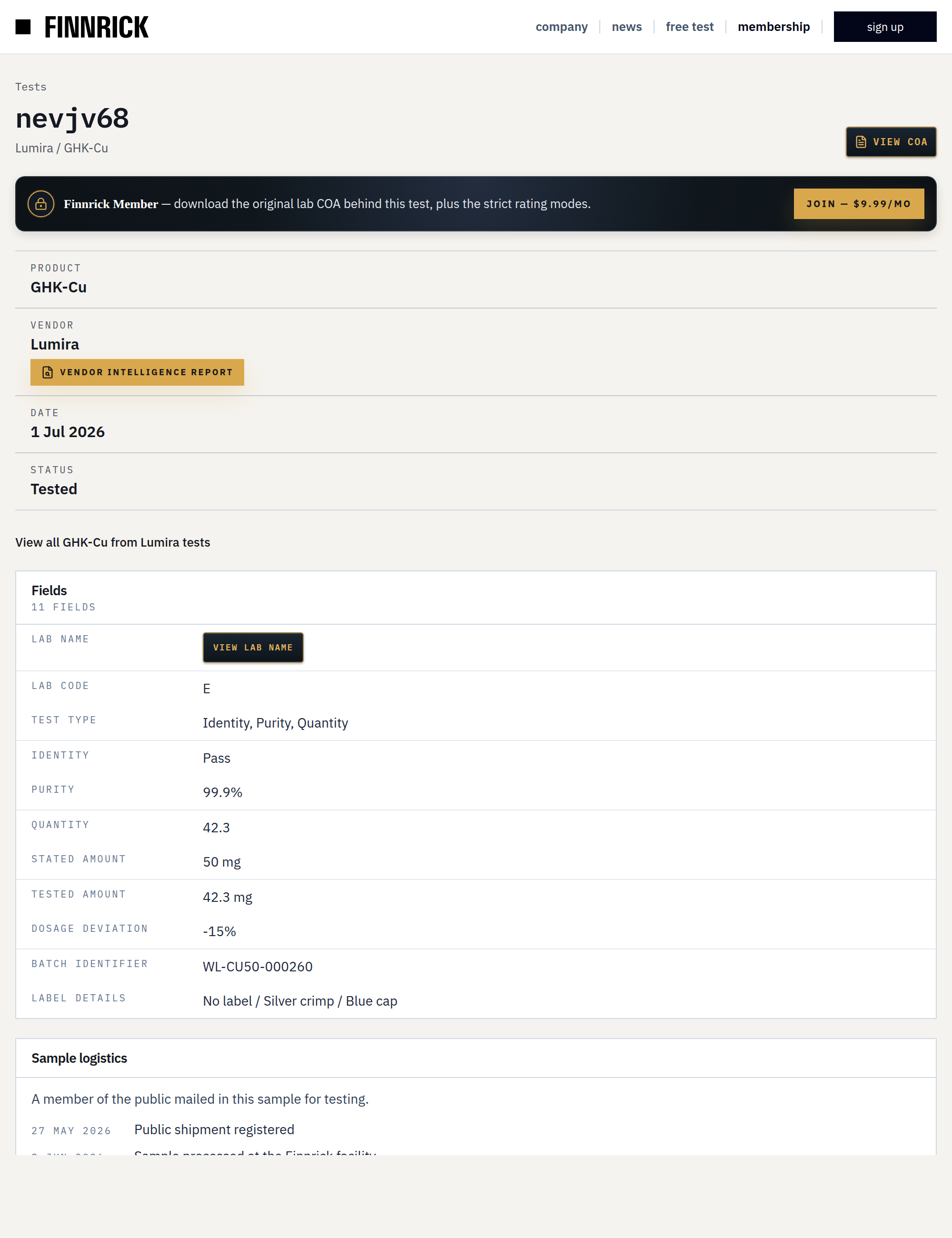 Lumira−15%vs labelGHK-Cu99.9% pure, but short of the labelled dose2026-07-01
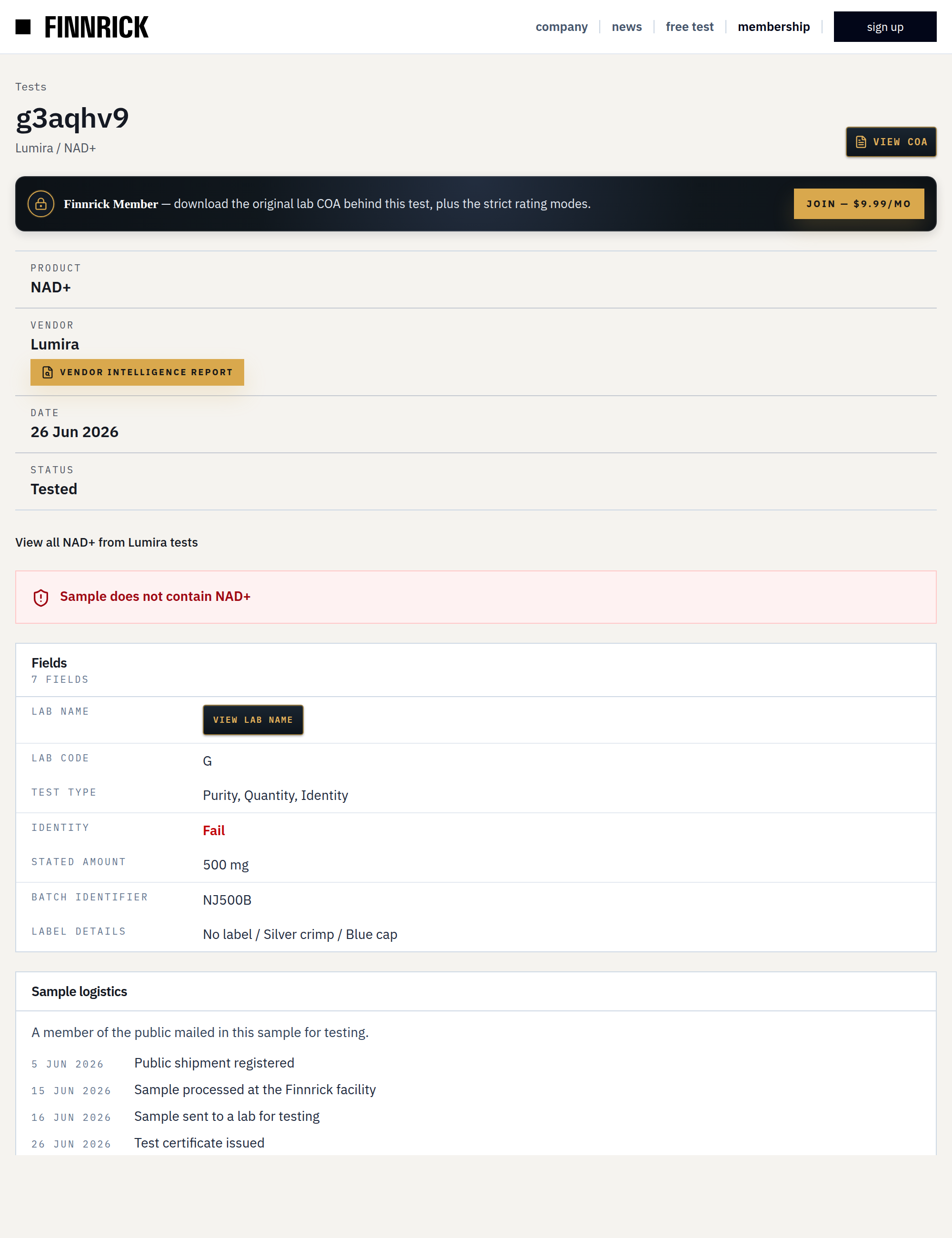 LumiraNOT DETECTEDNAD+identity failure — labelled compound not detected2026-06-26
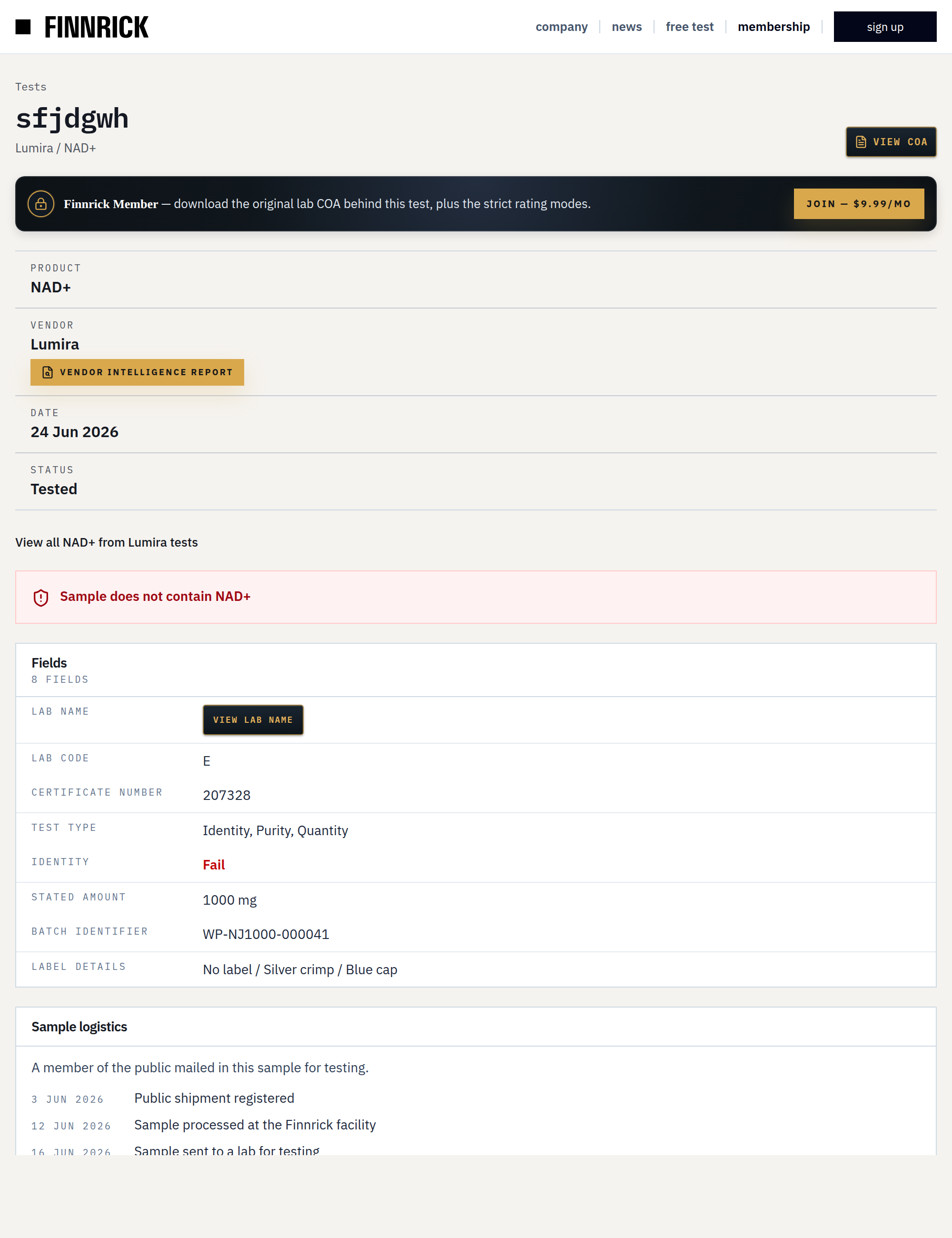 LumiraNOT DETECTEDNAD+identity failure — labelled compound not detected2026-06-24LumiraNOT DETECTEDTesamorelinidentity failure — labelled compound not detected2026-06-24LumiraNOT DETECTEDRetatrutideidentity failure — labelled compound not detected2026-06-24LumiraNOT DETECTEDRetatrutideidentity failure — labelled compound not detected2026-06-22Lumira−15%vs labelRetatrutide99.9% pure, but short of the labelled dose2026-06-16Lumira−54%vs labelRetatrutide65.7% pure, but short of the labelled dose2026-06-16
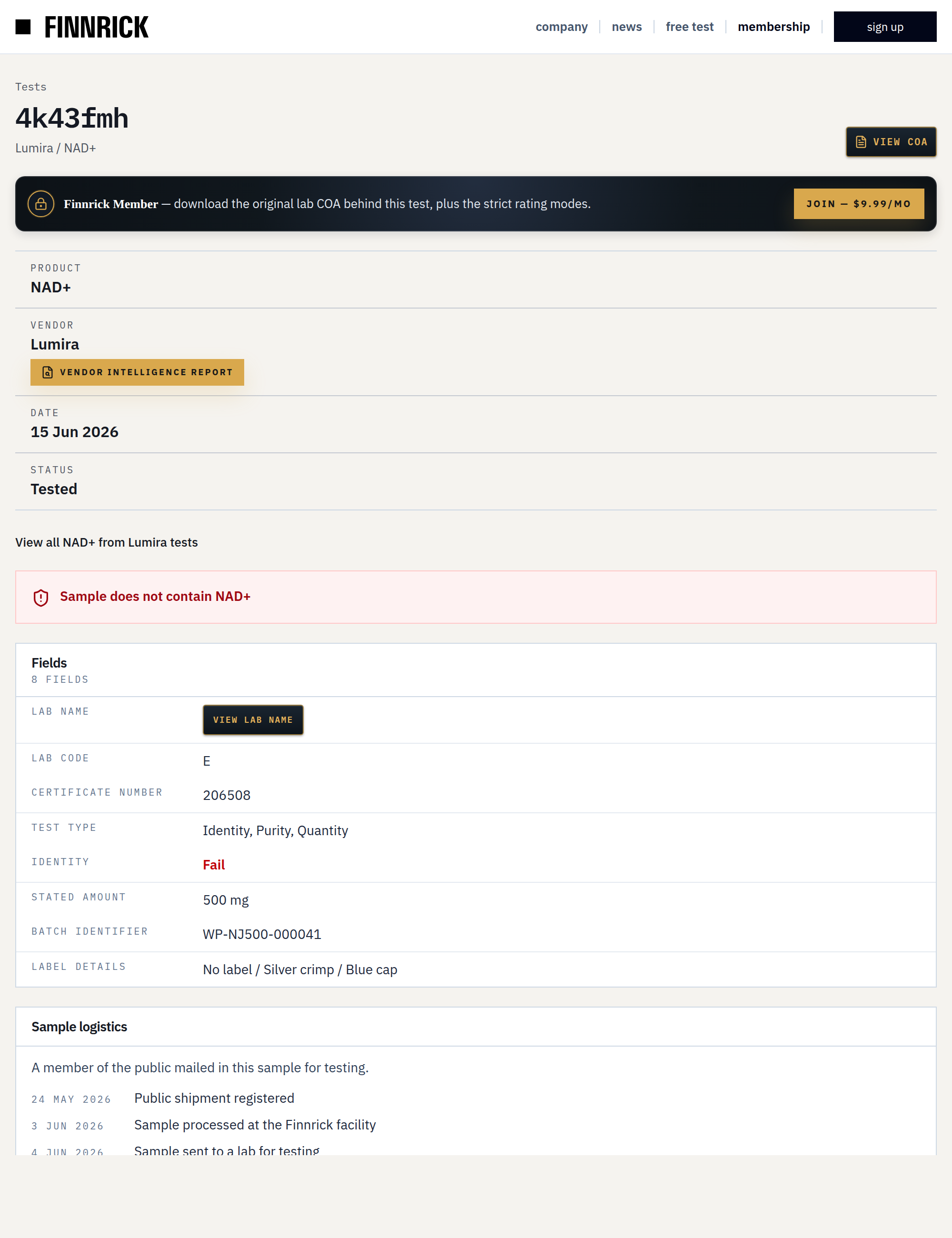 LumiraNOT DETECTEDNAD+identity failure — labelled compound not detected2026-06-15LumiraNOT DETECTEDTesamorelinidentity failure — labelled compound not detected2026-06-15Lumira−18%vs labelTirzepatide99.8% pure, but short of the labelled dose2026-06-15LumiraNOT DETECTEDTesamorelinidentity failure — labelled compound not detected2026-06-12LumiraNOT DETECTEDRetatrutideidentity failure — labelled compound not detected2026-06-12Welon Peptide SolutionsNOT DETECTEDHGHidentity failure — labelled compound not detected2026-06-12Lumira−21%vs labelTirzepatide99.9% pure, but short of the labelled dose2026-06-12Welon Peptide Solutions−40%vs labelTB-50099.7% pure, but short of the labelled dose2026-06-08Lumira−21%vs labelTirzepatide99.9% pure, but short of the labelled dose2026-06-05Welon Peptide Solutions−17%vs labelHGH94.5% pure, but short of the labelled dose2026-06-04
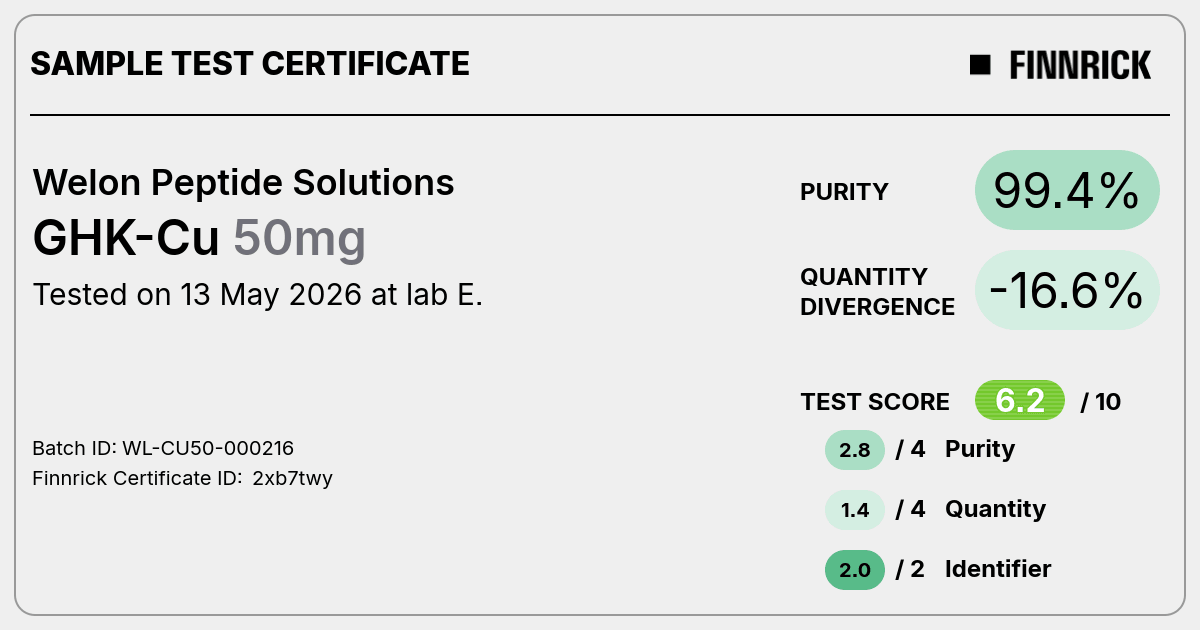 Welon Peptide Solutions−17%vs labelGHK-Cu99.4% pure, but short of the labelled dose2026-05-13
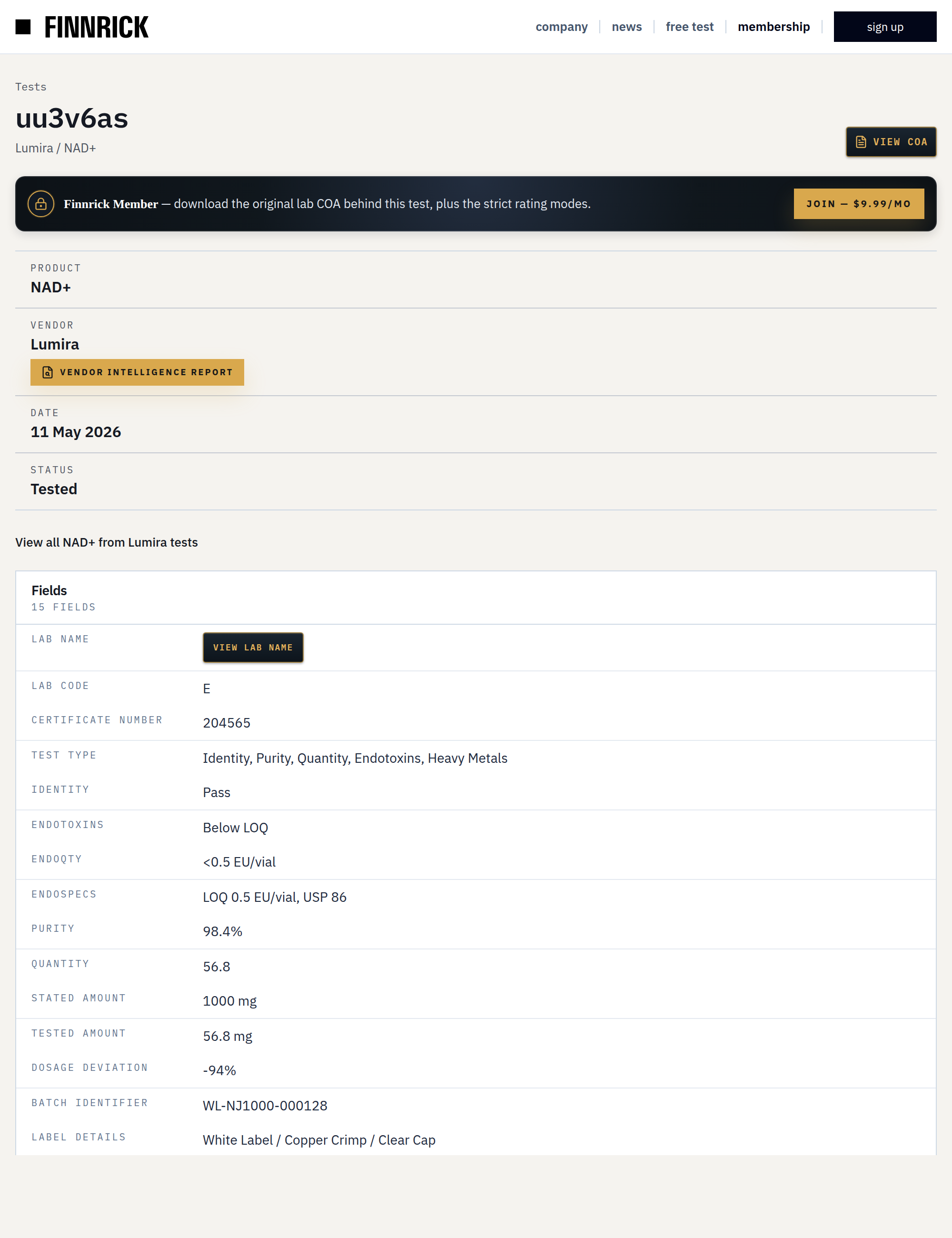 Lumira−43%vs labelNAD+98.4% pure, but short of the labelled dose2026-05-11
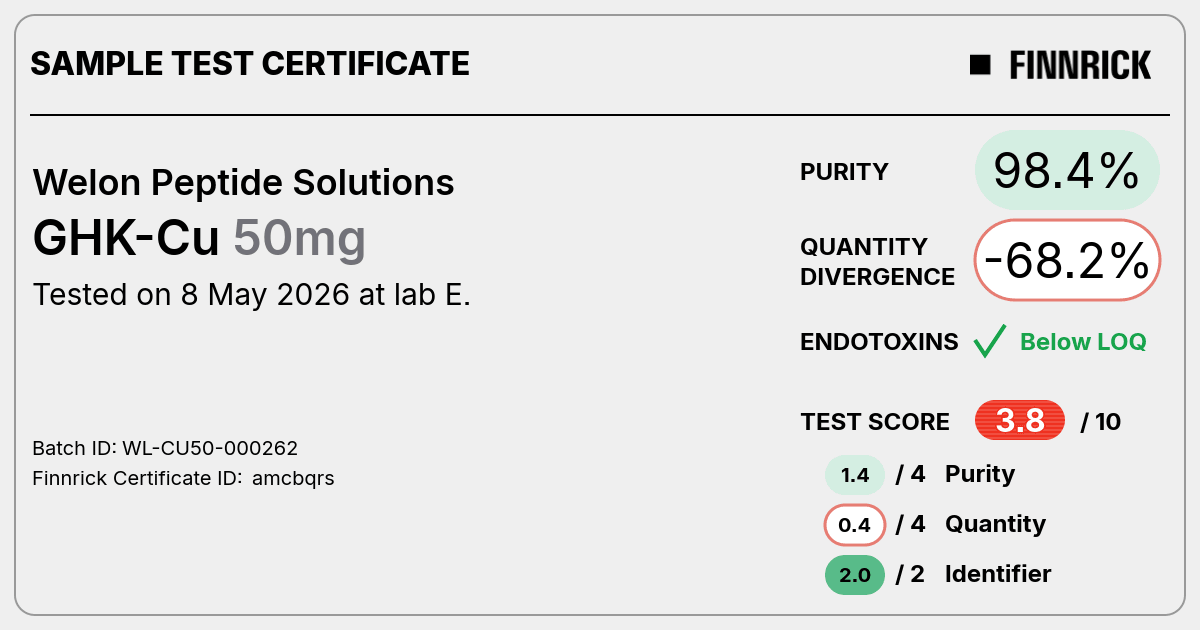 Welon Peptide Solutions−68%vs labelGHK-Cu98.4% pure, but short of the labelled dose2026-05-08LumiraNOT DETECTEDBPC-157identity failure — labelled compound not detected2026-05-06Welon Peptide Solutions−38%vs labelTB-50099.2% pure, but short of the labelled dose2026-05-06Lumira−16%vs labelTesamorelin99.9% pure, but short of the labelled dose2026-04-28
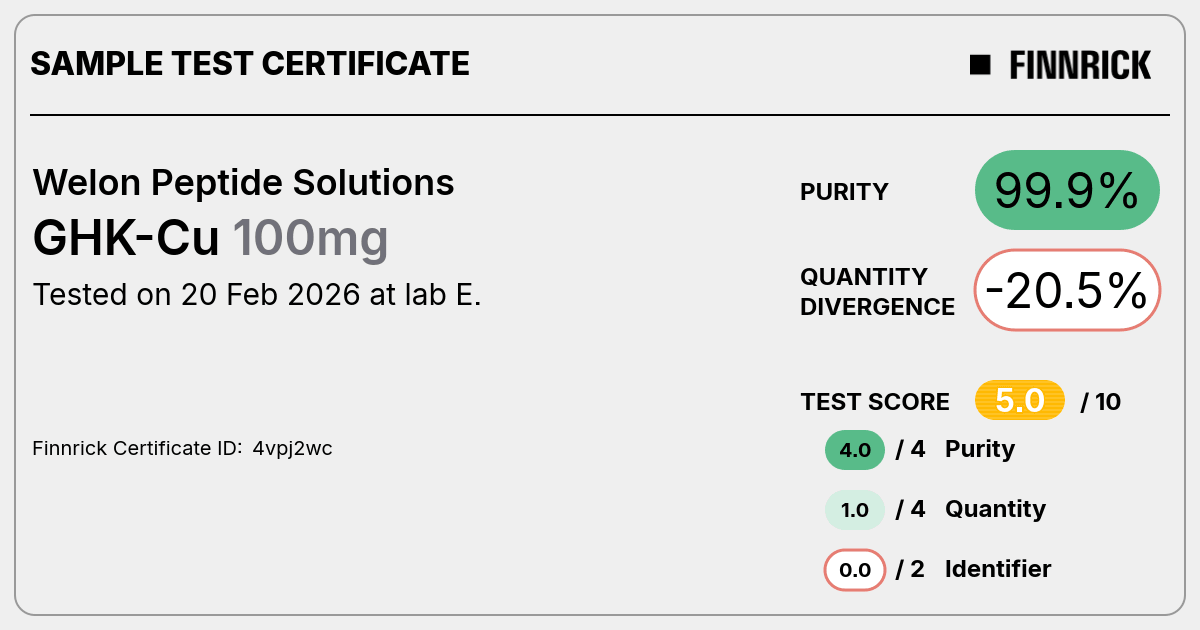 Welon Peptide Solutions−20%vs labelGHK-Cu99.9% pure, but short of the labelled dose2026-02-20
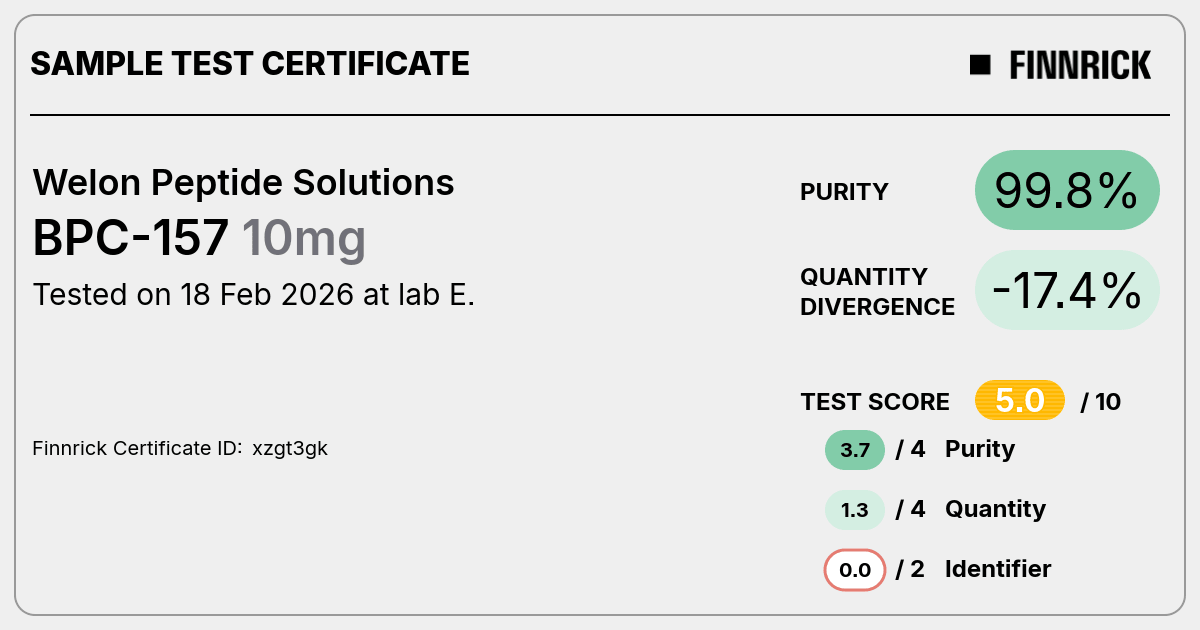 Welon Peptide Solutions−17%vs labelBPC-15799.8% pure, but short of the labelled dose2026-02-18
Every certificate in Peptaura’s Lumira and Welon record that fails identity, comes back more than 15% under its label, or assays below 96% pure. All are off-the-shelf tests commissioned by third parties, not by the vendor. Most recent first. Each tile links to that certificate’s own page. The remaining 78 published certificates in this record passed.
What buyers reported, and how staff answered
The certificates are one half. The other half is what customers reported in Peptaura’s own Telegram, in real time, while staff watched.
A buyer sent a Lumira KPV vial to Finnrick; it came back at 82.8% of its labelled dose — 8.28 mg in a vial sold as 10 mg. The founder’s first move was not to fix it but to discredit the lab that caught it: “open ticket, that’s below what they guarantee,” then, in the same breath, “finnricks labs are pretty mid tho, bit sloppy.”
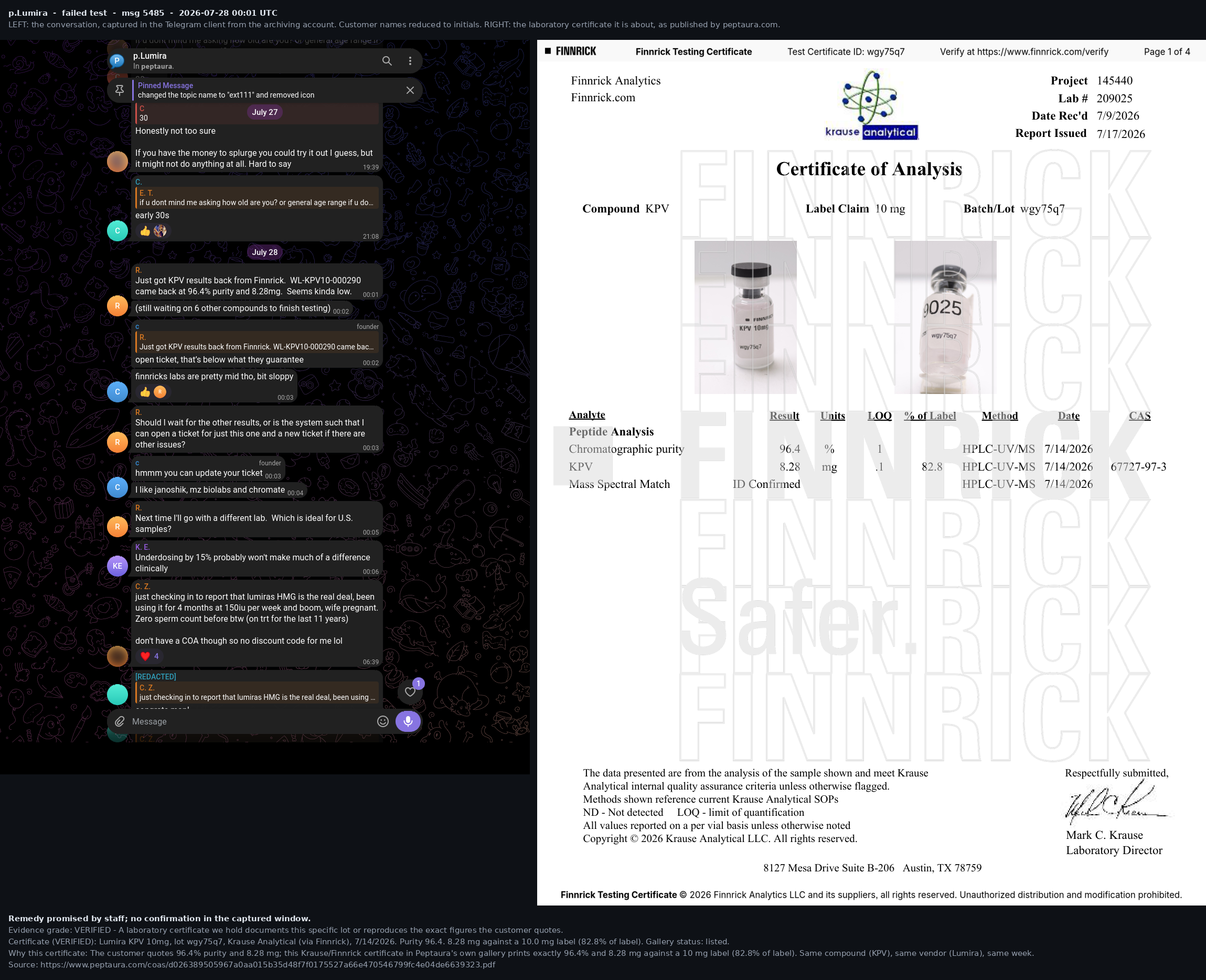
It was not an isolated vial. A cluster of buyers could not get the same Lumira glutathione batch to dissolve at all, even with acidic diluent — a batch-level formulation failure, not a user error:

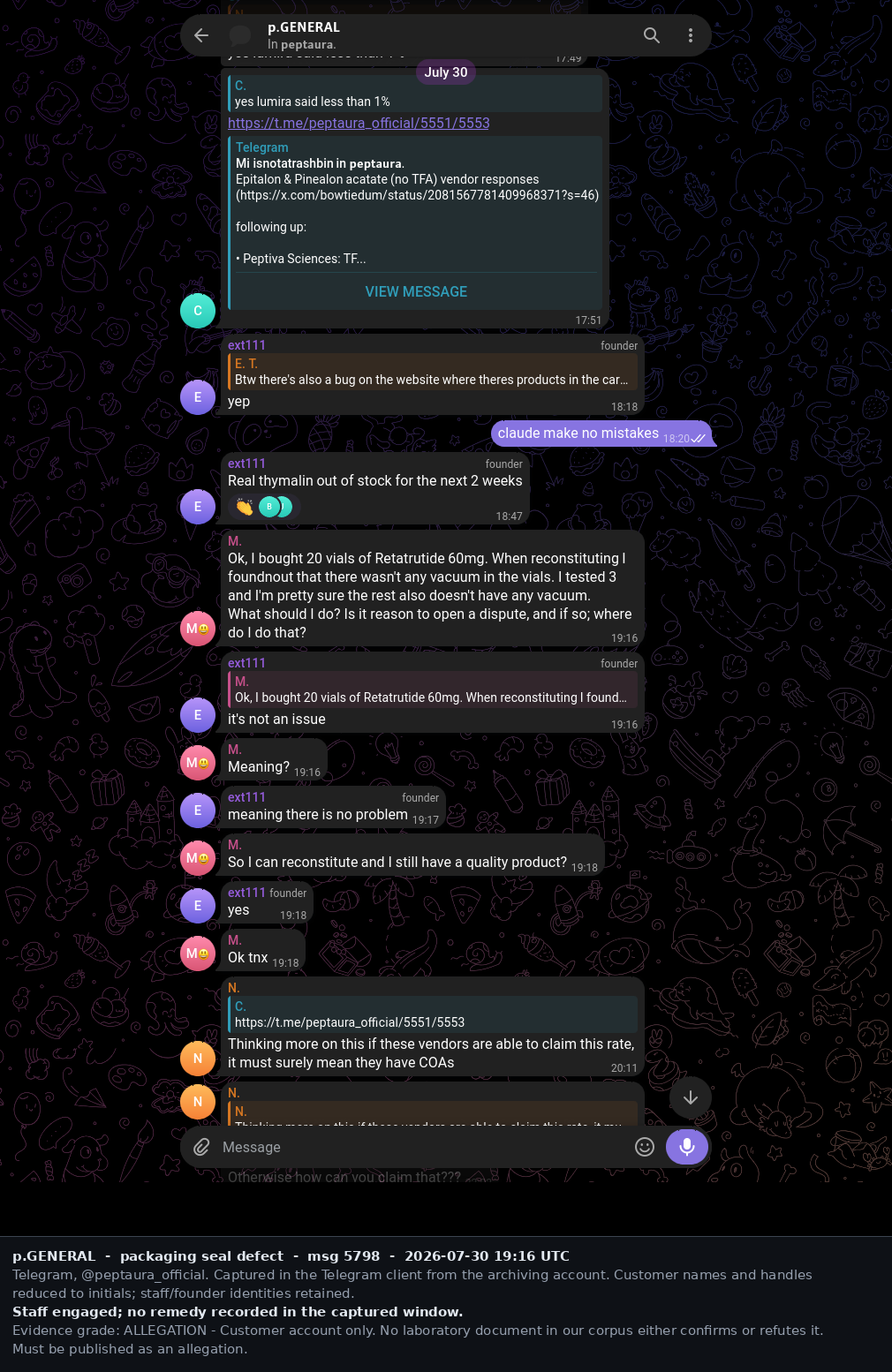
Another buyer’s SS-31 kit arrived with no vacuum in the vial — a seal-integrity failure that puts the contents’ sterility and stability in doubt:
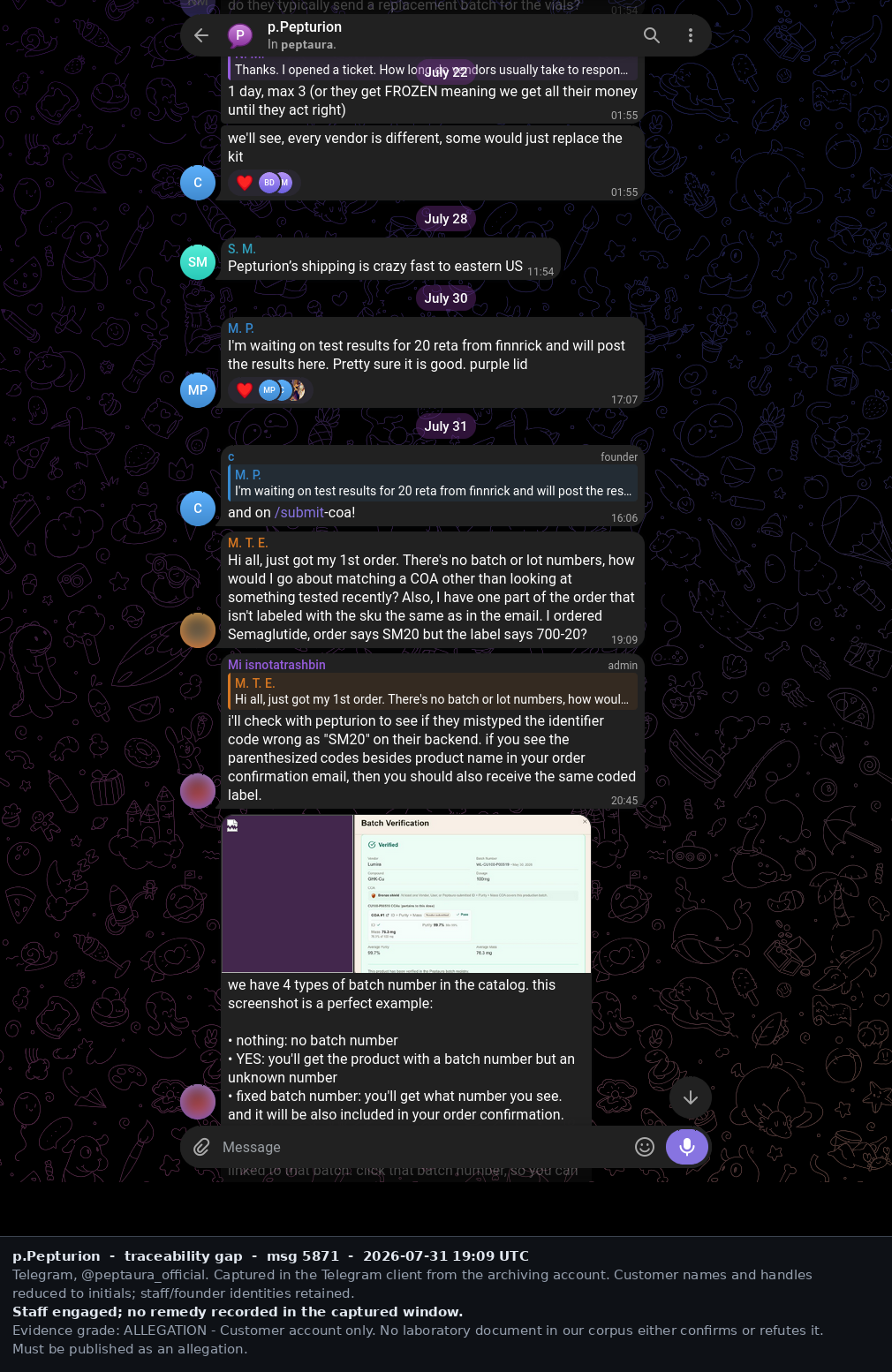
And a Pepturion buyer received product with no batch number at all, while a certificate for that product sat in the catalogue under a batch number that did not match anything they held — the traceability gap that makes the whole “check the batch” promise hollow:
A new lab appeared, and its certificates cannot be checked
After the June failures, a set of Lumira certificates appeared bearing a new lab name: Pacific Coast Biologics Inc. They passed, at 99% and above, all issued in a nineteen-day window right after the failures.
Pacific Coast Biologics is a real company — a small recombinant-protein manufacturer in Oxnard, California, incorporated in late 2025, with a single listed officer. We want to be exact, because the easy accusation is that the lab is invented, and it is not: the disputed certificates carry internal document fingerprints identical to those the company publishes for its own products, tying them to its real paperwork rather than to a forger.
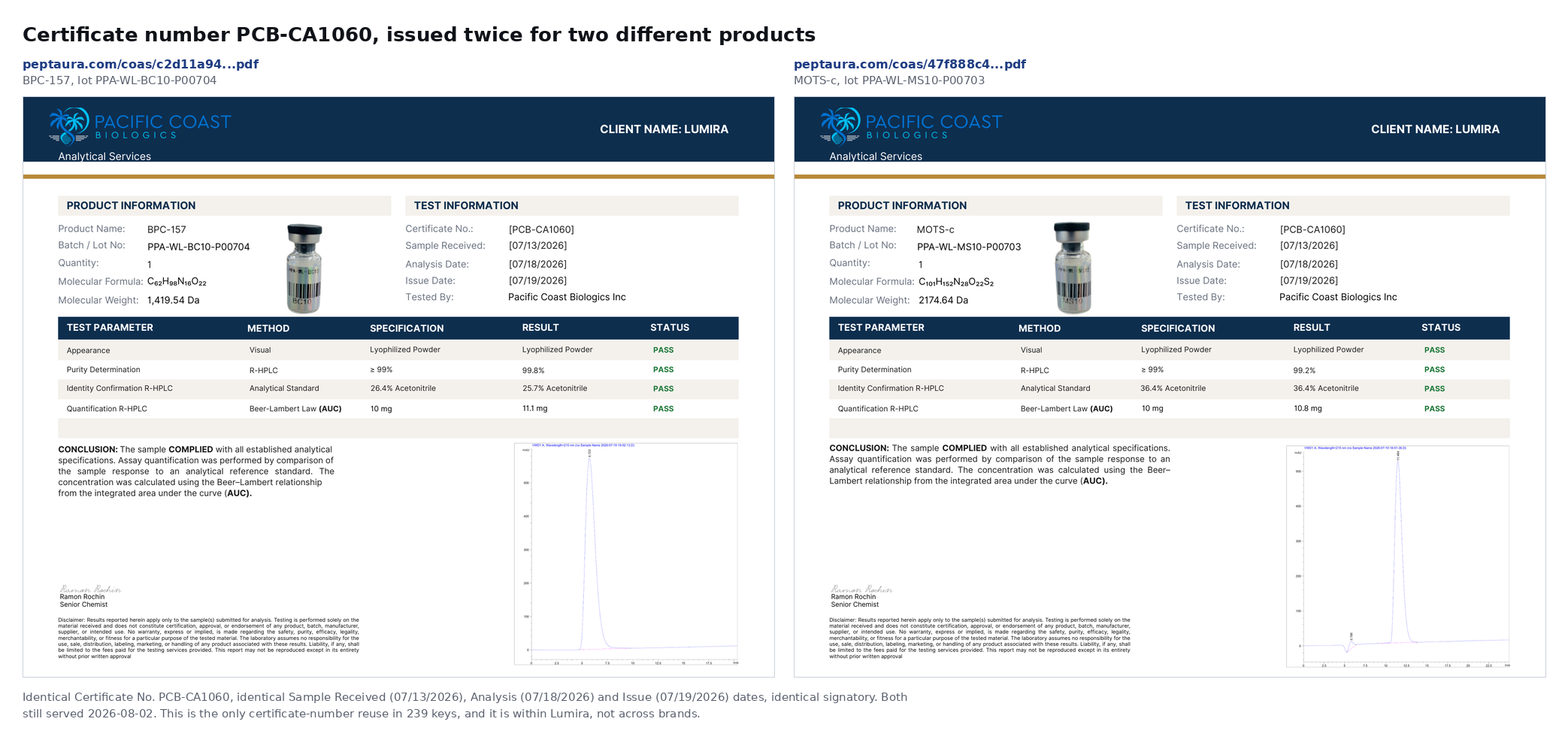
What we can say is narrower and still troubling. In three and a half years of archived site history the company has never advertised third-party analytical testing; it sells proteins. The certificates are signed by its chief executive under the title “Senior Chemist,” a role no public record connects him to. One certificate number was issued twice, for two different products, on the same day. Another was recorded as analysed two days before its sample arrived.
And unlike the Janoshik, Chromate and Finnrick certificates in Peptaura’s own gallery — issued the same weeks, some for the same manufacturer, each carrying a lookup URL and access key — these carry no verification code, no lookup key, no laboratory address. A buyer has no way to check they came from the lab whose name is on them.
We are not calling these certificates fabricated, and nothing here should be read as saying they are. What we are saying is narrower: as published, these documents cannot be checked by the person relying on them. Pacific Coast Biologics is welcome to resolve that — a lookup key, an address, or an account of the two anomalies would settle it, and we will print whatever they send.
Twenty tests, two “independent” brands, one client
The one piece of documentary evidence that Peptaura’s independent-supplier framing is thinner than it looks sits in another lab’s records.
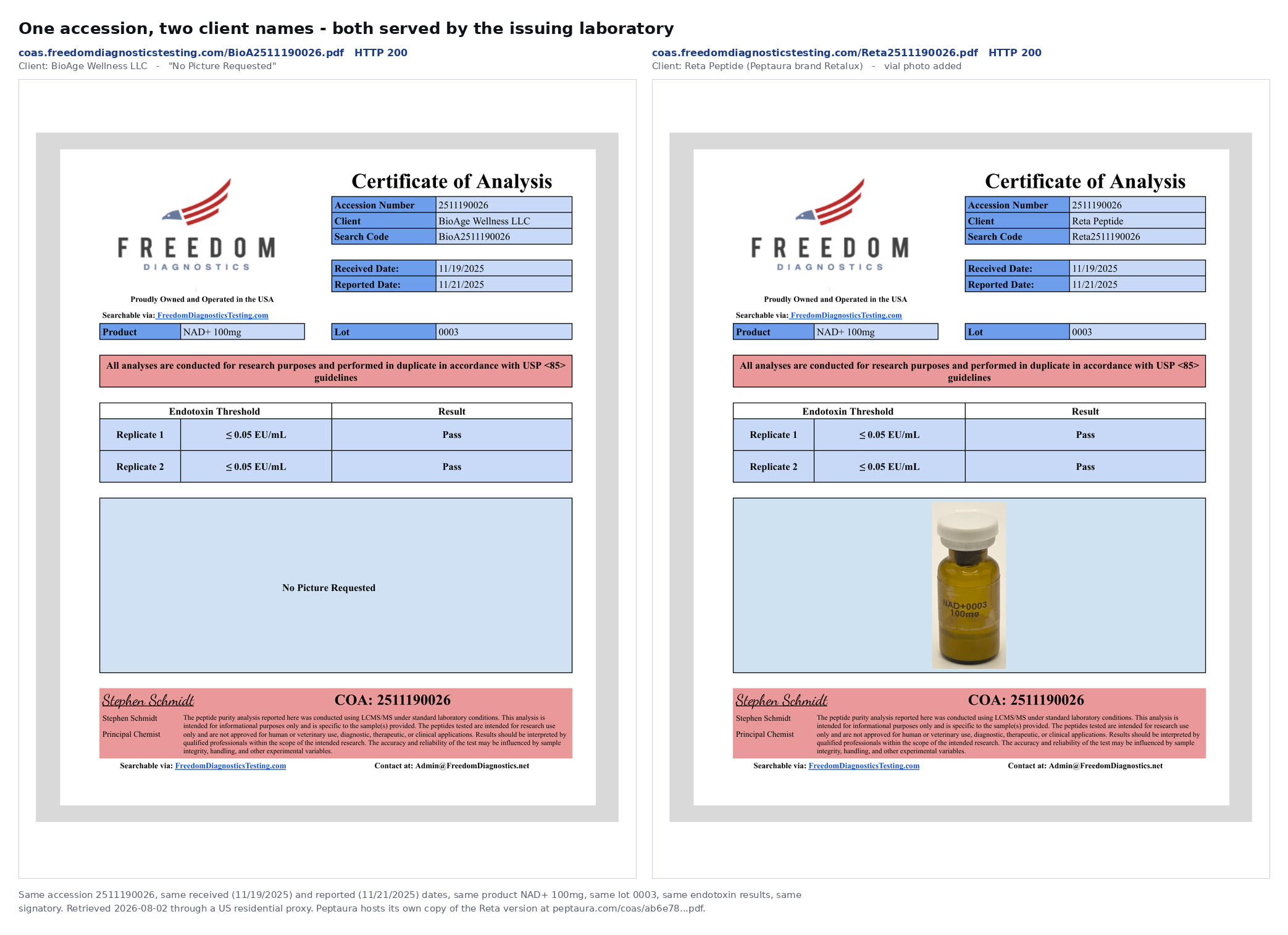
At Freedom Diagnostics, twenty consecutive test accessions are filed under one client: BioAge Wellness LLC. Peptaura republishes those same twenty — same dates, lots, purities, signatory — split across two of its supposedly separate brands, Retalux and Pepturion, with the lab’s lookup code rewritten. That rewritten code does not resolve in Freedom’s own certificate search; the original accession code does, and returns the version filed under the single client. The tests match the copies we archived in July. Twenty tests, presented as two independent vendors, trace back to a single commissioning client.
There is an innocent reading, and it should be stated: the lab may sell relabelled copies as a service, in which case the re-badging is a product Freedom offers rather than something done to its records. But a verification code that does not verify, printed on a certificate sold to a customer, is the platform’s problem regardless of which reading is right.
Publication snapshot: what the same kit cost on 1 August
Peptaura’s founders framed everything as a price war. Their captured homepage headline put a number on it — “10x Cheaper vs. Competitors” — and against the ten-times Western reseller prices their founder liked to quote, sure. But that was not the comparison a US buyer faced in the publication snapshot.

The comparison below is frozen to the product feeds and certificate corpus captured for the original article on 1–2 August. It supports what a buyer faced then; it is not a claim about today’s price, delivery window or corpus totals.
Take the most ordinary purchase there is: a kit of retatrutide, 10 mg × 10. TitrateLab’s vendors listed it from US stock for $165 all-in, arriving inside a week. Here was the same kit on Peptaura, from their own product feed and quoted delivery windows:
| Retatrutide, 10 mg × 10 (100 mg) | TitrateLab | Peptaura — Lumira |
|---|---|---|
| Product + shipping | $135 + $30 | $146 + $72 |
| All-in | $165 | $218 |
| Advertised per mg | $1.65 | $2.18 |
| Quoted delivery | 4–7 days | 12–15 days |
| Lab record below is measured against the wider market, not our own shelf | ||
| Independent certificates (2 Aug snapshot) | 46,928 | 86 |
| Average purity | 98.7% | 84.2% |
| Average fill vs label | 108% | 79.5% |
| Identity failures | 0.54% | 15.1% — one in six |
| Real cost per mg delivered | $1.53 | $2.75 |
Price and delivery were the same kit on both sides — Peptaura’s captured product feed against TitrateLab’s captured catalogue. The lab rows are not a claim about TitrateLab’s own product: the left column was the market baseline, the average across all 46,928 published independent certificates from vendors holding twenty or more tests. Lumira’s column was its full merged Lumira/Welon record at that review. An identity failure was counted as zero. “Real cost per mg delivered” divided the all-in price by the share of the labelled dose actually found in the vial.
Download Peptaura’s full price feed (CSV, captured 2026-08-01)
The aggregator lost to the domestic comparison on every measured axis in that snapshot. The advertised gap was 32%; after dividing by what the laboratory found in the vial, Lumira cost $2.75 per milligram delivered against $1.53. The market cohort’s vials averaged slightly over label at 108%. Lumira’s averaged 79.5%.
In the captured feed, getting it inside ten days raised Peptaura’s cheapest option to $240, a 45% premium. Its own catalogue was not the cheapest place to buy this kit in that comparison. “10x cheaper” was a homepage headline, not the observed price.
The August claim that the rest of the shelf had never been tested is no longer true
At publication, Railion Tech, CorePeptide, Zenove, HelixBridge, Peptiva Sciences and Pai Chemicals had no independent certificate under those names in the 63,000-certificate corpus we searched. That historical statement no longer applies to HelixBridge.
We found two exact-batch HelixBridge passes in the later Telegram record: Eloralintide, Janoshik task 209398 measured 12.86 mg against a 10 mg label at 99.705% purity on 5 August, and Vilon, Chromate report 38919 measured 20.26 mg against a 20 mg label at 99.482% purity on 31 August. Peptaura’s exact Eloralintide and Vilon batch pages identify HelixBridge and link the same artifacts. Two vendor-arranged, batch-linked passes do not establish a vendor-wide failure rate, but they directly correct the earlier absolute claim and belong in the record.
Where the shipping fee actually lands
The captured flat per-order fees were the mechanism. They vanished into the per-milligram rate on a big box, but on a single 5 mg Lumira vial the $72 fee turned a $3.51 sticker into $17.91 a milligram.
Nor was this an artefact of the one kit size we priced. In the 2 August snapshot, across 31 retatrutide lots, weighing measured fill by measured purity, the average Lumira vial delivered 84% of its labelled retatrutide — dragged down by four batches, one in eight, in which the labelled compound was not detected. Nearly a third delivered under 90% of the label. For those four the honest cost per milligram of labelled compound was not a number at all: full price, none detected.
So the man who mocked resellers for “$10-12/mg” and took credit for dropping reta to “$4-6” was, in that snapshot and weighted by the lab results we held, charging more per milligram delivered than his sticker suggested and more than the domestic comparison. “Racing to the bottom on price” is a good slogan. The captured prices and measured record did not support it.
What we could not prove
A responsible version of this piece is as clear about the accusations that failed as the ones that held.
- That Peptaura secretly owns the Chinese factories. Be precise about what is actually in doubt here, because it is narrower than it sounds. That Lumira is Peptaura is not in doubt at all. Peptaura’s own /vendors data maps the brand to the manufacturer Welon. One lot was certified under both names. Peptaura brands it, arranges its testing, publishes its certificates, stamps them verified, claims the power to force its refunds and reships — and its founder says it cannot be bought anywhere else on earth. To a buyer, Lumira and Peptaura are one counterparty, and treating them as two is the mistake the whole arrangement invites. What we cannot show is the separate question of whether Peptaura owns Welon, the factory — a real Chinese manufacturer that existed before the brand did, and whose output is sold under other names too. The infrastructure tests that would settle that are inconclusive. So: the brand is theirs, and we say so. The plant we cannot place, and we do not claim it.
- Fabricated laboratories. No. Pacific Coast Biologics, SideChain, Janoshik, and Finnrick are all real. The problem with the Pacific Coast Biologics certificates is verifiability, not existence.
-
Bought followers. We cannot measure follower growth, so we make no astroturfing claim. There is a referral programme — an ordinary one, not a bot network — and it was still running in late July, when a buyer posted their own code publicly. (r/Scam_Finder, archived.)
-
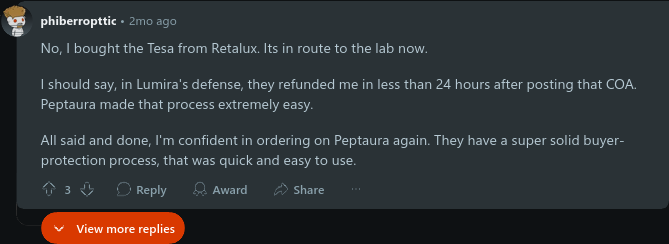
Systematically hiding bad results. Not established. At the 2 August review, six of seven identity failures visible in Peptaura’s certificate library were still published. There are two documented deletions (one pulled mid-argument, one the independently observed ILS test above), but the 22 August hGH failure is also public and marked recalled. The fair way to show a complaint is with its answer:
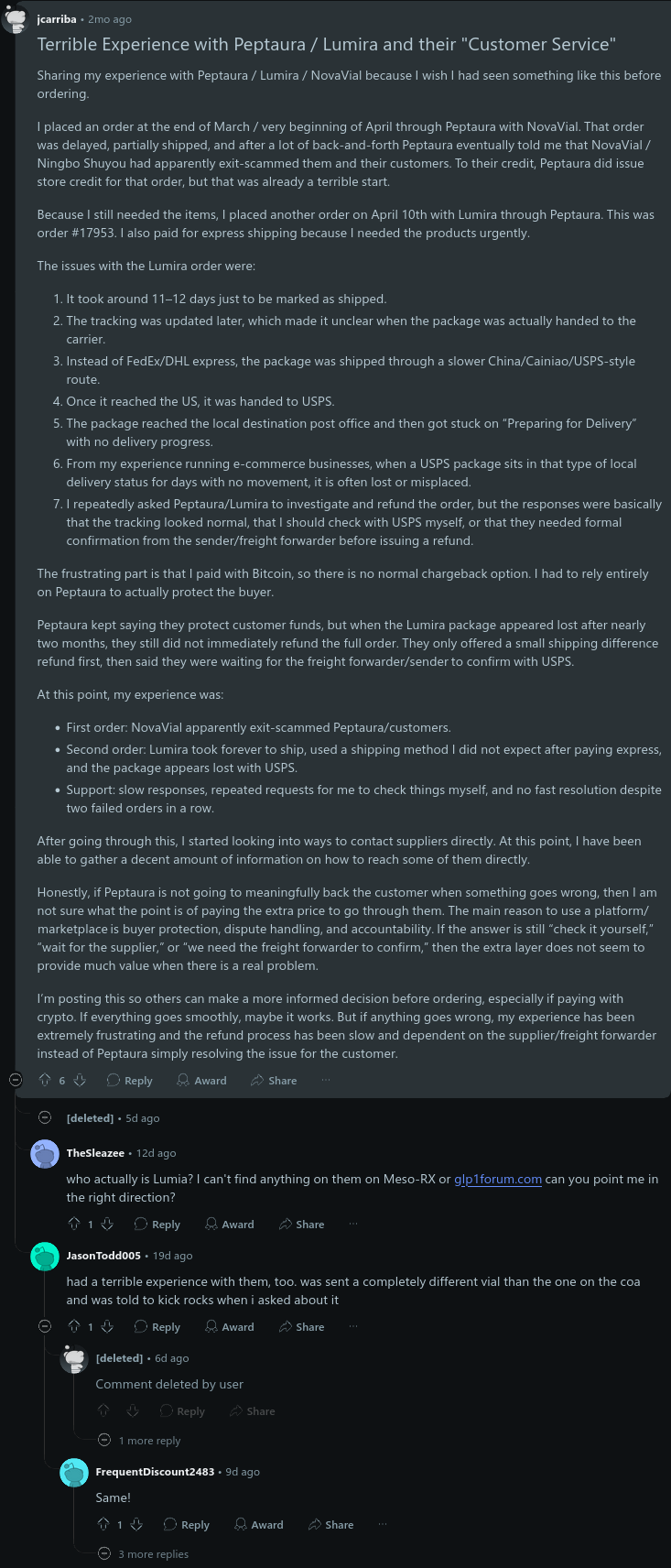
Peptaura answered in the same thread, specifically enough to check. Posting as “Peptaura here,” they said they refunded the order in full on 12 June — $441.46 in USDT, on-chain, to the wallet the customer nominated — and had refunded an earlier order in full too, $441.96 including shipping, out of their own funds, after the supplier exit-scammed them:
Four paid orders. Two arrived. Two refunded in full. You are out zero dollars. We are out $883.42.
They add that order #17953 was a two-supplier split and the customer received the Pepturion half; that the customer spent the first refund with them thirteen days later on a $666.96 order that shipped in three days and was never disputed; and that the $90 express charge was refunded in full. They conceded the two things the customer got right — the package was lost, and eleven days to ship was too slow. The complaint was never updated.
Source: r/Biohackers, comment p01lcia, 2026-07-27, archived to Wayback. Evidence: FIRST-PARTY MERCHANT RECORD (self-identified; the refund amounts are their account, not independently confirmed on-chain by us). Quoted rather than screenshotted: the comment sits behind a collapsed “10 more replies” fold that does not render to a logged-out reader, so no honest screenshot of it exists. These two accounts must run together or not at all.
The real risk: nobody is accountable
Strip away everything unproven and this remains: the people who brand these products, test them, publish the results and certify them as passing are pseudonymous. No named company, no accountable individual, no jurisdiction. When the verification is wrong — and we have shown one case where it is — there is no one to hold to it. It does not take secret ownership or a fake lab to hurt you. It only takes the day the paperwork is wrong and nobody is home.
