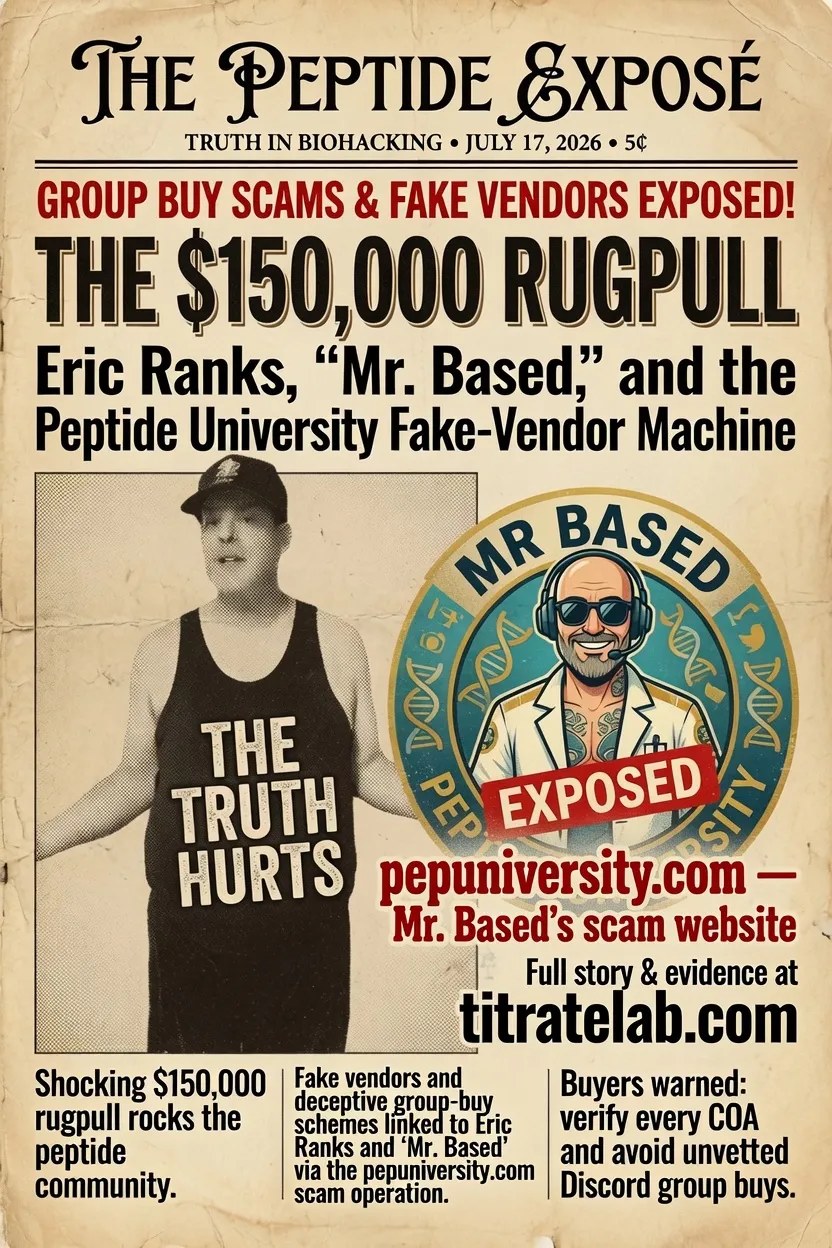
The short version
In the grey market for research peptides, the one safety guardrail is the third-party lab test, the COA. It is the only thing standing between a buyer and a vial of the wrong compound, an underdosed dose, or a contaminated injection. TitrateLab exists to make those certificates verifiable.
This is not a story about one bad vendor. It is a story about a machine that manufactures vendors. The same small group of people has run the same play at least twice: stand up a “vendor” nobody outside the group can verify, use a trusted-looking promoter to vouch it into the community, funnel members’ money to it, defend it through every failure, and, when it finally collapses, announce that the vendor was the scammer and move on to the next one.
The promoter is Eric Ranks. The first vendor was “Bella.” The money and the certificates run through a never-seen principal called “Mr. Based” and his paid brand, Peptide University. The second vendor was the one Peptide University’s July group buy was built around. When it collapsed, members were out roughly $150,000. This time the money did not vanish into an untraceable Chinese lab. In traceable Solana stablecoin transactions, about $178,000 off-ramped at Coinbase, Binance, and OKX — three regulated, know-your-customer exchanges. The members received nothing.
The people, and how they connect
Four names run through both operations.
- Eric Ranks — the promoter. Posts on Discord as [PepU] (Peptide University) and elsewhere from +1 (801) 673-3265. Presents as a charitable veteran who has “collected over 20,000 COAs.” He is, by a wide margin, the loudest voice vouching for both vendors.
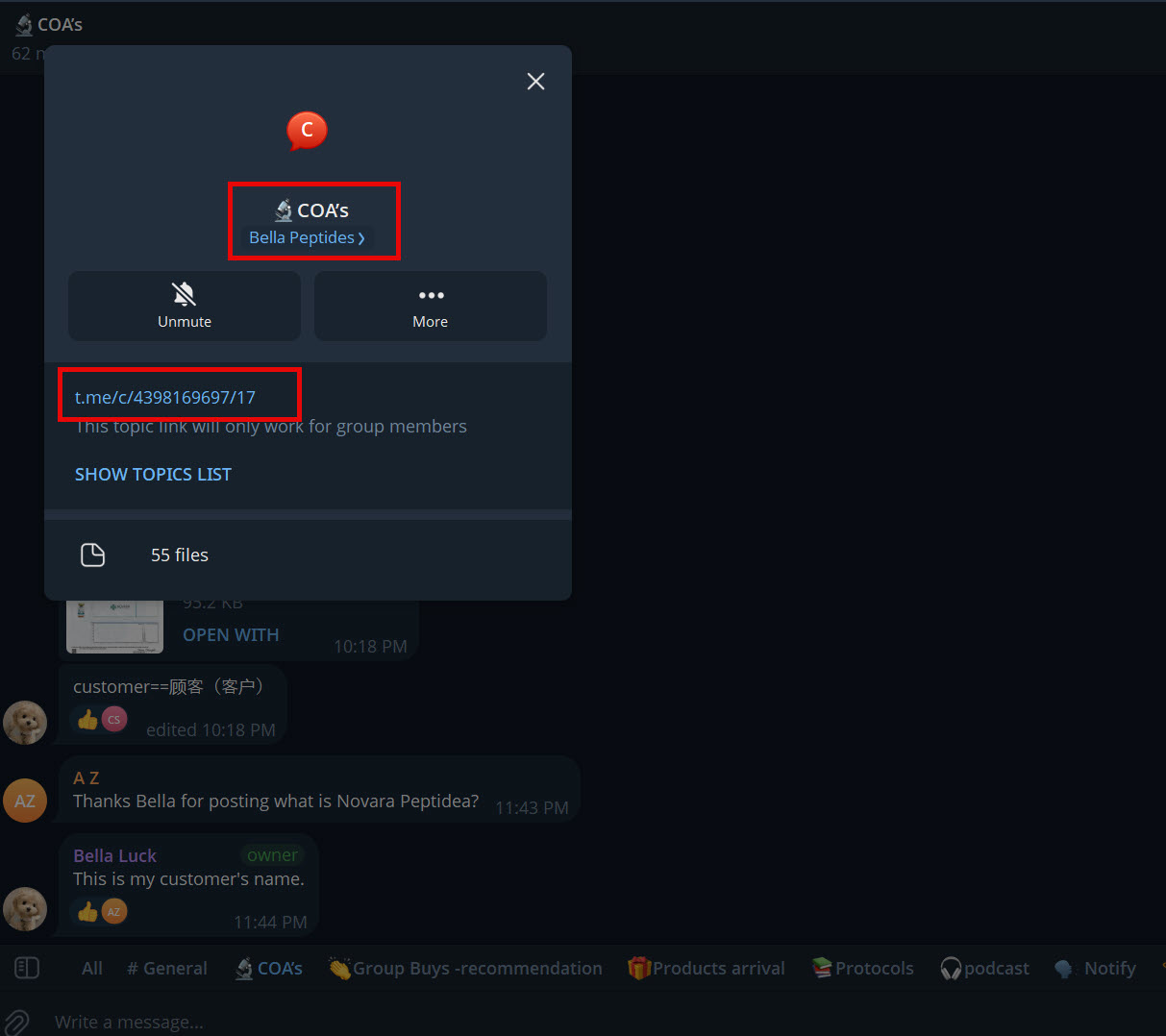
- “Bella” / “Bella Luck” — vendor number one. Runs a Telegram group tagged owner, rarely speaks, and leaves the talking to American admins.
- “Chelsea” / “Chelsea1989” / “Chelsea Smith” — the admin who runs Bella’s channels day to day, and who disclaims all responsibility for the product.
- “Mr. Based” — a principal who never appears in any chat. He collects the payments, holds the product, and issues the COAs. His brand is Peptide University (
pepuniversity.com, a Patreon, the address[email protected]). Asked directly whether he was the site, he answered: “LOL, I am Pepuniversity.com.”
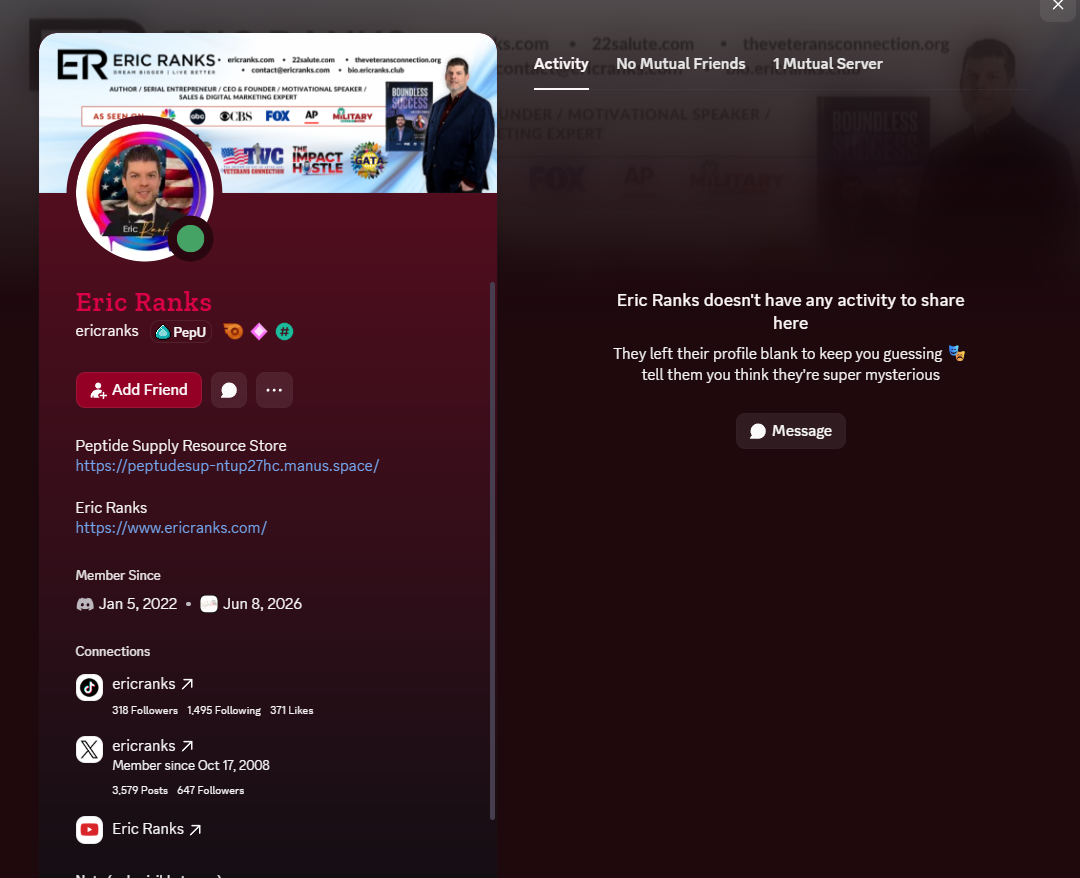
The connection is not our inference. It is in their own messages. In the Bella group, Eric routes buyers straight to Mr. Based’s paid channel and tells them the vendors are interchangeable: “join Mr. Based Patreon if you’re not a member. All the GB get paired there across all vendors.” A promoter for “Bella” is also the recruiter for Mr. Based’s cross-vendor group-buy operation.
The supporting cast overlaps too. Harold (+1 786-985-7435, in Miami) is what “amplify by shilling” looks like in one person. Through the spring he hard-sold Bella to the group — “Ive been selling everyone bellas rt30 and its been like Crack,” “I’ve sold 3 rt30 today $180 each,” “In bella we trust” — and kept vouching straight through the mounting evidence that it was a scam, still insisting in the Peptide University group after the collapse that “We should’ve just waited for bella shes always been solid.” He was also candid, in writing, about how he moves product to buyers around Miami: he mislabels the doses on purpose — “Sell them as 10s… Tell the people you labeled them wrong by accident” — and invents a sourcing story to reassure them — “I tell the people I went to china and watch them make the Peps in front of me.” That is a reseller knowingly selling misrepresented grey-market product to local walk-up buyers, and saying so out loud.
A longtime grey-market regular, who turns up beside Eric brokering Bella’s discounts, is in the Peptide University group too, there to normalize the loss: “You trusted a vendor they made out with the cash… can’t go to police or law enforcement… It’s an assumed risk.” And Chelsea Smith, Bella’s admin, is the one coordinating Bella’s group-buy tallies. Same promoters, same admins, two “vendors.”
The room where this happened
The conversations quoted throughout this piece took place in a small, private WhatsApp group — a room its own members named, half-joking, “SKETCHY CHINESE POWDER DEALERS.” About twenty accounts were active in it.
It did not start as a scam. It started as spillover from another well-known vendor. Through the spring, members traded complaints that ERP — a large grey-market supplier many of them had bought from — had slipped: “ERP got big with sales, they don’t care about quality or customers anymore,” bad GHK, a warehouse group chat full of problems. As that trust eroded, a handful of the more active voices, Eric among the loudest, pulled people out of the open vendor channels and into a smaller, more private room. That structure is the point. A contained, curated group of about twenty is not a marketplace; it is an audience — one where a few people decide which vendors get recommended and which warnings get buried.
And this is not a room of consumers being scammed by outsiders. It is a room of grey-market resellers, and the dangerous actors are inside it. Some, like Harold, openly discussed ripping their own buyers off. The threat model is not “a Chinese factory lied to us.” It is “the people setting the narrative in here profit from what you buy.”
The admin, TB (+1 561-901-0130) — himself a reseller — enforced that narrative. When members kept raising the possibility that Bella was a scam and that Eric was steering them into it, TB’s answer was not to look into it but to threaten: “Ill kick anyone who brings it up again.” When a newcomer warned that Bella had been “removed from like 10 different verified vendor groups,” TB shut it down with “I know you just joined.” People who tried to warn the room were removed from it.
None of this is unique to one chat. In TB’s own words, “there is enough of it in every other vendor and peptide chat.” Curated private groups are the medium; a captive, trusting audience is the method. This investigation happens to hold the receipts for one of them.
The playbook
Before either vendor, there is a method. It shows up the same way both times:
- Build authority by debunking a rival scam. Establish the promoter as the person who knows what is fake.
- Steer everyone to a captive vendor that the group cannot independently verify.
- Vouch after doubt — the instant anyone questions the vendor, the promoter defends it, harder than before.
- Discredit the labs, so no independent test can settle the question.
- Ban the messengers who post failures or ask for certificates.
- Run the money through a never-seen principal, so no single person is holding it on paper.
- When it collapses, blame the vendor and, if possible, turn the defrauded members into a posse hunting a disappeared third party.
What follows is that playbook, run on “Bella,” then run again through Peptide University.
Iteration one: “Bella,” a vendor built to be unverifiable
Bella has the shape of a manufactured vendor. She operated primarily on Discord with a small customer base — on the order of a few dozen buyers — which is part of why it worked: a contained room is easy to control. The “vendor” herself rarely speaks; American admins do essentially all of the customer-facing work; and the operation claims to own a Chinese factory yet cannot produce a single lab report with its own name on it.
The hook was PayPal. Almost no real grey-market vendor takes PayPal, because PayPal means chargebacks, tax reporting, and account freezes on exactly this kind of product — the risk all sits with the seller. Offering it was the lure that pulled buyers in (“you’re protected”), and, to anyone paying attention, the tell: a “Chinese factory” that cheerfully accepts the one payment rail a real overseas seller avoids is not what it says it is.
That is the modus operandi in miniature. A small group stands up the pieces of a vendor — the quiet “owner,” the busy American admins, the reassuring promoter, the recirculated certificates — and then amplifies the whole thing by shilling it to each other’s audiences until a manufactured brand reads as an established one. (That Bella is a fabricated front rather than a real overseas vendor is an inference the pattern strongly supports; what is documented below is that the operation could not be verified and behaved as described.)
Build authority, then steer
In April, Eric publicly debunked a competing operation, showing it faked lab reports through a look-alike domain built to impersonate the real lab, Janoshik. The debunk was correct. It also installed him as the group’s authority on what is fake — the position from which every later recommendation carried weight.
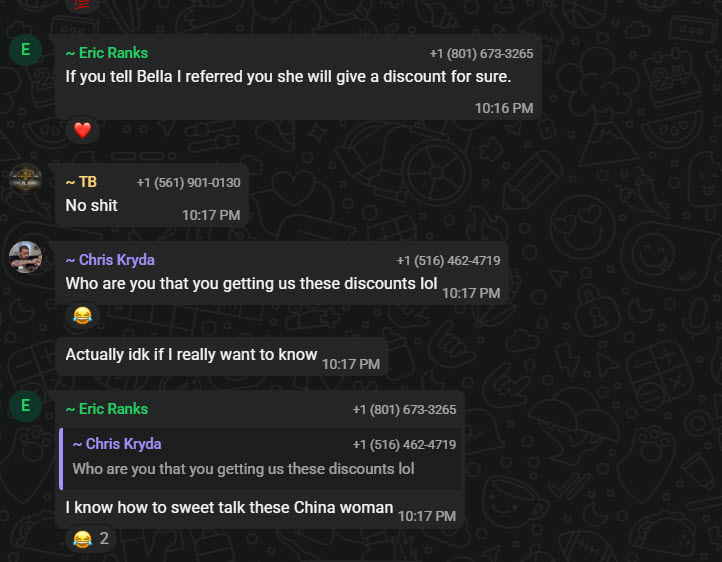
From there he pushed Bella relentlessly and made himself her gatekeeper: “Bella is great! Make sure to let her know I sent you”; “Don’t trust any other Bella.” The referral relationship is not subtle. Asked how he gets buyers a discount, Eric answered: “If you tell Bella I referred you she will give a discount for sure,” and, pressed on how, “I know how to sweet talk these China woman.” His standing claim, repeated whenever money came up, was that he profits nothing. Members did not buy it, and said so to his face. Some did not bother with the accusation at all; they just called the vendor “Eric’s Bella,” the way you name a thing by its owner.

(That Eric is literally “Bella” is a member allegation the evidence does not prove — the stylometric pass found no in-chat alt. What the transcript does show, over and over, is that the room treated Bella and Eric as one thing.)
One voice, over and over
The clearest measure of Eric’s role is quantitative. TitrateLab parsed the full 13,923-message export (April 17 to June 19) and counted, per account, every mention of “Bella” or “Alisa,” the two vendors Eric pushed. One account dominates the entire room.
| Account | “Bella” / “Alisa” mentions | In those mentions |
|---|---|---|
| Eric Ranks (+1 801-673-3265) | 98 | recommending / defending |
| “Harold” (+1 786-985-7435) | 69 | recommending / reselling |
| patrick (the whistleblower) | 56 | challenging / investigating |
| a reseller account | 26 | reseller |
| TB — admin / owner (+1 561-901-0130) | 13 | ran the room; silenced dissent |
| a member | 12 | member |
| a member | 11 | member |
| ArathorN | 8 | member |
| six other accounts | ≤ 6 each | members |
Across two months and nearly 14,000 messages, Eric Ranks brought up Bella or Alisa 98 times — more than anyone in the room, including the whistleblower who was actively investigating her (56). His co-promoter Harold adds another 69. And Eric’s mentions are not idle chatter; they are pitches and defenses: “I buy 90% of my peps from her”; “I inject 12+ peptides a day from Bella and get really great results”; and, every time someone raised doubt, a version of “it honestly feels like you have a personal vendetta against Bella.” When one person is the single largest source of all mentions of a vendor, and nearly every one is a recommendation or a defense, that is not a happy customer. That is the vendor’s marketing.
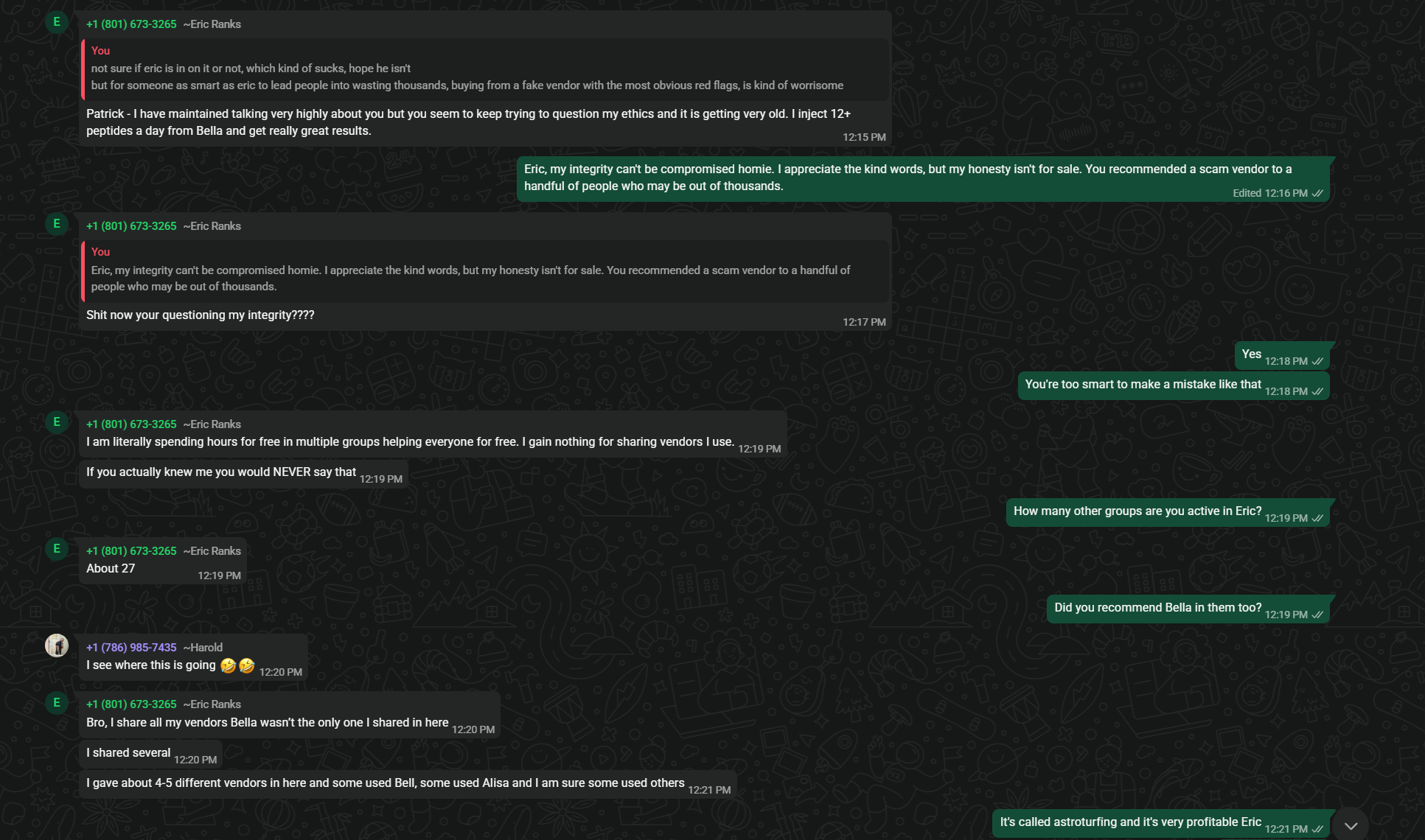
When the group’s analyst, patrick, finally said it to Eric’s face — “You recommended a scam vendor to a handful of people who may be out of thousands” — Eric reached for the script: “I gain nothing for sharing vendors I use,” “I am literally spending hours for free in multiple groups helping everyone for free,” “I inject 12+ peptides a day from Bella and get really great results.” Then came a number worth holding onto. Asked how many other groups he was active in, Eric answered plainly: “About 27.” Asked whether he pushed Bella in those too, he confirmed he shares his vendors across all of them. patrick named the model in one line: “It’s called astroturfing and it’s very profitable Eric.”
The COA problem, and the “grey market doesn’t test” defense
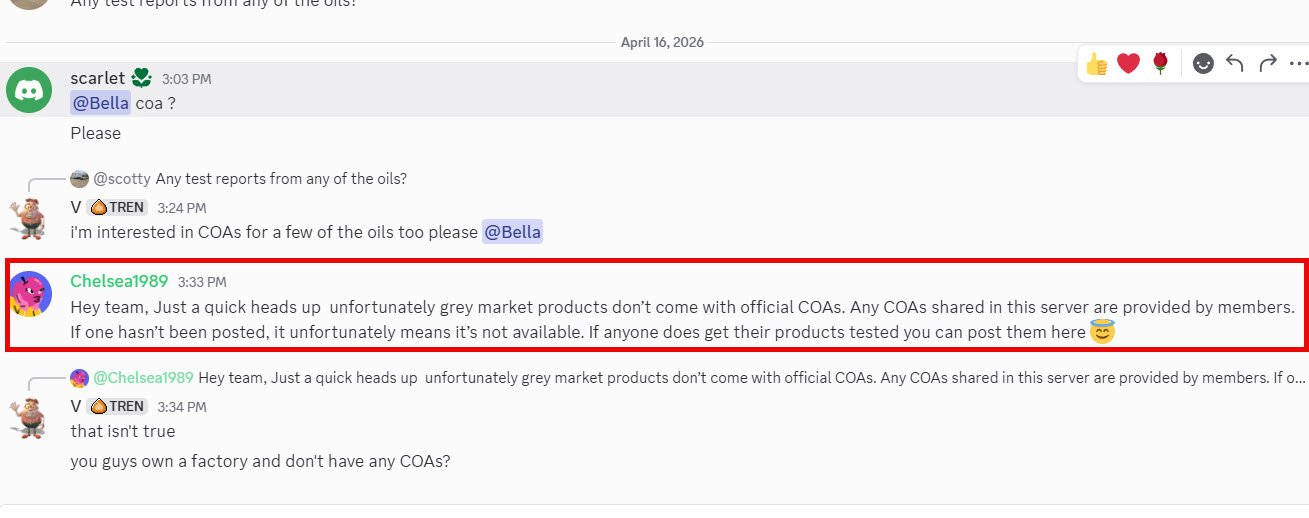
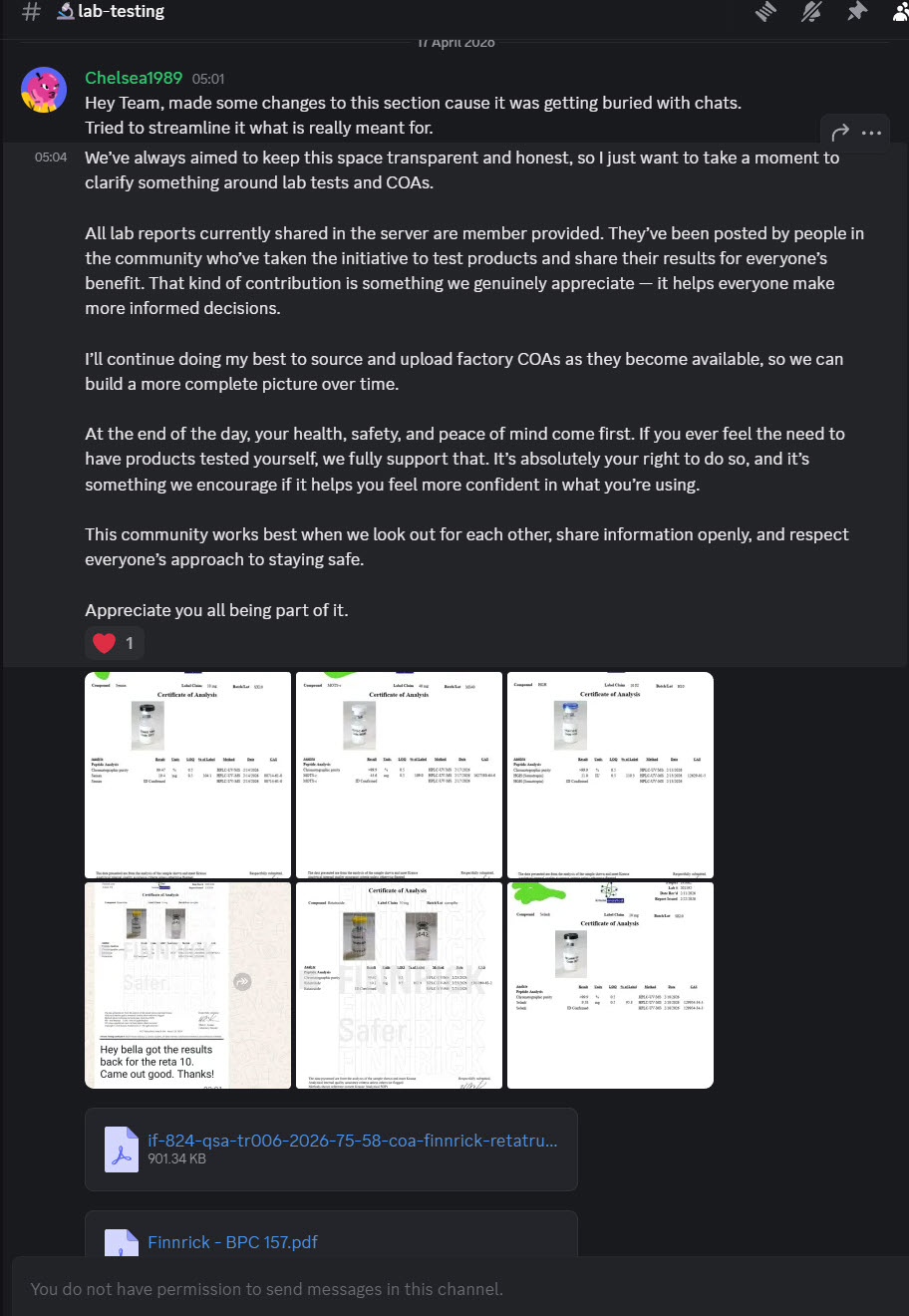
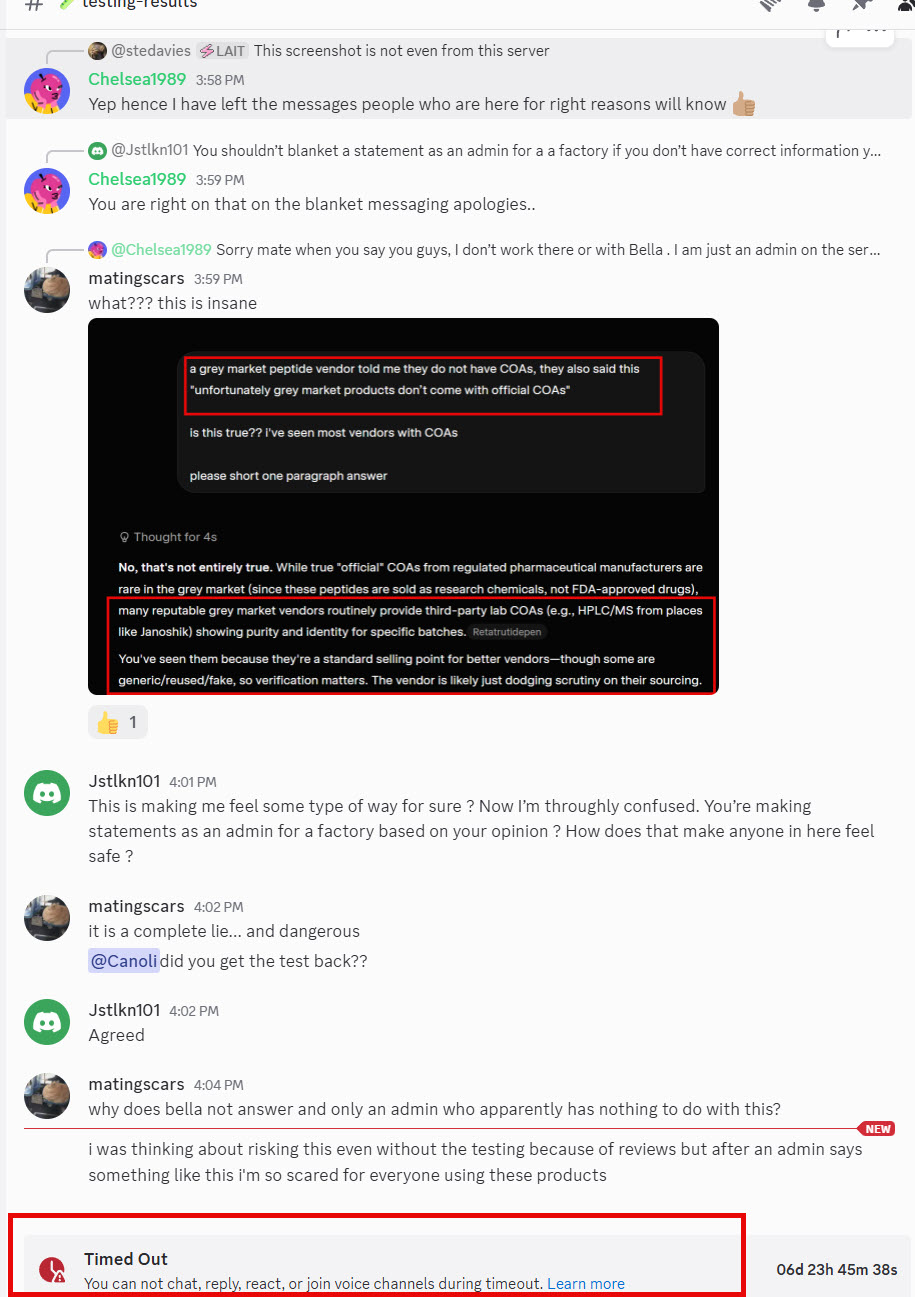
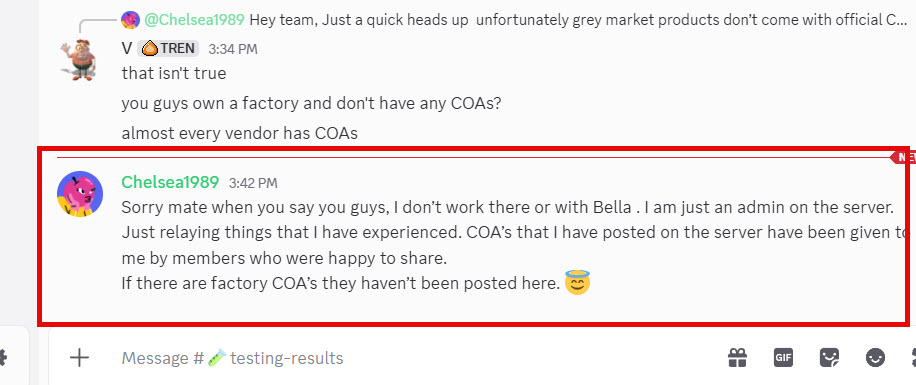
A vendor claiming to own a Chinese factory could not produce a single lab report with its own name on it. The admin’s fix was to redefine the problem. In Bella’s testing channel, when members asked for COAs, Chelsea1989 replied: “unfortunately grey market products don’t come with official COAs.” A member answered immediately: “that isn’t true… you guys own a factory and don’t have any COAs? almost every vendor has COAs.”
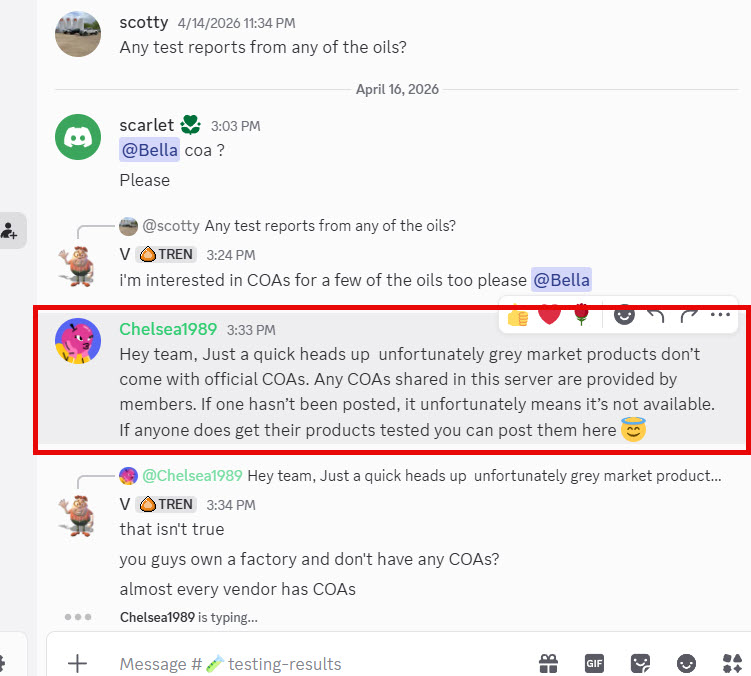
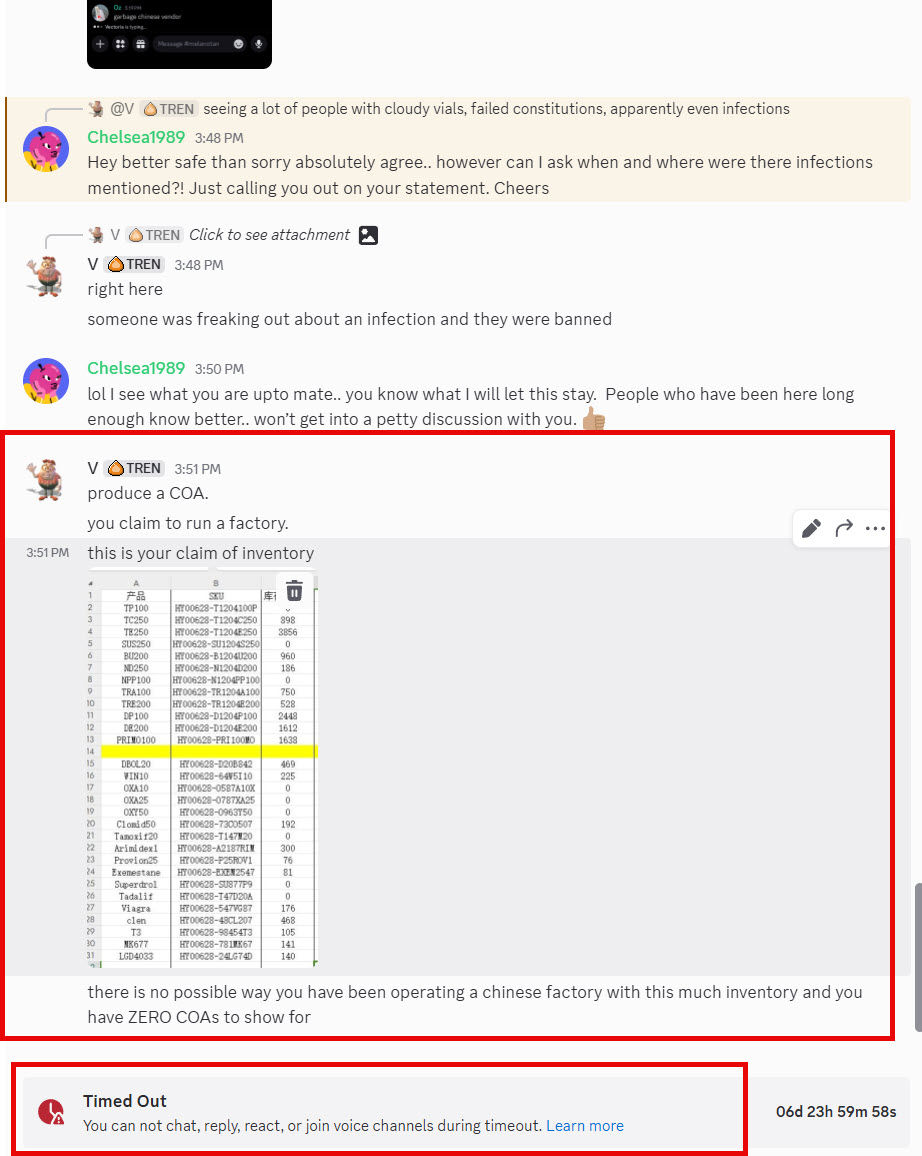
That is backwards. Testing is the point of the grey market, and the member was right: most of the vendors we track hold at least one published certificate. When another member confronted Chelsea with the operation’s own Chinese inventory spreadsheet — thousands of units of peptides and anabolic steroids — and demanded “produce a COA… you have ZERO COAs to show for,” the response was a roughly seven-day timeout.
The certificates that do not check out
When COAs were produced, they did not survive inspection, and this is verifiable against the labs’ own websites.
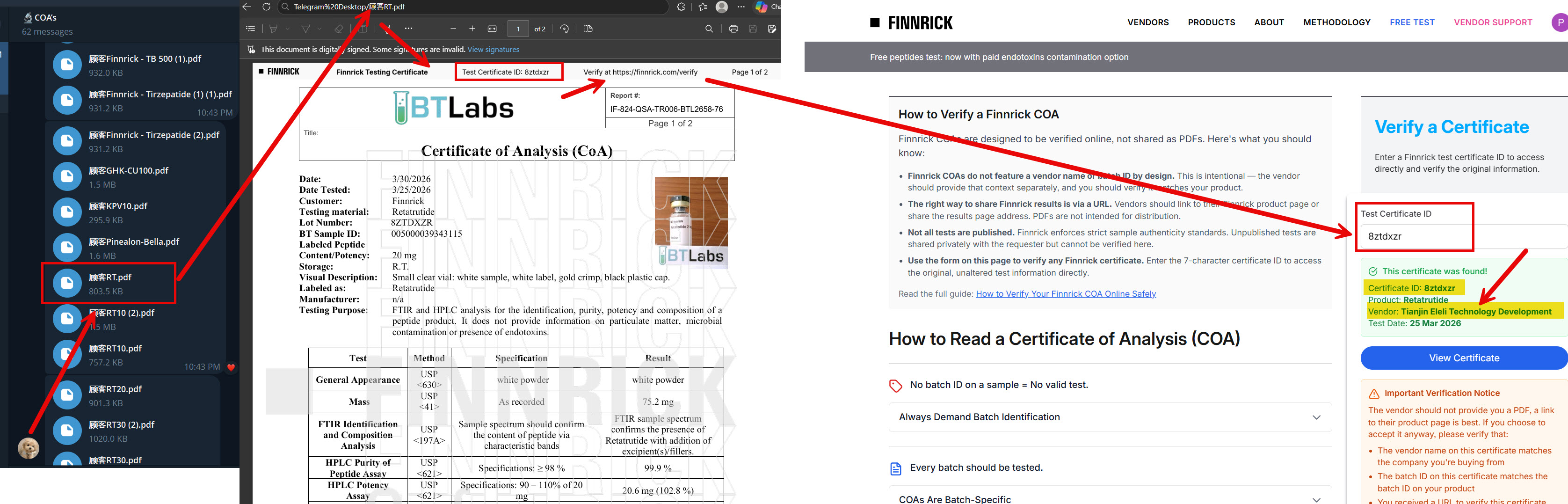
The certificate belongs to a different company. One certificate circulated for Bella — a genuine Finnrick record for retatrutide, ID 8ztdxzr — verifies on Finnrick’s own site to vendor “Tianjin Eleli Technology Development,” not Bella. Its Manufacturer field reads “n/a,” and the reader flags “Some signatures are invalid.”
A second certificate, from a different lab (Bioviridian), names its vendor as “Novara Peptides,” again not Bella. It carries Novara’s own branded vial photo (“NOVARA PEPTIDES · GLP2-TIRZ · 60 MG”) and Novara’s own web verification code — the marks of a separate vendor running its own testing program, not of a “customer.”
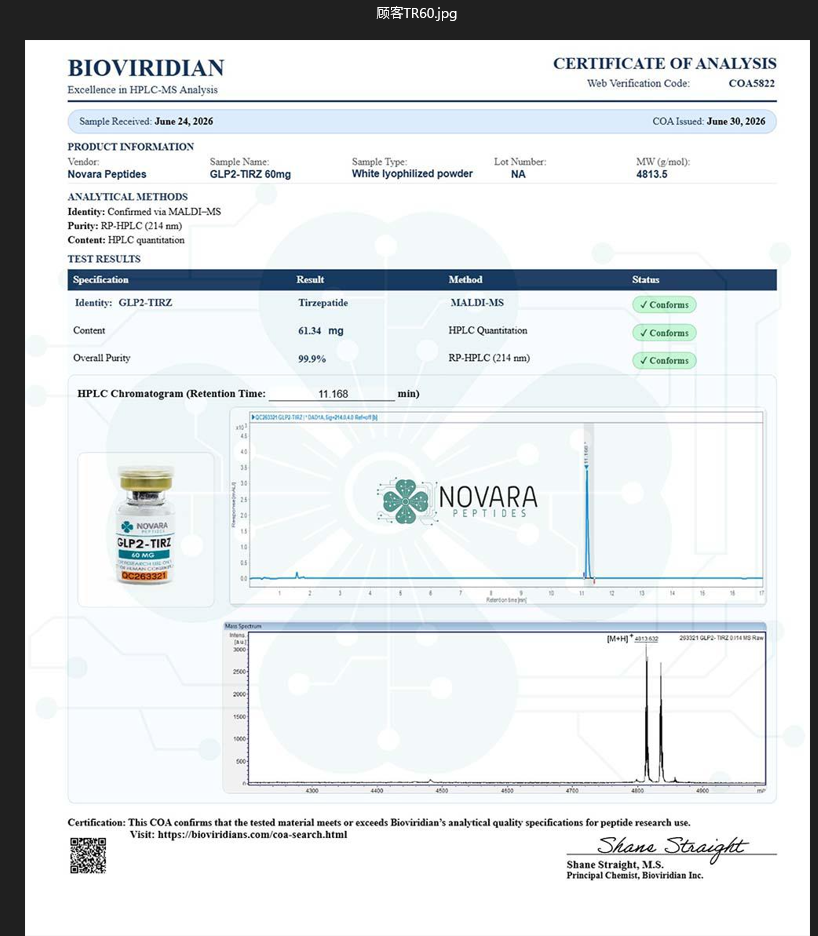
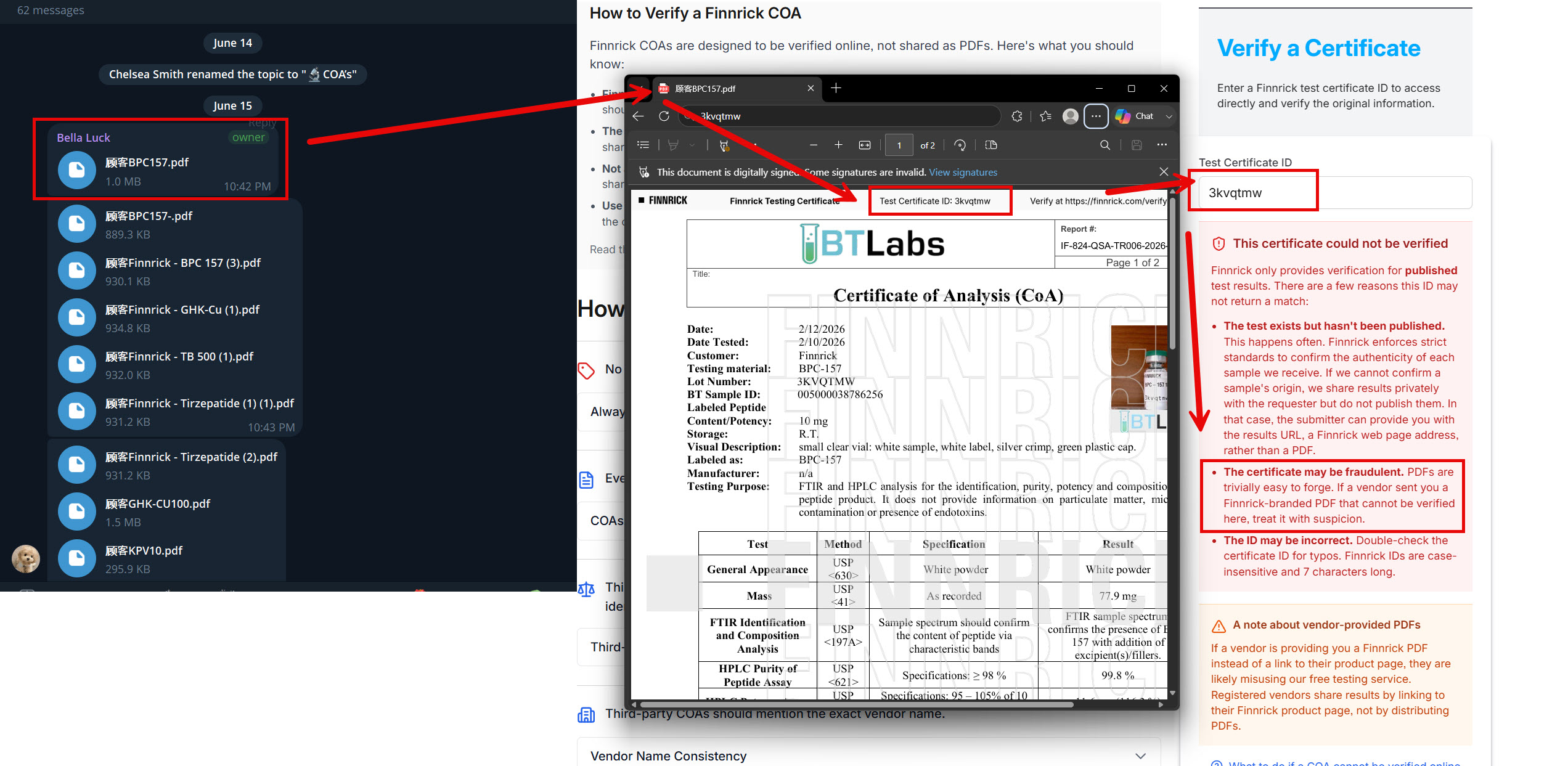
These are other vendors’ certificates, not “customers.” This is the tell, and it is worth being precise about, because the operation has a ready excuse. Asked what “Novara Peptides” was, Bella answered: “This is my customer’s name.” That is false. Both certificates carry the name, branding, and independent lab testing of separate, real vendors. Tianjin Eleli Technology Development is an established manufacturer with 23 certificates in TitrateLab’s own corpus, spanning four different peptides and tested across at least two independent labs, including Freedom Diagnostics. Novara Peptides ships its own branded, verification-coded product line. Neither is a “customer” of Bella. Bella took two other vendors’ lab reports and passed them off as if they backed her own stock — and the filenames admit it: every one carries the Chinese prefix “顾客” (gùkè, “customer”), i.e. someone else’s order. It is not “our customer provided a COA.” It is one company’s certificate wearing another company’s name. When the admin needed a batch of certificates to point to, they were the same Finnrick-branded PDFs the lab explicitly warns vendors against distributing.
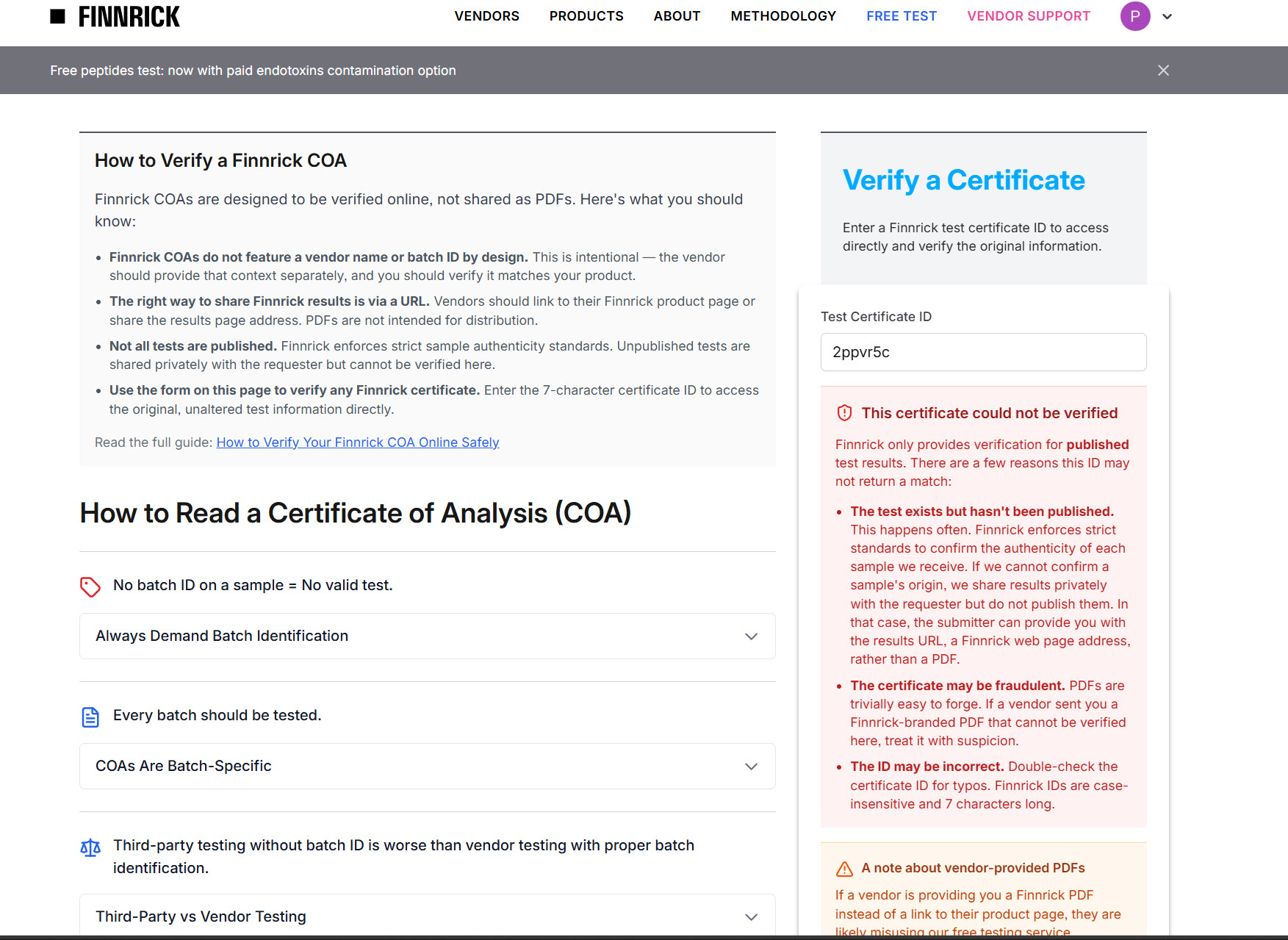
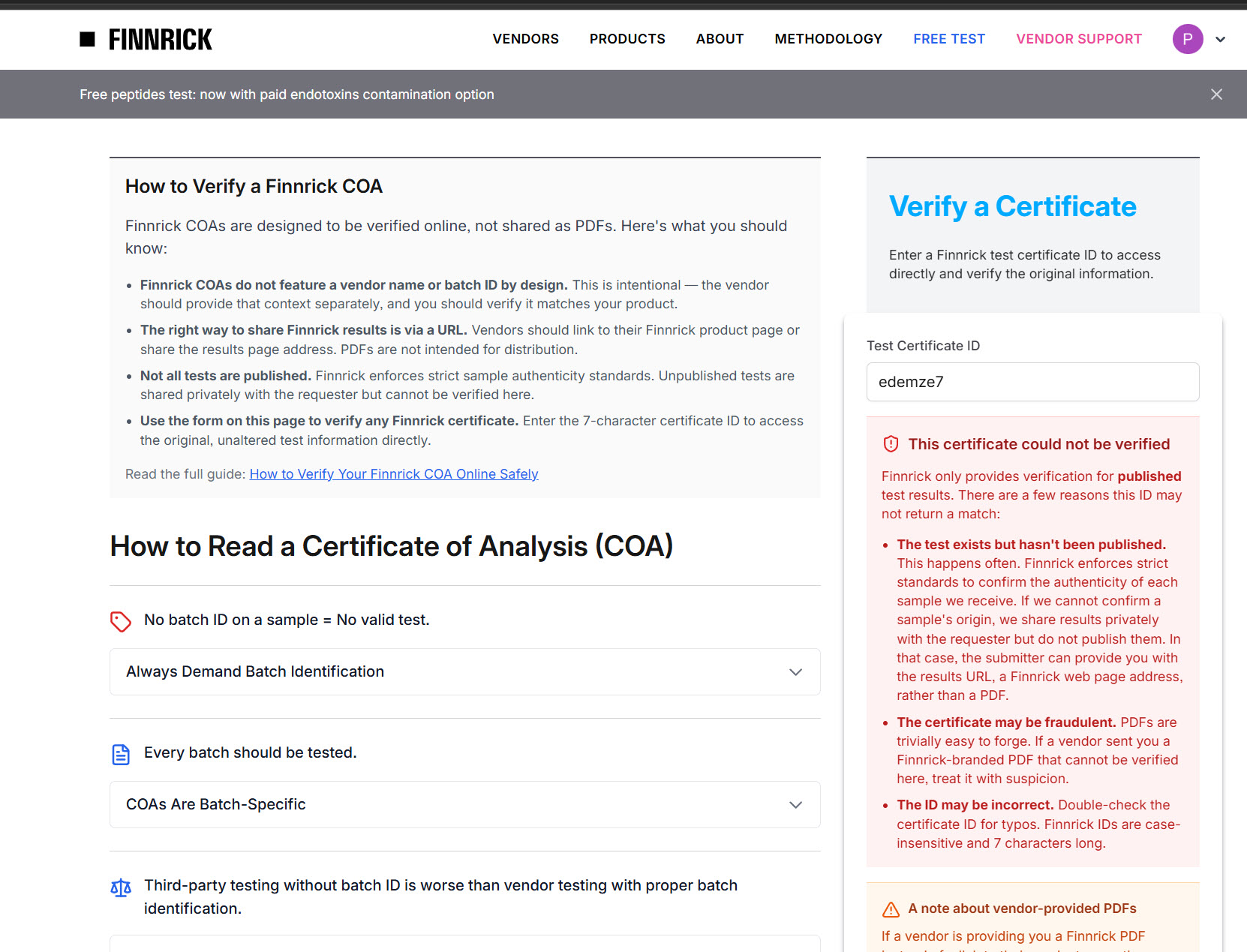
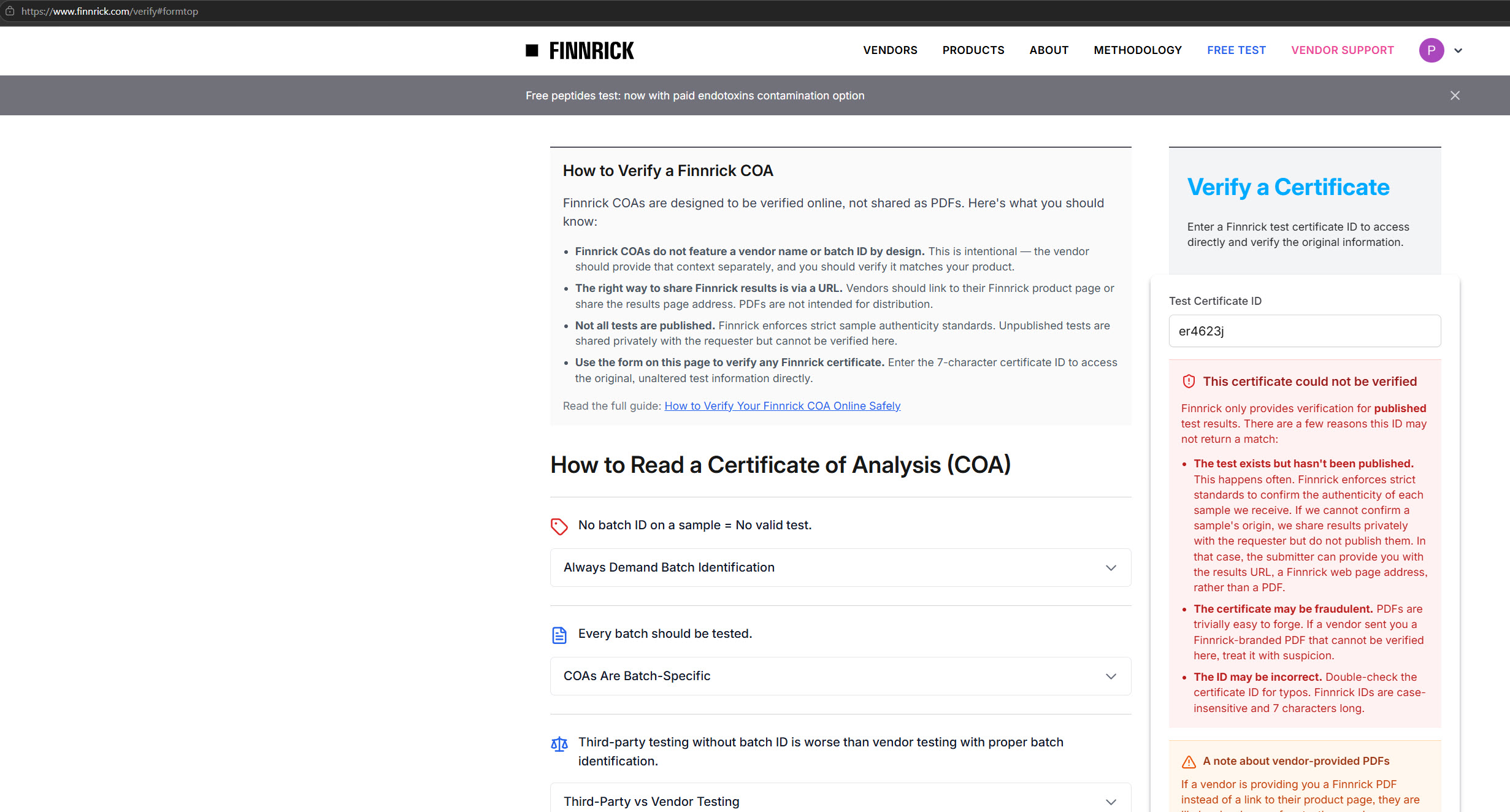
The IDs fail live verification. A Finnrick-branded certificate that Bella herself posted, ID 3kvqtmw, returns on Finnrick’s live site as “This certificate could not be verified,” with the warning “The certificate may be fraudulent. PDFs are trivially easy to forge.” And it is not one certificate. Feed Finnrick the other IDs off Bella’s PDFs — 2ppvr5c, edemze7, er4623j — and each returns the same wall of “could not be verified.” A vendor with a real testing program produces IDs that resolve. Bella’s produce “not found,” over and over.
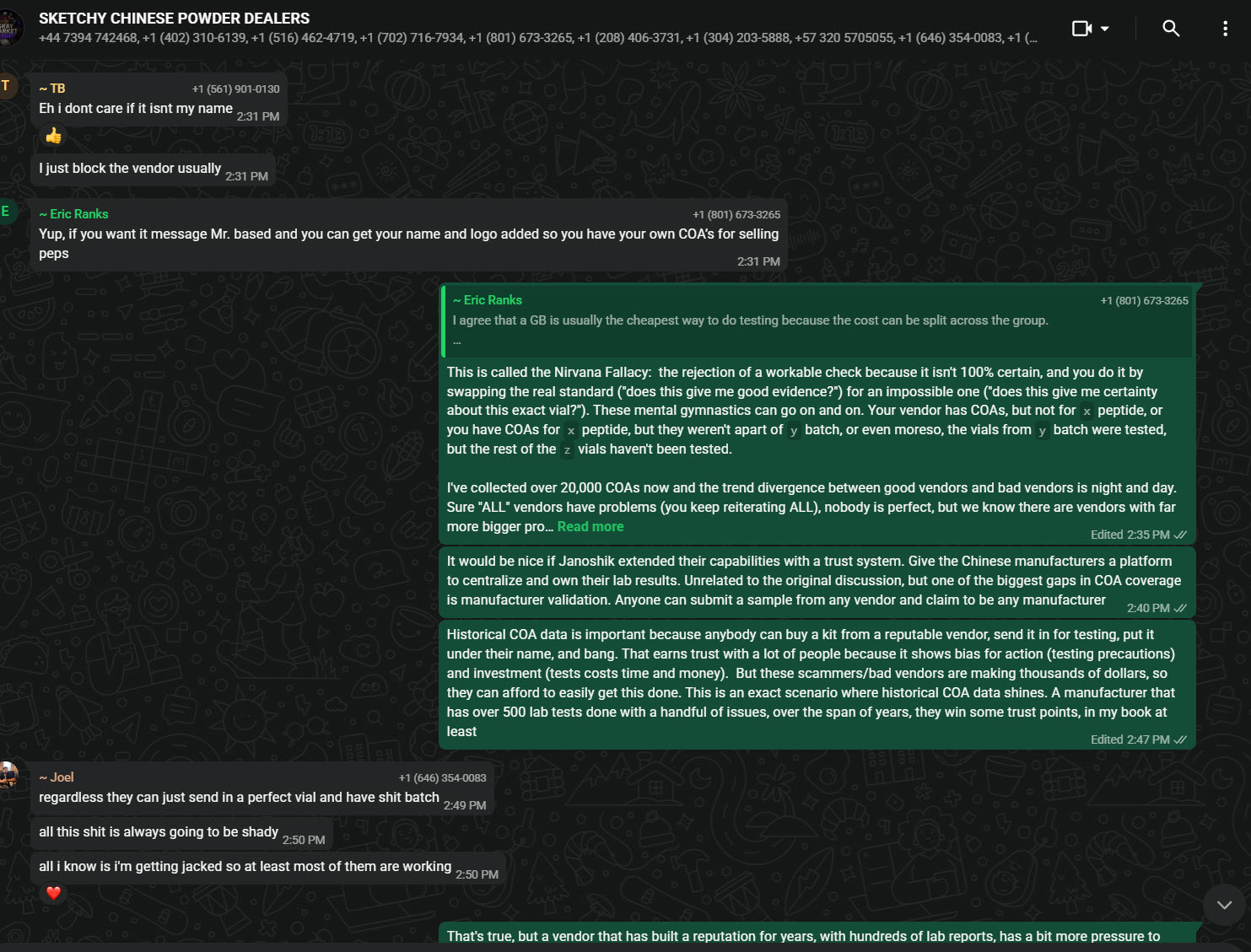
Then the mechanism, in Eric’s own words, in a Telegram group named without irony “SKETCHY CHINESE POWDER DEALERS”: “if you want it message Mr. based and you can get your name and logo added so you have your own COA’s for selling peps.” And separately: “anybody can buy a kit from a reputable vendor, send it in for testing, put it under their name, and bang.” That describes a custom-branded-certificate service, routed through the same never-seen principal who runs Peptide University.
Discredit the verifier
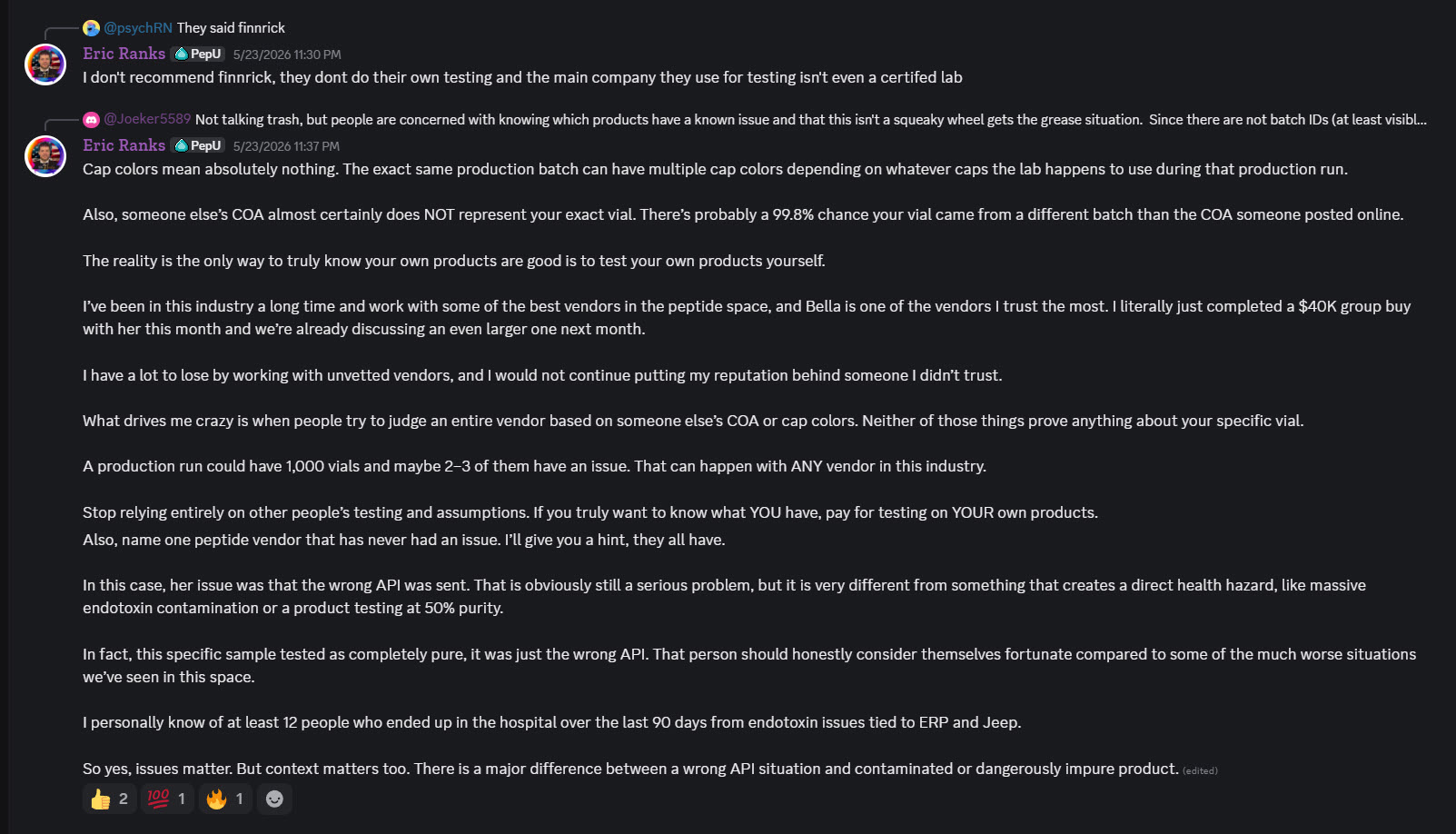
A COA fraud only works if independent testing can be waved away. So the promoter who built his brand on “20,000 COAs” campaigned against the labs. He claimed Janoshik lets manufacturers pay for good tests. On Finnrick: “they dont do their own testing and the main company they use for testing isn’t even a certifed lab.” His all-purpose solvent for any specific failure: “someone else’s COA almost certainly does NOT represent your exact vial,” an argument that, taken to its end, means no COA can ever prove anything. In the same message he conceded a Bella order was “the wrong API,” and disclosed a “$40K group buy with her this month” — a five-figure financial stake, from the man who says he makes nothing.
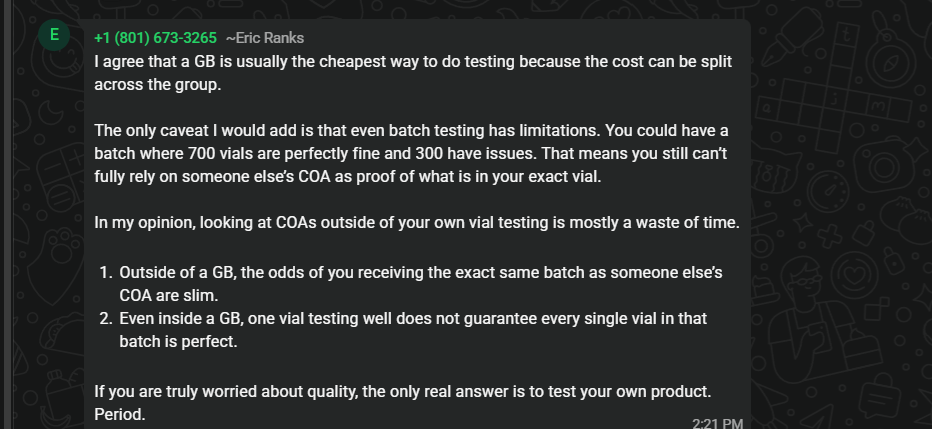
He made the same case at length, and it is worth quoting because it is the tactic distilled. A shared certificate can’t guarantee your vial, therefore — “looking at COAs outside of your own vial testing is mostly a waste of time,” and “the only real answer is to test your own product. Period.” It has the shape of reason. Its effect is to make the one affordable safeguard a group actually has — pooling money to test the batch — feel worthless, which is exactly the safeguard that would catch a fake vendor. There is a precise name for this move: the Nirvana Fallacy, the rejection of a workable check because it isn’t perfect. Refuse the pooled batch test because it can’t certify your exact vial, and you’ve argued your way out of the one safeguard a group could actually afford. That is Eric’s case, start to finish.
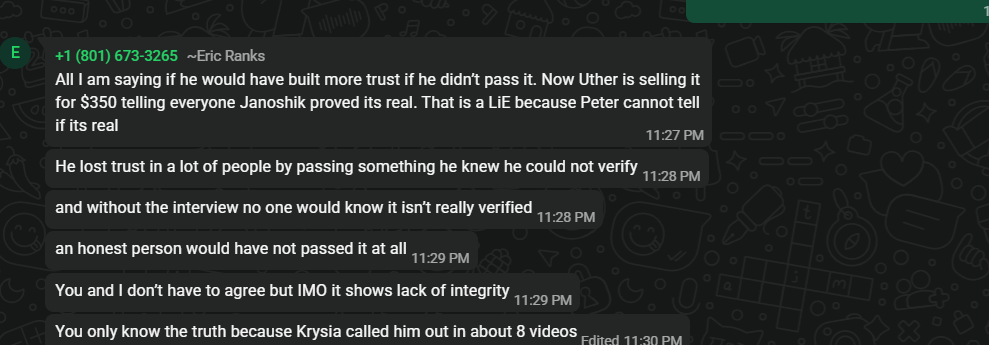
It goes further than doubting the labs. When a test comes back clean, Eric inverts it — the person who passed it becomes the liar. In one exchange, about a Janoshik-verified result, he insists that passing it is “a LiE,” that the tester “lost trust… by passing something he knew he could not verify,” that “an honest person would have not passed it at all,” and that it “shows lack of integrity.” Read the logic: if a test fails, the product is fine and the test is meaningless; if a test passes, the tester is dishonest. Either way, the one thing you must not do is trust the test — which is the only outcome that protects an untested vendor.
The product
The certificates matter because the product failed in the field, with photos. A Discord search for “cloudy” returned more than a hundred results across multiple members reporting the same source: reconstituted vials that turned milky with floating particulate, from retatrutide kits with no batch number to match a certificate against.
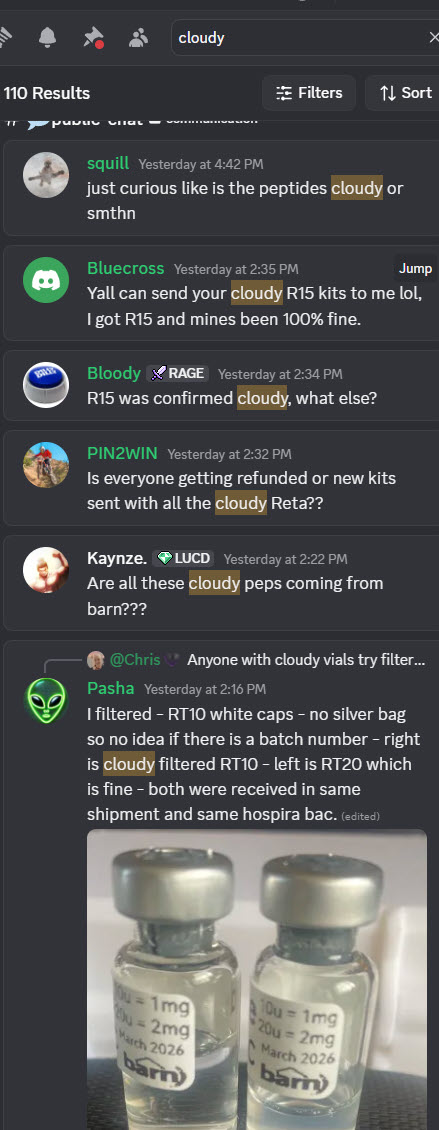
It was not one bad kit. Members traded photos: a second vial reconstituted milky and full of floaters; a batch where the first vial was fine and the next two failed; retatrutide that came up cloudy while the same water dissolved every other peptide clean. And each time, the same missing detail — no batch or lot number anywhere on the vial, so there is nothing a certificate could even be matched to.
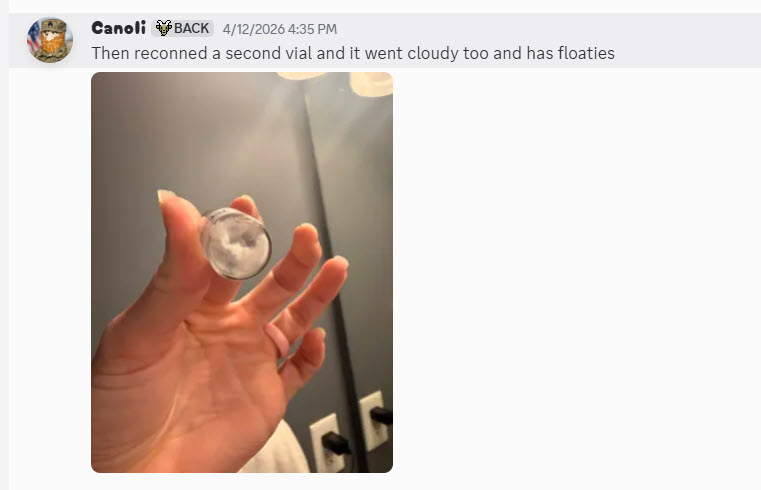
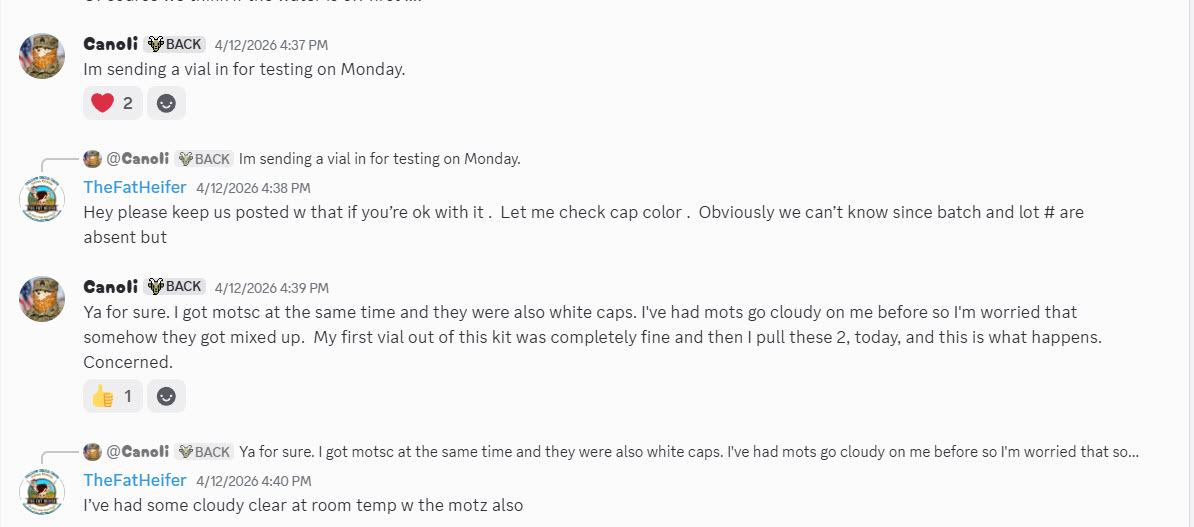
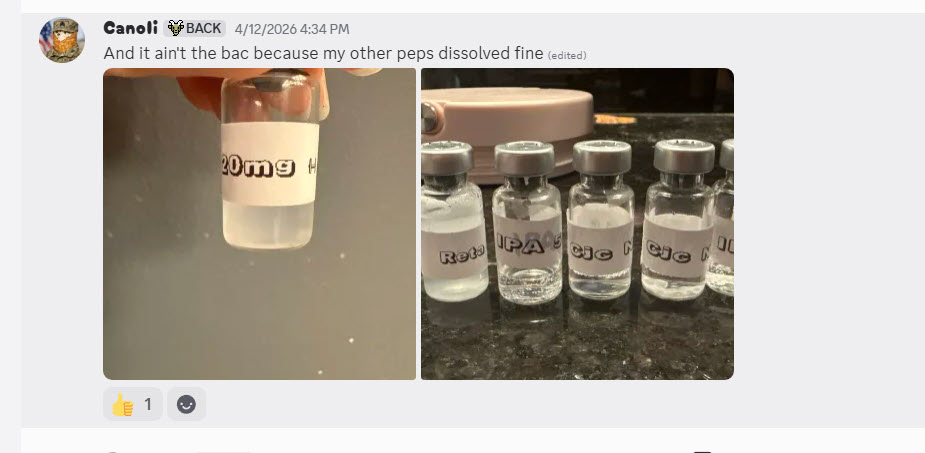
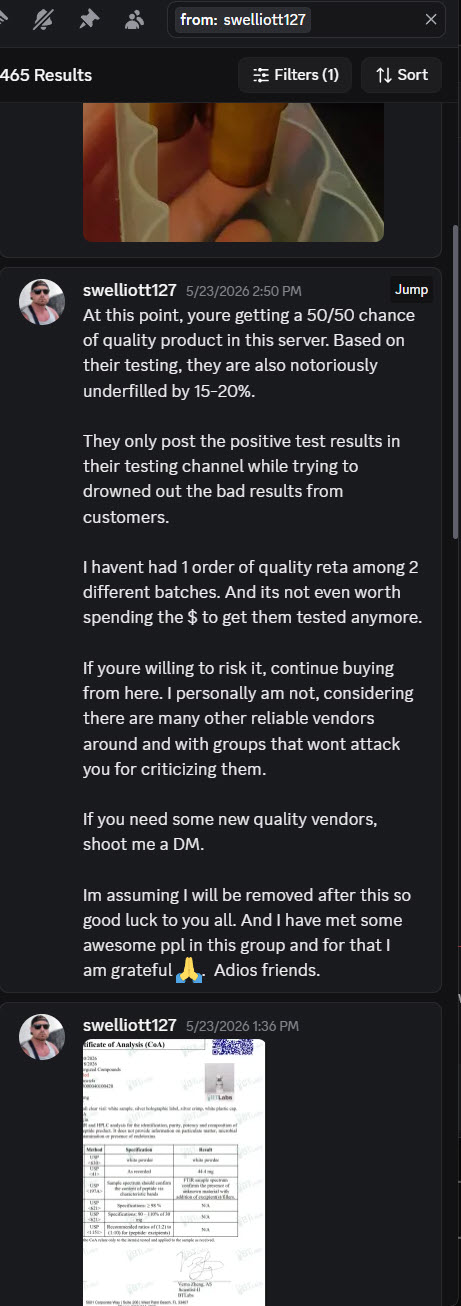
Others escalated past cloudiness to retatrutide that gelled into a semi-solid. A departing customer summarized it: buyers were getting “a 50/50 chance of quality product… notoriously underfilled by 15-20%.” The vendor’s public remedy was to blame the buyer’s water; a member rebutted it directly, showing brand-name solvent worked while the vendor’s own produced “lumps and debris.”
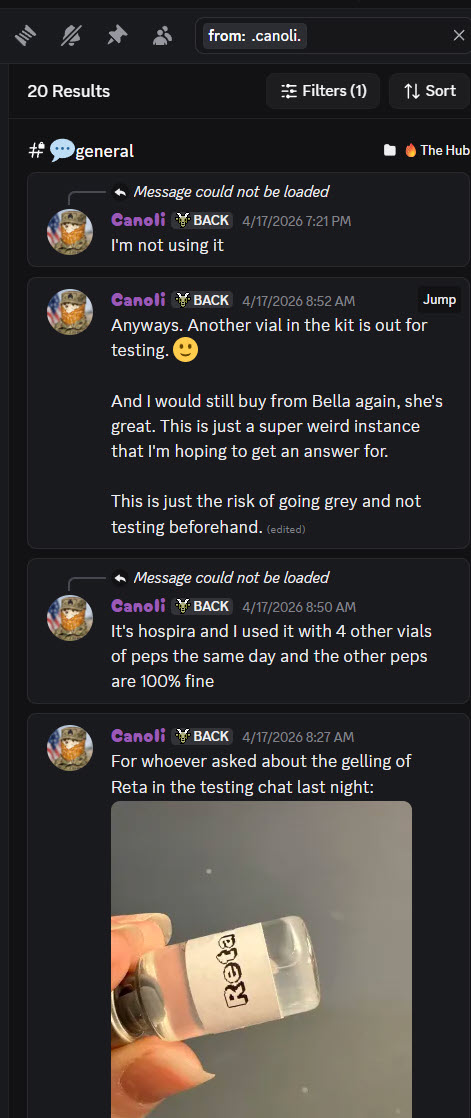
The vendor’s answer was to put it back on the buyer. Bella’s public remedy for cloudy or gelled product was to blame your solvent: “you can try replacing the BAC water or letting it sit for a few hours.” A member took that apart on the spot — brand-name Hospira water worked on five bottles; the vendor’s own solvent produced “lumps and debris” on three.


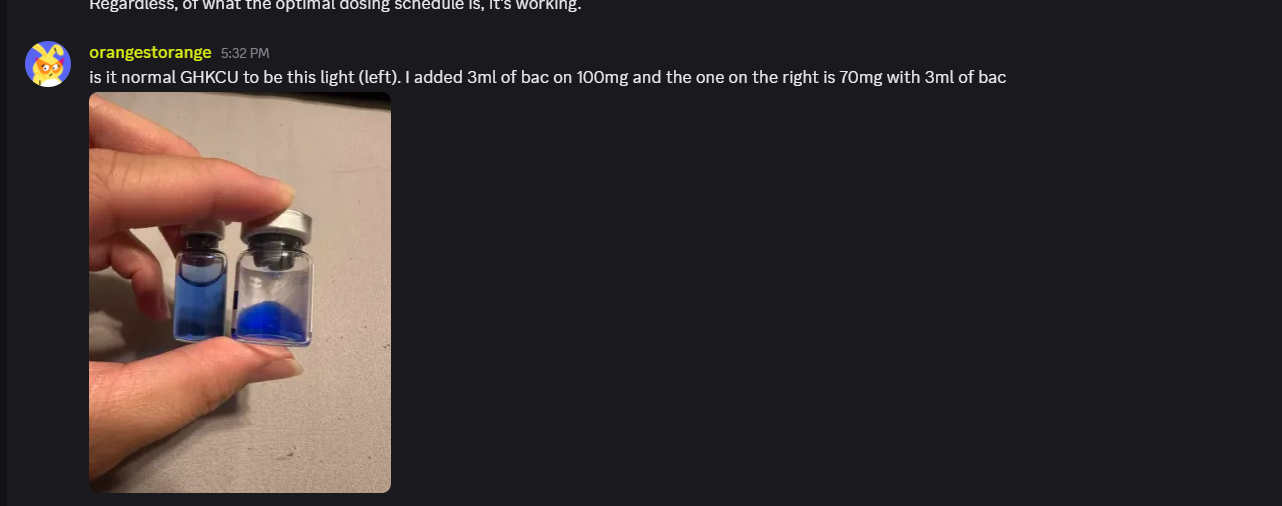
Underdosing showed up the same way, visibly. Reconstitute a “100mg” vial and a “70mg” vial with the same amount of solvent and the one that should be stronger comes up lighter than the one that should be weaker.
Ban the messenger
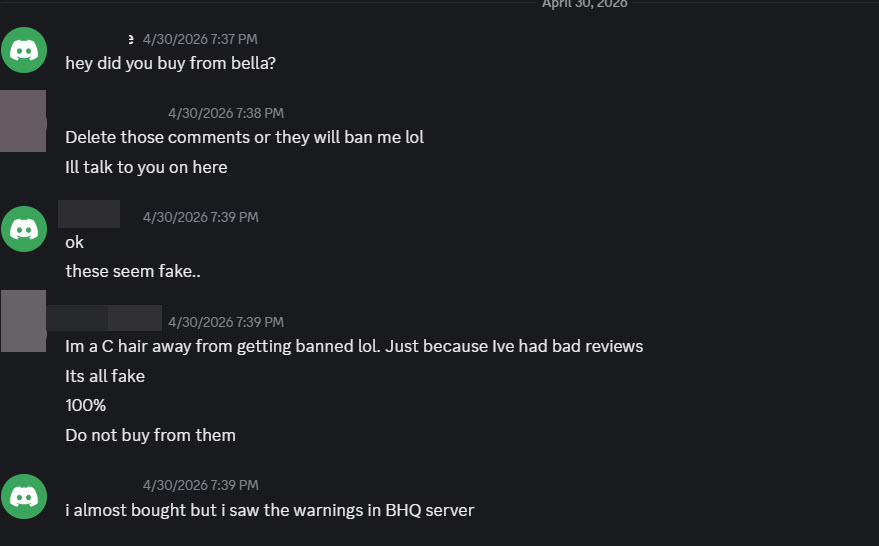
The consistent response to documented complaints was removal. One buyer warned another in a private message: “Delete those comments or they will ban me… Do not buy from them.”
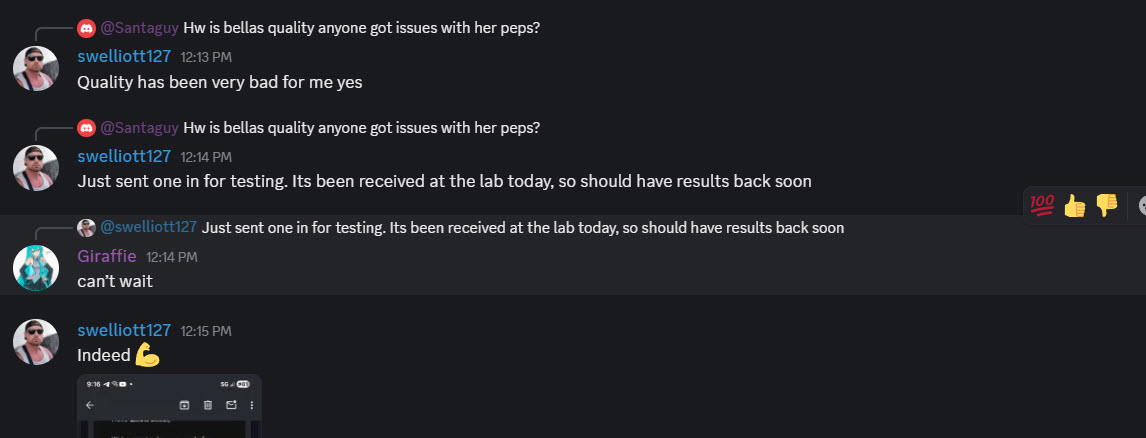
This was the same customer who, asked directly whether Bella’s quality was any good, had answered “Quality has been very bad for me yes” and put a vial in for independent testing — the sequence that precedes every removal here.
He then signed off, correctly predicting his own removal:
And after members called the admin’s “no COAs” line “a complete lie… and dangerous,” the viewer was timed out for roughly seven days in the vendor’s own testing channel.
The scapegoat
Cornered, the admin who does all the talking disowns the product entirely. It is the move that makes the whole structure work: the “vendor” never speaks, and the person who does claims to have no connection to what is sold.
Iteration two: Peptide University, and the group-buy machine
The same period, the same people, a bigger vehicle. Peptide University is a paid membership whose Patreon markets itself as “not hype, not trust me bro, not vendor marketing” and, per its live join page, runs roughly 350 paying members at about $12 to $75 a month. That positioning is the opposite of what the logs show the operation to be.
In June, Mr. Based opened a store and began taking group-buy orders. Members paid directly into his personal crypto wallet. His own instructions: “you send directly to my exodus wallet address”; “Open cashapp… put my wallet address. Hit pay.” He stated plainly that he controls the money end to end: “I host, handle payments, and forward orders and funds.”
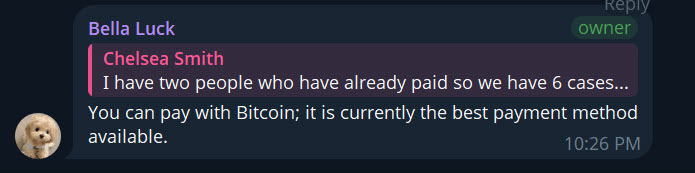
Alongside that, Mr. Based insisted he profits nothing: “I make zero on sales. Z.E.R.O.” Members rejected it: “Mr based didn’t sell at cost guys he made good profit” and “If u think he did all this to make Cpl bucks per kit ur deluded.” It is the same “I make nothing, this is for the community” script Eric ran for Bella, from a second operator.
And Eric was not a bystander here. In the Peptide University group he posts the Patreon group-buy announcements, calls Mr. Based “Bossman,” and during the collapse identifies himself as the one who sourced the vendor: “I was the one who found the lab… I had never personally purchased from them before.” His “just an admin, I make nothing” claim from the Bella logs is, on this evidence, false. He co-ran the group buys.
Follow the money
This is the part the operators could not talk their way around, because it sits on a public ledger.
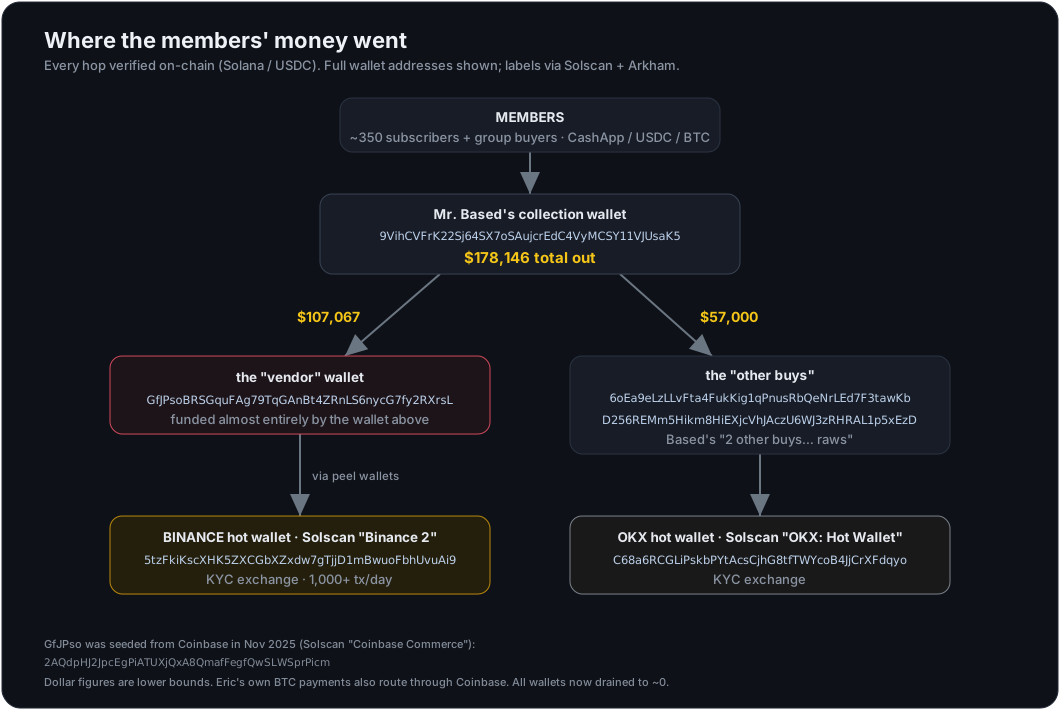
The group’s collection wallet is the Solana address Mr. Based handed members, 9VihCVFrK22Sj64SX7oSAujcrEdC4VyMCSY11VJUsaK5. Across 363 transactions it pushed out $178,146 in USDC, more than the roughly $150,000 members were later told was at stake. Where it went:
- $107,067 to
GfJPsoBRSGquFAg79TqGAnBt4ZRnLS6nycG7fy2RXrsL, the wallet Mr. Based himself pointed members to as “the vendor’s.” From there the money moved through a set of low-activity pass-through wallets and into Binance. The endpoint,5tzFkiKscXHK5ZXCGbXZxdw7gTjjD1mBwuoFbhUvuAi9, is labeled “Binance 2” by Solscan, indexed as Binance by Arkham, and processes over a thousand transactions a day — the signature of an exchange hot wallet. - About $57,000 to two more addresses —
6oEa9eLzLLvFta4FukKig1qPnusRbQeNrLEd7F3tawKbandD256REMm5Hikm8HiEXjcVhJAczU6WJ3zRHRAL1p5xEzD— that both funnel toC68a6RCGLiPskbPYtAcsCjhG8tfTWYcoB4JjCrXFdqyo, labeled “OKX: Hot Wallet” by Solscan. This is the money Mr. Based waved off as “2 other buys for someone else… raws.” On-chain it bought nothing; it deposited to OKX. - A further roughly $13,000 left the collection wallet for a third address that, instead of reaching an exchange, ran through high-volume DEX/swap hubs and dispersed there — routed through swap infrastructure, untraced. That leg, with small residual transfers, accounts for the remainder of the $178,146.
- The “vendor” wallet itself was seeded from Coinbase — its first funding was a small transfer from an address Solscan labels “Coinbase Commerce,” in November 2025. Separately, a payment screenshot shows Eric sending Bitcoin through a Coinbase custodial withdrawal, the same exchange.
Two facts about this flow matter. First, the money did not vanish; it off-ramped at three regulated, KYC exchanges. Second — and this is the part worth slowing down on.
Why an American exchange trail is the tell
The important fact about this money is not merely that it reached exchanges. It is which exchanges, and what that implies about who can actually control the accounts.
Coinbase. The “vendor” wallet, GfJPso, was born from a Coinbase transfer. Coinbase is a US-regulated exchange that has never operated in mainland China and blocks Chinese residents at signup. Opening an account requires a government ID from a supported country and, for US users, a Social Security number and a linked US bank. A peptide lab physically in China cannot open a Coinbase account. So a “vendor” wallet seeded from Coinbase was funded by a Coinbase account holder — someone in the US or another supported Western country, not a Chinese manufacturer. Eric’s own Bitcoin payments, documented separately, route through the same Coinbase.
Binance and OKX. Both are the destinations here, and both are off-limits or heavily restricted to mainland-Chinese users. Binance formally barred mainland-China accounts in 2021 and geoblocks Chinese access; OKX, despite its Chinese origins, withdrew from the mainland retail market and enforces KYC that excludes Chinese residents. A vendor operating inside China does not, as a matter of routine, hold Binance and OKX accounts to receive Western buyers’ money and cash it out.
What a real Chinese vendor’s money actually looks like. The grey-market supply chain out of China runs on a specific, well-documented set of rails, and not one of them is a Western KYC exchange. Payment comes in as USDT on the Tron network (TRC-20) — cheap, fast, and the default unit of account for Chinese over-the-counter trading. It is then settled through Chinese OTC desks and Telegram “guarantee” marketplaces (the Huione-style markets) that convert crypto to RMB and move it into Alipay, WeChat Pay, or Chinese bank accounts. That entire architecture exists precisely to avoid venues like Coinbase, Binance, and OKX — because those venues are exactly where a Chinese operator gets frozen and identified. A six-figure flow that instead originates from Coinbase and re-consolidates into Binance and OKX is the photographic negative of that pattern. It is what money looks like when a US-based person is moving it through the only accounts a US-based person can readily open.
Stated plainly: the chain does not, by itself, prove who owns the exchange accounts. But it says, loudly, that this money behaved like a domestic operator’s and nothing like an overseas lab’s. The honest caveat is that KYC-for-hire exists — verified accounts can be rented, and a sophisticated Chinese operation could push funds through a Western mule. So this is strong, converging, circumstantial evidence, not a fingerprint on a wallet. And the thing that converts it to proof is the same as everywhere else in this story: the KYC records sitting behind those Coinbase, Binance, and OKX accounts.
In their own words: the “vendor update”
When the group buy collapsed, Mr. Based posted a long “vendor update: the good, the bad, and the ugly” to the group. It is the single most useful document in the file, because it confirms, in his own words, the things the rest of this investigation had to assemble from screenshots and a blockchain.
Bella was their vendor. He opens with the history: “For our May group buy, we worked with a known vendor named Bella. She was excellent to work with… The May group buy was completed successfully, everyone received their products.” There it is, from the operator himself. “Bella” and Peptide University are the same operation. The group ran on Bella in May, then switched vendors for June. The two “vendors” in this article are two vendors of one machine.
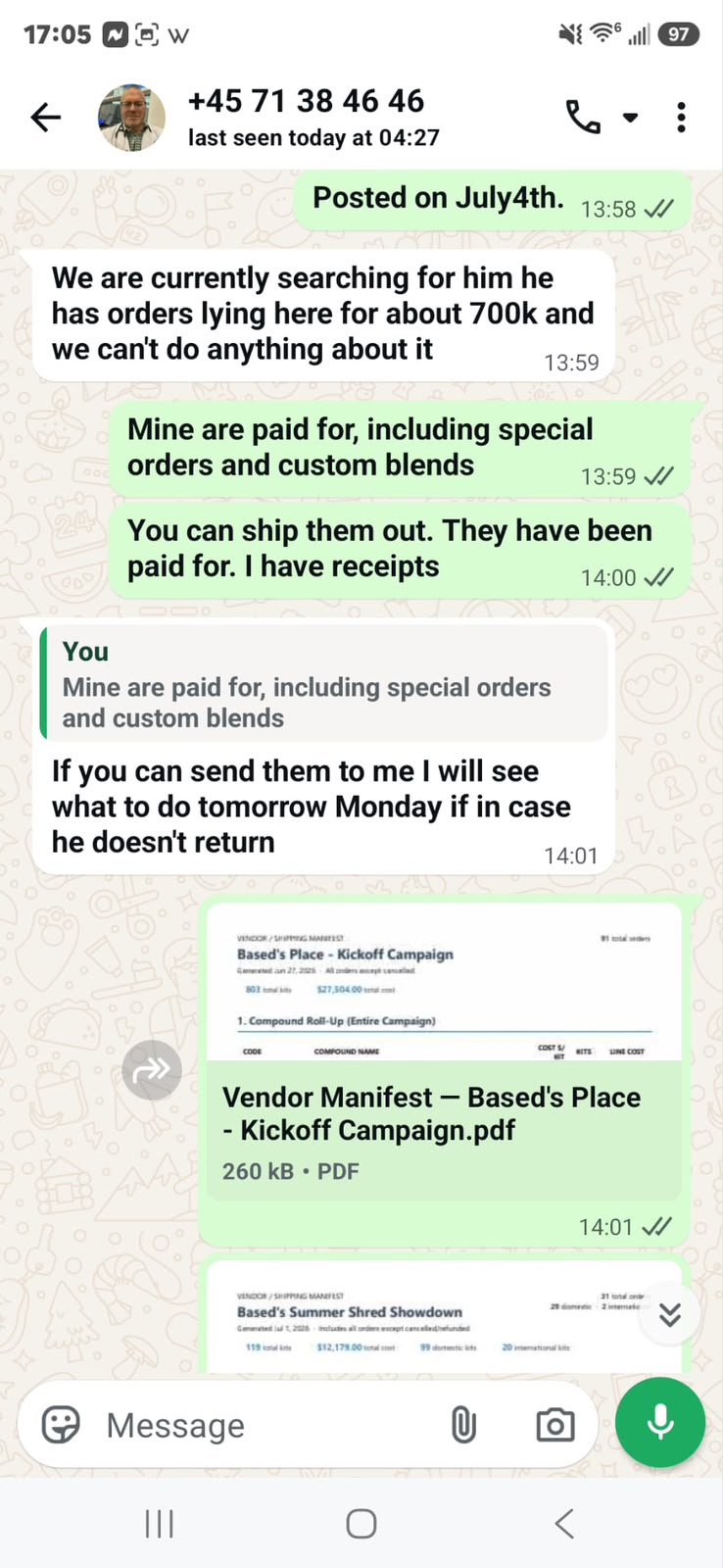
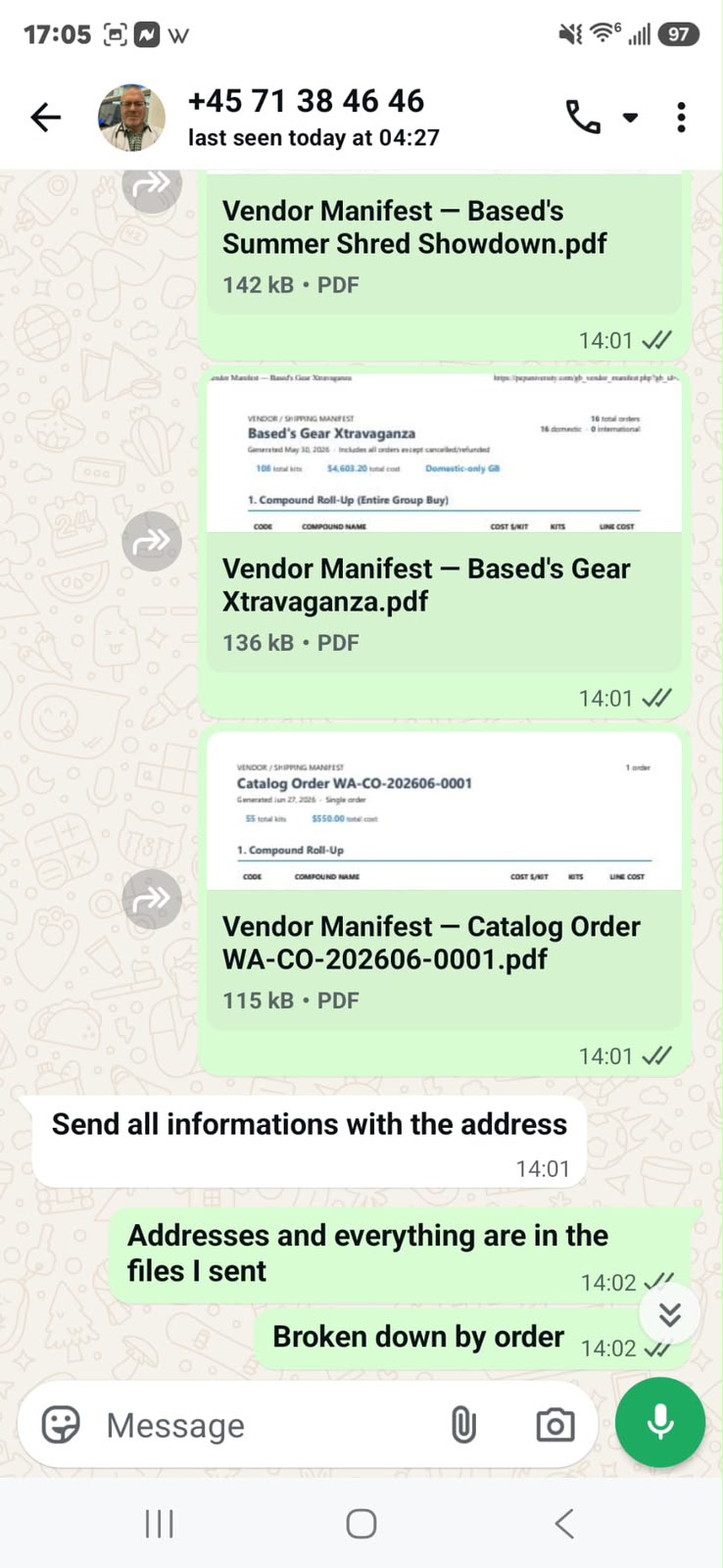
Eric picked the next one. “Eric then volunteered to research other laboratories… He reviewed approximately 10 different vendors, narrowed the list down to a few options, and ultimately selected Rx Anabolics.” The promoter who spent the spring vouching for Bella is the same person who sourced the vendor that took the June money. Not a bystander — the buyer’s agent, choosing from ten interchangeable vendors.
The vetting was theater. He describes his diligence: “We placed four separate test orders, increasing in value from approximately $500 to $5,000. We also contacted eight randomly selected members of their WA group who confirmed that they had successfully placed and received orders.” Set that beside the fact that Rx Anabolics had already been publicly flagged as a scam in December 2025. A vetting process built on small test orders that clear and testimonials from “eight randomly selected members” is exactly the manufactured social proof this playbook runs on. The small orders arrive; the six-figure one does not.
The NDA is the whole trick, and it is backwards. He frames the nondisclosure agreement as protecting recipes: “Rx Anabolics also agreed to sign a nondisclosure agreement… The primary purpose of the NDA was to prevent online vendors and resellers from selling our custom products.” Eric described the same document as “an NDA, Non Compete and Non Circumvent all in one.” Read that again. Members were asked to wire six figures to a laboratory they were contractually forbidden from seeing, verifying, or contacting directly — a non-circumvent clause exists precisely to stop buyers from going around the middleman to the source — and it was sold to them as protection.
It is nonsense on every level. There is nothing to protect: a peptide “blend recipe” is a list of known compounds at known doses, not a trade secret. There is nothing to enforce: no one is taking an anonymous Chinese grey-market lab to court over a breached NDA. The document accomplishes exactly one thing, and it is the one thing a fake vendor needs — total opacity. Members could not check the lab, could not reach it, could not audit a single certificate against it. Then, when it all fell apart, that same opacity became the alibi: in Based’s own words, “How are you going to call shit in on a warehouse that you don’t know the location of?” and “This isn’t my lab, nor my warehouses… Think they gave me a fucking tour?” The NDA he was proud of getting signed is the reason no one — including, allegedly, him — could ever locate the people holding the money. That is not a protection. It is a blindfold, handed to the members, with a bow on it.
The warehouses were never his. Earlier, Based told the group “I have warehouses in the US, UK, Aus, and China.” In the update, the same warehouses belong to the vendor: “I went back to Chen and asked about inventory at their United States, United Kingdom, and Australian warehouses… He provided inventory sheets, shipping manifests.” The possessive quietly moved from “I have” to “their,” and the inventory sheets he had shown members as proof turn out to have been handed to him by the party that took the money.
The $5,000. “Yesterday, I received a message from Smith Anabolics… He then told me that I would need to pay an additional $5,000 for him to process the existing orders.” That demand is in the images he attached — the same advance-fee squeeze, on top of six figures already paid, that the WhatsApp record captures.
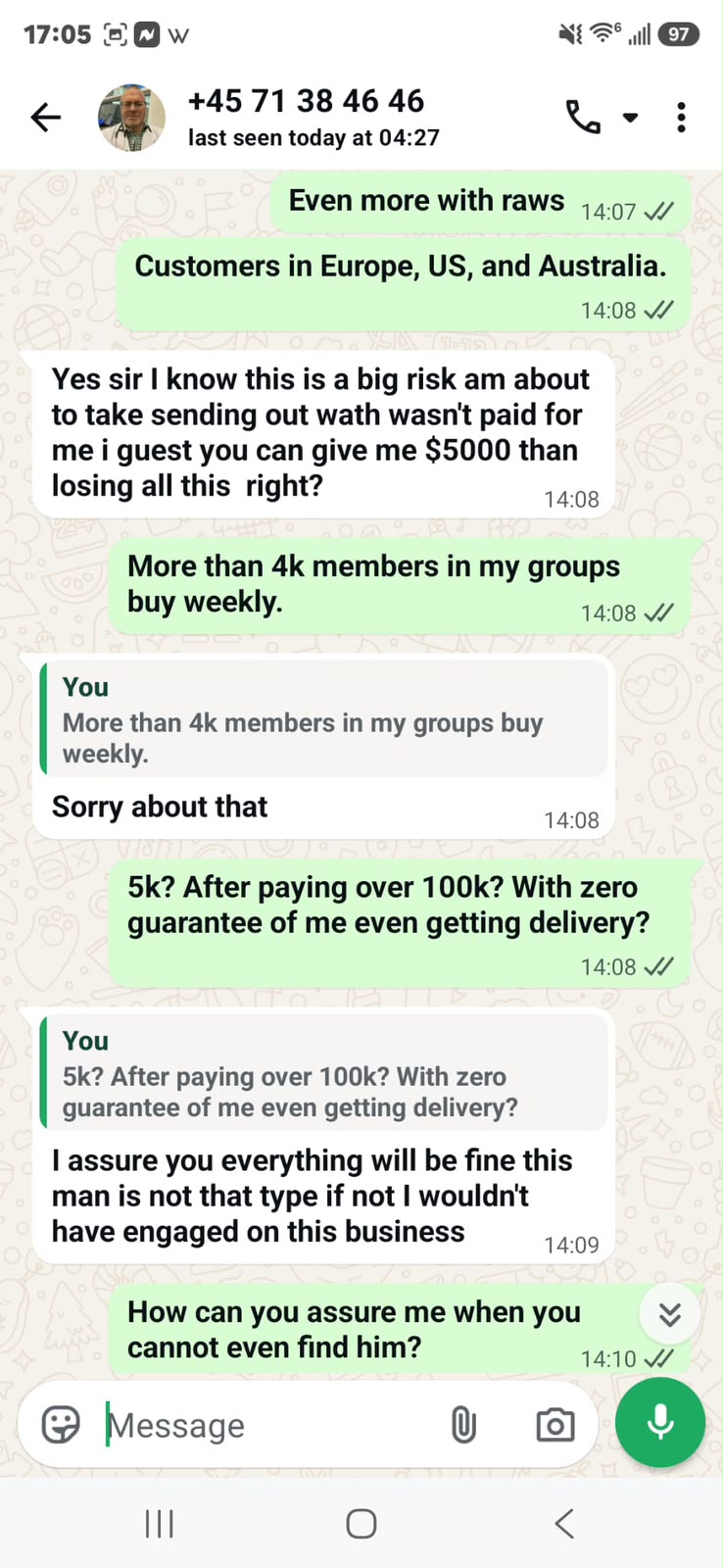
The rest of that exchange is the whole scam in one conversation. The buyer states the total — over $150k across four orders, zero delivery — and that he was removed from the group for asking. The vendor confirms the goods are sitting there, worth “over $50k,” and then, instead of shipping what was already paid for, asks for more.
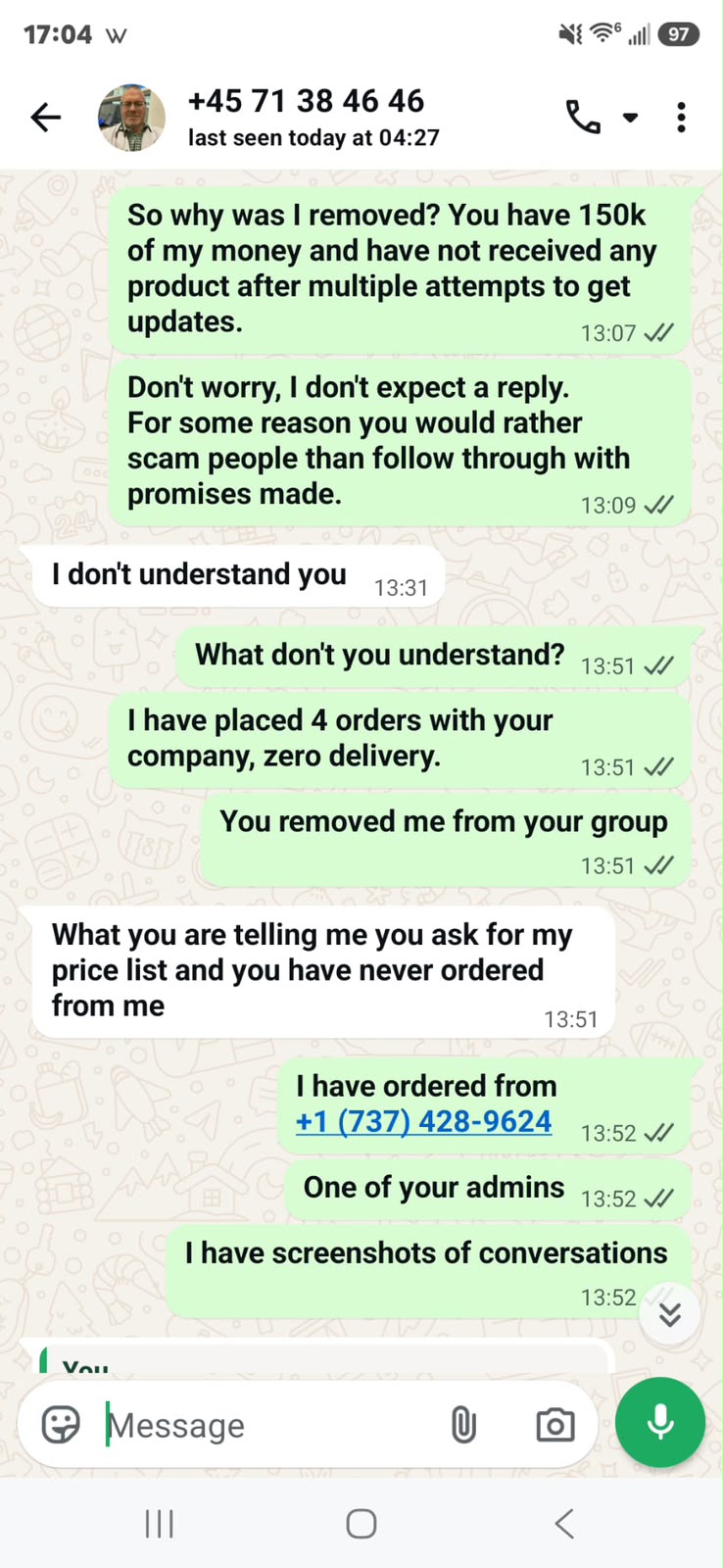
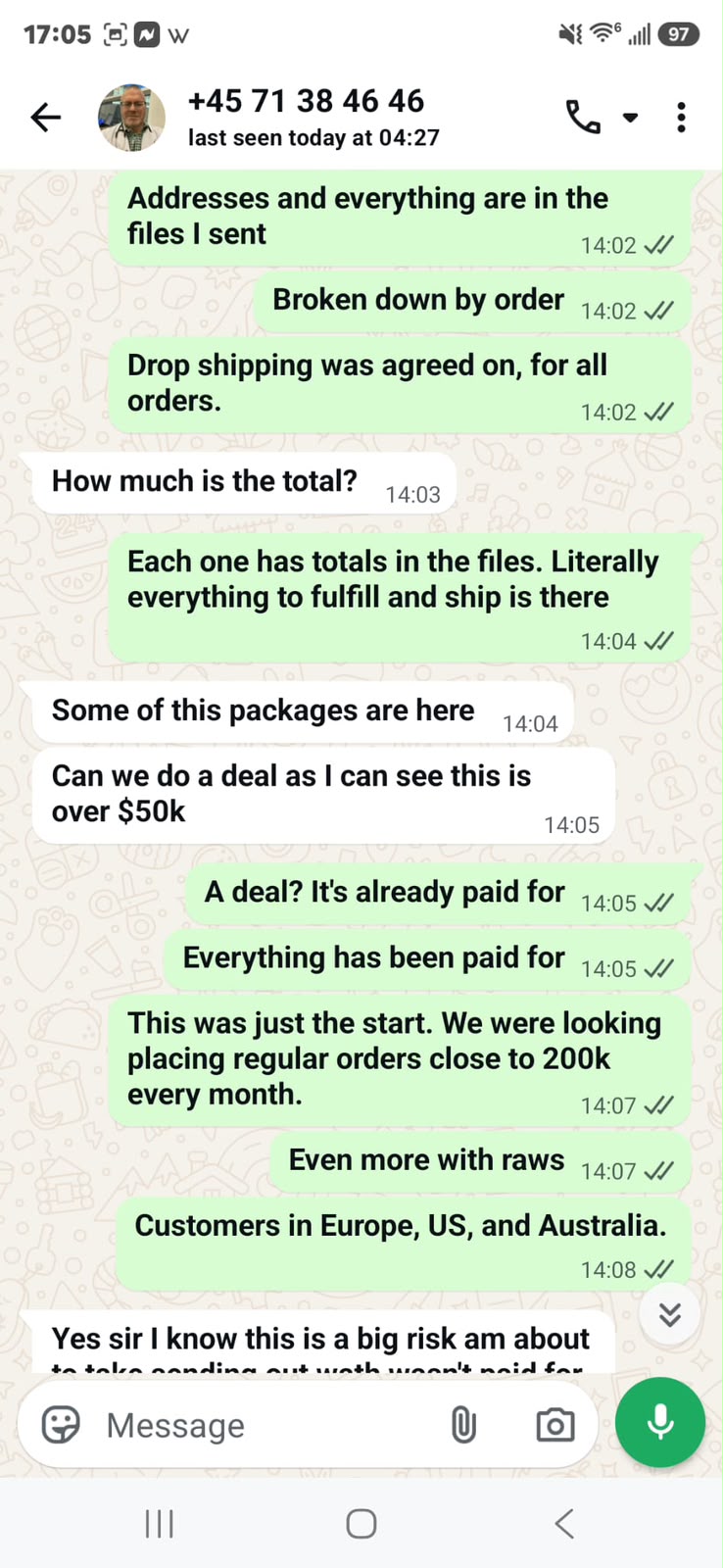
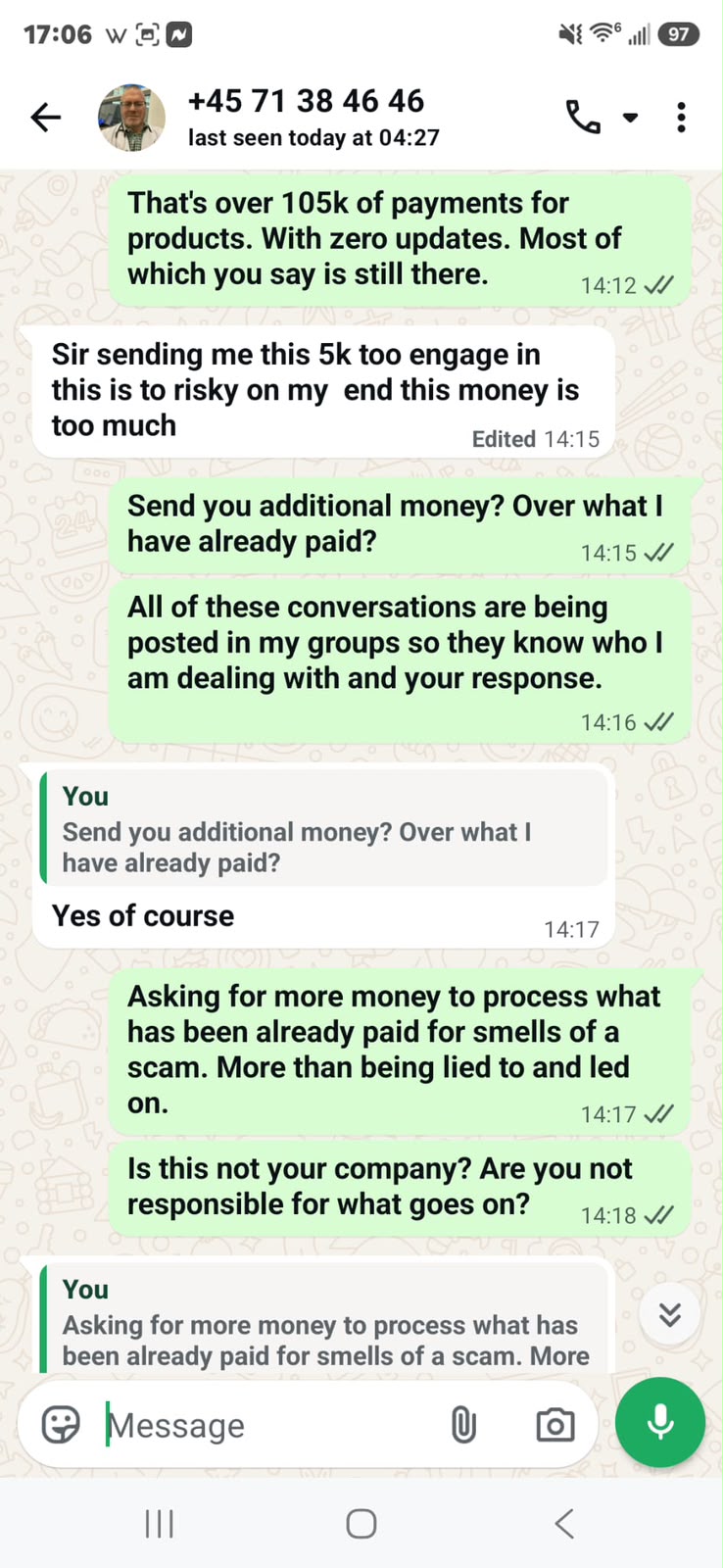
And already, the next vendors. The update ends not with a refund plan but with a sales pipeline: another vendor to “take over fulfillment and provide volume discounts in the range of 20 to 30 percent,” a California lab, and a China lab “being launched by a British owner” that will “provide live streams of its testing.” One vendor had just burned down with the members’ money inside it, and the machine was already pairing the next ones.
The update, in full
Every passage above is pulled from a single post. Because it is the operator’s own account, in his own words, here is that “vendor update” reproduced in full — nothing added, nothing removed. Read it against the blockchain trail and the screenshots and decide for yourself.
Primary document · Mr. Based's post to the group, reproduced verbatim and in full
Vendor update: the good, the bad, and the ugly
It is time for a complete update on what has been happening with the vendor we selected.
Let me start with some backstory. For our May group buy, we worked with a known vendor named Bella. She was excellent to work with, but she would not ship certain products internationally. The May group buy was completed successfully, everyone received their products, and it was time to begin planning for June.
For June, we wanted to do something no one else had done. We wanted to create custom blends beyond Tri-Heal. We presented the idea to Bella, and she took it to her lab. Unfortunately, the lab could not accommodate the request because of its production backlog and the availability of raw materials. Their own production was given priority over ours, which was completely understandable.
Eric then volunteered to research other laboratories that might be able to work with us. He reviewed approximately 10 different vendors, narrowed the list down to a few options, and ultimately selected Rx Anabolics.
We had already been speaking with Rx Anabolics for several months before making that decision. We placed four separate test orders, increasing in value from approximately $500 to $5,000. We also contacted eight randomly selected members of their WA group who confirmed that they had successfully placed and received orders. Most of those customers were located in the United States, but one was in Canada and another was in the Netherlands.
After that research, we had an extensive conversation with our primary contact, Richard Chen. We agreed on pricing, production requirements, and expected timelines. Rx Anabolics also agreed to sign a nondisclosure agreement preventing them from disclosing the blend formulations or selling those formulations to other vendors.
The primary purpose of the NDA was to prevent online vendors and resellers from selling our custom products. At that time, only one laboratory had the recipes.
In the beginning, communication was impeccable. We had daily conversations whenever needed leading up to the June group buy, followed by regular production updates once the orders had been submitted.
Looking back, should we have waited until production was further along before opening the group buy to everyone here? Yes, we should have.
At the same time, I was trying to fill a product void within the group. I went back to Chen and asked about inventory at their United States, United Kingdom, and Australian warehouses. He told me that the warehouses received weekly deliveries to keep them fully stocked. He provided inventory sheets, shipping manifests, and other supporting information. From a distance, everything appeared legitimate and properly organized.
Based on those representations, I built an application to manage transactions, payments, reporting, and the other administrative requirements involved in running the group buys. It took me approximately three weeks to get the system working correctly. Once it was ready, I opened orders to the group.
Communication with the laboratory remained good through the end of the first group buy. The situation began to change during the second and third campaigns.
That was when the excuses started. Messages went unanswered, updates became inconsistent, and frustration continued to grow for everyone involved. Eric and I were both sending daily requests for information. Eric also contacted the three other administrators in the Rx Anabolics group, but none of them responded.
Approximately two weeks ago, Chen suddenly replied and provided the status update that I previously posted here. Everyone saw the explanations and reasons that were given for the delays. After that update, communication stopped again.
Eric and I were then removed from the Rx Anabolics group. I sent messages to both Chen and another administrator seeking an explanation and an update.
Yesterday, I received a message from Smith Anabolics asking why I was bothering him. He then told me that I would need to pay an additional $5,000 for him to process the existing orders. The complete conversation is available in the attached images.
That brings us to where things stand now.
Eric and I are actively speaking with other vendors to determine what can be done to fulfill as much of the outstanding volume as possible. We are discussing whether another vendor can take over fulfillment and provide volume discounts in the range of 20 to 30 percent.
I have also been speaking with two labs directly.
The first is a United States based lab that supplies products to both medical spas and RUO resellers. That introduction came from a member of this group named Mike. I have already tagged him in a post in the General channel.
The second is a lab in China that is being launched by a British owner. The Chinese lab is expected to open in approximately four weeks and plans to provide live streams of its testing and manufacturing processes.
The US laboratory is named PepSolutions and is located in California. They are partnered with Pyxis Biologics. One of their largest clients is Applied Biological Materials. The company will not publicly identify its RUO clients. They have standard peptides in stock and will provide domestic and international drop shipping on our behalf. Unfortunately the lab does not manufacture anabolic products. A separate connection is currently being developed with another United States UGL that works with this lab.
There is your update.
The vendor was already a documented scam
The “vendor” Eric selected has more than one name. In Mr. Based’s own update, the primary contact is “Richard Chen” and the party that later demands more money signs as “Smith Anabolics”; the operation itself is RX Anabolics. A victim-advocate channel that tracks grey-market scams had catalogued what members identify as the same seller under a different stack of aliases — “Supercell peptides,” “Leo Chen,” “Rx anabolics source,” “Jetro” — and, per members in the Peptide University group, had been warning about it since December 2025, months before Peptide University wired it six figures.
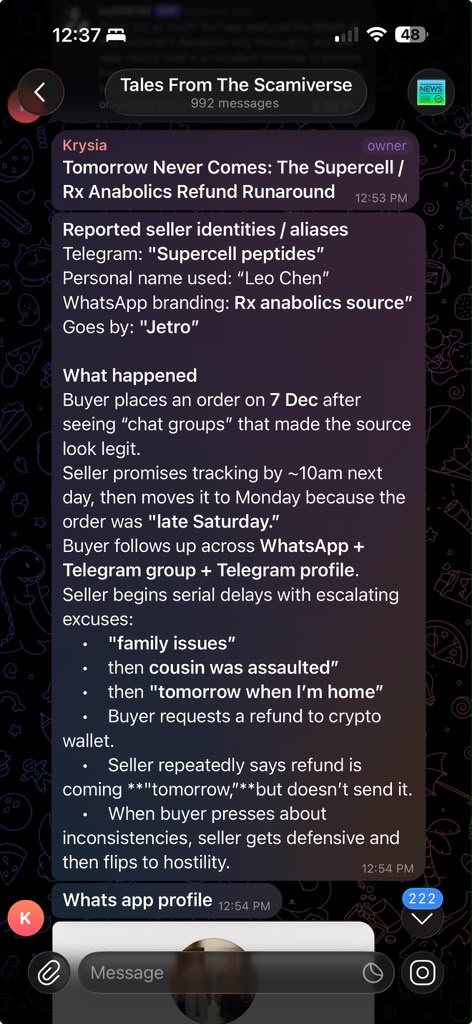
Its method with earlier victims is the one Peptide University then experienced at scale: take payment in crypto, promise tracking “tomorrow,” invent a barrier when pressed (“all payment goes to my crypto wallet in my work computer”), and, when the buyer keeps pushing, accuse them of being a competitor’s plant and go silent.
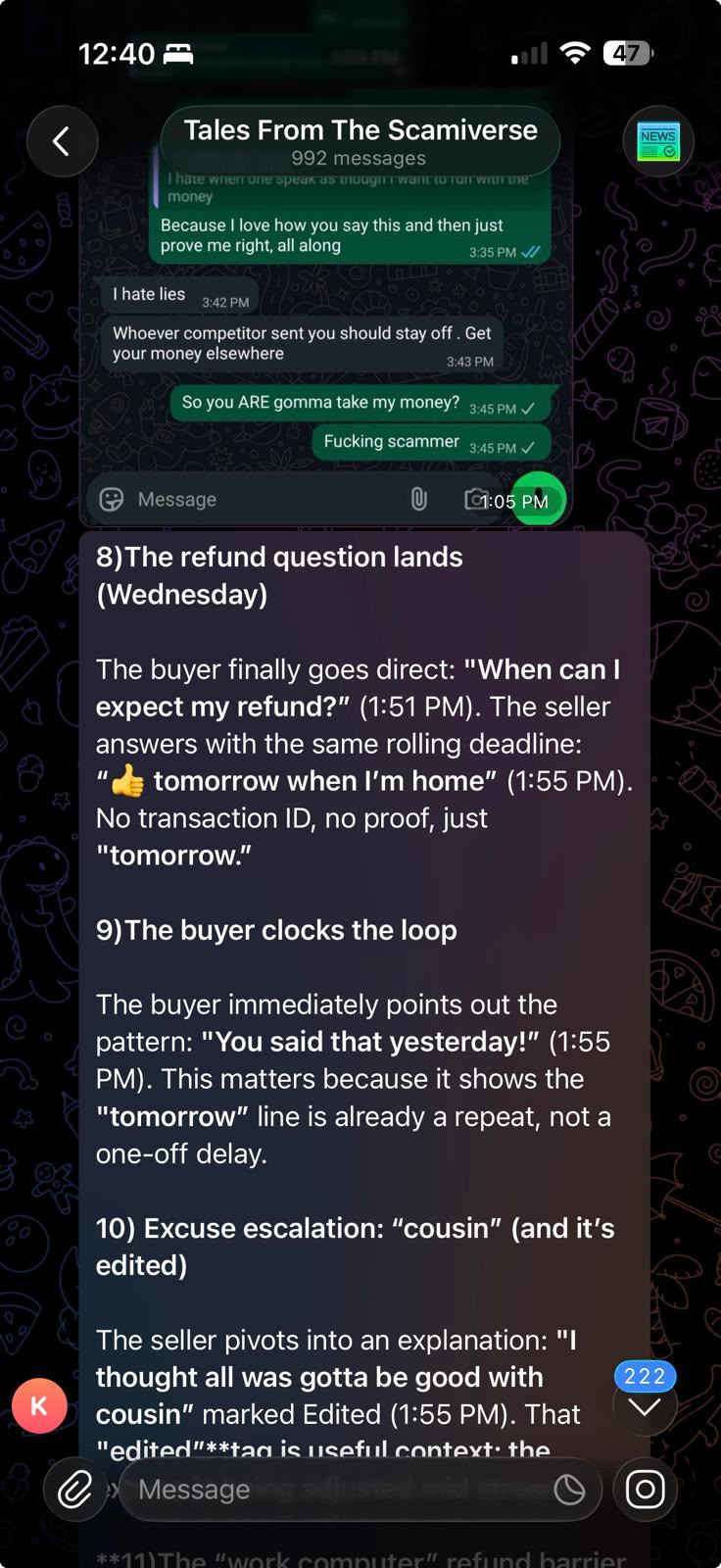
None of this was hidden. It was searchable. An operation advertising “validated vendors” either did not look, or looked and proceeded anyway.
The $150,000 heist
By mid-July the group buy had failed and the members were out roughly $150,000 in aggregate, individual losses running from a few hundred dollars to several thousand. Strip away the vendor names and the warehouse story and what is left is a heist, structured so that when the money vanished, the people who had collected it stood among the victims. Members had wired six figures to an “NDA lab” no one could verify, sourced from a vendor that was a published scam seven months earlier, paid into a wallet the organizer says he “never checked… never did that with any vendor.”
Then the retreat, exactly as before: reframe the operators as fellow-victims, and turn the defrauded members into a posse hunting the “vendor.” But the on-chain address count contradicts the story. Mr. Based described one vendor and one lab, singular, throughout. The group’s collection wallet fanned the money to at least four distinct destinations across two exchanges. He branded the operation “my own lab” and “I have warehouses in the US, UK, Aus, and China,” then, after the collapse, denied ever claiming ownership: “not once did I say that… this isn’t my lab, nor my warehouses.” The four claimed warehouses shrank to two, then to a member’s flat statement that there was no warehouse in Australia at all.
The pattern, stated plainly
Set the two side by side and they are the same machine. Both vendors are unverifiable by design — one a rarely-speaking “Bella” fronted by American admins, the other an “NDA lab” nobody was allowed to see. Both are vouched into trust by the same promoter, Eric, who tells buyers the vendors are interchangeable and pipes them to Mr. Based’s Patreon. Both defend the vendor through every failure and ban the people who document it. Both route the money through a never-seen principal. And both end the same way: the vendor did it, the middleman vanished, nothing to be done, and a longtime member is on hand to remind everyone that “it’s an assumed risk.”
The vendor is the disposable part. That is the point of the design. When one name burns down — Bella’s reputation, or RX Anabolics’ — the promoters are insulated, the admin “just works here,” the principal was “just an admin,” and the next vendor is already being paired in the Patreon.
If you were scammed by a group buy like this
Start with how the money moved, because it decides what you can do about it. A grey-market “group buy” takes everyone’s payment — crypto, CashApp, Venmo, PayPal — into one organizer’s personal wallet, pools it, and forwards it on. Here, roughly $178,000 flowed out of Mr. Based’s own Solana wallet into a “vendor” wallet and then into deposit addresses at Binance and OKX, and that vendor wallet had itself been funded from Coinbase. What that means matters: the money did not disappear into an untraceable void. It off-ramped at exchanges that know their customers.
That is the crack in the whole scheme. Coinbase, Binance, and OKX all collect government ID and respond to law enforcement, and the deposit addresses your money reached are sitting on the public blockchain right now. You can’t unmask an account holder yourself — but a prosecutor holding those addresses can, and can move to freeze and trace the funds. Your job as a victim is to hand someone a finished trail.
If you’re out money, in order:
- Preserve everything before it disappears. Screenshot the chat, the order, and the payment (transaction hashes, CashApp/Venmo/PayPal receipts), and save the wallet addresses and the sellers’ handles and phone numbers. These groups delete fast and remove the people who ask questions.
- File an FBI IC3 complaint at ic3.gov with the wallet addresses, amounts, dates, and the operators’ handles, and note that the funds off-ramped at Coinbase, Binance, and OKX. IC3 aggregates victims of the same scheme — the more of you who file, the more traction it gets.
- Report to the exchanges and the regulators. Use the exchanges’ law-enforcement / compliance channels, file with the FTC (reportfraud.ftc.gov), and — because misbranded, unverified injectables are involved — the FDA, plus the state authorities where the sellers operate.
- Claw back anything reversible. If you paid by credit card, PayPal, or Venmo, open a dispute or chargeback immediately; those can be reversed in a way crypto cannot. (This is exactly why a “vendor” that takes only crypto, or friends-and-family, is a warning sign.)
- Do not pay a cent more. The “send $5,000 and I’ll release your order” demand is a second scam stacked on the first. Paying again buys nothing.
- Make it public. These operations survive on private, moderated chats where warnings get deleted and whistleblowers get kicked. Put the addresses and the evidence somewhere they can’t control.
And treat this as a pattern, not a one-off. The same operators shepherd people from group to group as each vendor “rugpulls.” Members here had migrated from a previous group that exit-scammed, and the vendor they were steered toward had been publicly flagged as a scam months before their money went in. The churn is the business model, and the accountability ultimately sits at the exchanges: every dollar here off-ramped at a regulated, KYC venue, and the identities behind those accounts are knowable to law enforcement. If they resolve to the operators, this was self-dealing; if to a genuine third party, the operators still funneled six figures of other people’s money to a known scammer through a structure designed to keep anyone from checking. Either way, the trail does not end in a void. It ends at doors that can be opened.
If you buy in this market
- Verify every COA at the lab’s own site, never a PDF. Reject any look-alike domain.
- Reject any COA that names a different vendor, has no batch or lot ID, or cannot be pulled up on the lab’s site by ID. No batch ID means no valid test.
- Treat referral-gated discounts and “message someone for your own branded COA” as red flags, not perks.
- Be suspicious of a vendor that never speaks while an admin who “doesn’t work there” does all the selling.
- Avoid friends-and-family, PayPal, USDT-to-a-personal-wallet, and pay-one-point-of-contact group buys. These are the rails every confirmed scam here used.
- A vendor that bans the people asking for lab reports has answered your question.

Discussion (0)
Anonymous, instant, lightly moderated. Be factual — this page names real people. No links; comments with phone numbers or emails are held for review.