- What happened. STAT News reported on June 23 that the FDA and Eli Lilly granted one unnamed patient early access to the unapproved weight-loss drug retatrutide through the compassionate-use pathway.
- The patient. Reported as a 79-year-old man with refractory obesity, sleep apnea, and pulmonary hypertension, whose doctor advised against bariatric surgery.
- The speculation. Trump turned 80 on June 14 and used the same pathway in 2020, which fueled guessing that he was the patient. The White House flatly denied it. The identity is not confirmed.
- Why it spread. A senator asked whether a single well-connected person got a highly sought drug for free while millions cannot get in.
- Why it matters here. The real story for buyers is the access gap. When the only legal route is a trial almost nobody can enter, people source grey-market retatrutide of unknown purity and dose. That is exactly what a certificate of analysis is supposed to pin down.
A community-news explainer. This is a plain-language summary of reporting by STAT News and others, not original investigation. We report the disputed parts as claims and attribute them, we treat the patient’s identity as unconfirmed, and we keep the drug pharmacology factual. The point of interest for our readers is the access gap, not the politics.
What actually happened
On June 23, 2026, STAT News reported that Eli Lilly and the FDA quietly granted a single, unnamed person access to retatrutide through the FDA’s expanded-access pathway, the program usually called “compassionate use.”
Expanded access is a real and longstanding FDA route. In one sentence: it lets a patient with a serious or life-threatening condition receive an investigational drug outside a clinical trial when there is no good approved alternative, provided a treating doctor requests it, the manufacturer agrees to supply it, and the FDA authorizes it.
According to STAT, the request was filed by Dr. Ranganath Muniyappa, a senior NIH clinician, on behalf of a 79-year-old man diagnosed with refractory obesity, obstructive sleep apnea, and pulmonary hypertension. The reporting says Muniyappa advised against bariatric surgery given the patient’s age and other conditions, Eli Lilly agreed to provide the drug, and the FDA authorized the request. STAT attributed the account to three people who spoke anonymously, citing fear of reprisal.
That is the core of what was reported. Everything after it is either disputed or unconfirmed, and we flag it as such.
The part that is unconfirmed
The detail that turned a regulatory story into a viral one was the patient’s age. Trump turned 80 on June 14, 2026, meaning he was 79 in April when the access was reportedly granted. He had also used this same compassionate-use pathway once before, in 2020, to receive Regeneron’s monoclonal antibody cocktail during COVID. That combination, the matching age and the prior use of the pathway, was enough to set off speculation that he was the mystery patient.
The White House denied it. Spokesman Kush Desai posted on X that the application “was not for the President,” and dismissed the STAT reporter, Lizzy Lawrence, in personal terms. Lawrence said she had asked Desai, the FDA, and HHS directly and repeatedly whether the patient was Trump before publishing, and that no one answered. When STAT asked whether Trump had obstructive sleep apnea or pulmonary hypertension, Desai pointed to Trump’s most recent medical evaluation; STAT reported that neither condition appears in that document.
It is worth stating plainly: a coincidence of age plus a prior use of the same pathway is not proof, and there is an explicit denial on the record. The honest summary is that the patient’s identity is unknown.
Some outside clinicians did raise a separate, narrower question, which is about the bar rather than the name. Jamy Ard, chief science officer at Advocate Health, told STAT that compassionate use is typically reserved for terminal illness or for conditions facing a very long or marginal path to approval, and that obesity with these comorbidities is an unusual fit. The matching ClinicalTrials.gov listing is also unusually sparse, with no condition, no eligibility criteria, and no location given.
Why the story spread beyond politics
Senator Maggie Hassan sent a letter to HHS Secretary Robert F. Kennedy Jr. asking whether the administration had used the compassionate-use pathway to hand a “highly anticipated medication” to a single well-connected individual, for free, while millions of Americans remain locked out. Eli Lilly’s response, as reported, was that it makes these decisions “following all applicable regulations.”
You do not have to take a side on who the patient was to see why that question landed. The friction is the same either way: there is one legal door, it is very narrow, and almost no one can walk through it.
What retatrutide actually is
Retatrutide is Eli Lilly’s investigational obesity drug. It is a triple agonist, meaning it activates three receptors at once: GLP-1 and GIP (the two incretin targets behind drugs like semaglutide and tirzepatide) plus the glucagon receptor. The community nickname for it is the “Godzilla” of weight-loss drugs because of how strong the trial results have looked.
The figures cited in the reporting are roughly 24 to 28 percent body-weight reduction over about 72 to 80 weeks, a range people associate with bariatric surgery. Treat those as reported trial results for an unapproved drug, not as an approved label, and remember that individual results vary.
The key fact for anyone reading this hoping to get it: retatrutide is not FDA-approved for anything. As of mid-2026 it is still in clinical trials, and trial enrollment is essentially the only legal way to obtain it. Most people cannot enroll. We keep the published trial summaries alongside the independent lab data on our retatrutide research and testing hub.
The access gap is the real story
Here is where this stops being a news item and becomes relevant to what TitrateLab tracks.
A drug that produces surgery-level weight loss, with no approved version available, and one legal access route that almost nobody can use, creates enormous pent-up demand. That demand does not evaporate. It moves to the grey market, where retatrutide is sold as research-use-only powder. The mystery-patient story is, at bottom, a single dramatic illustration of the gap that pushes ordinary people toward unregulated vials in the first place.
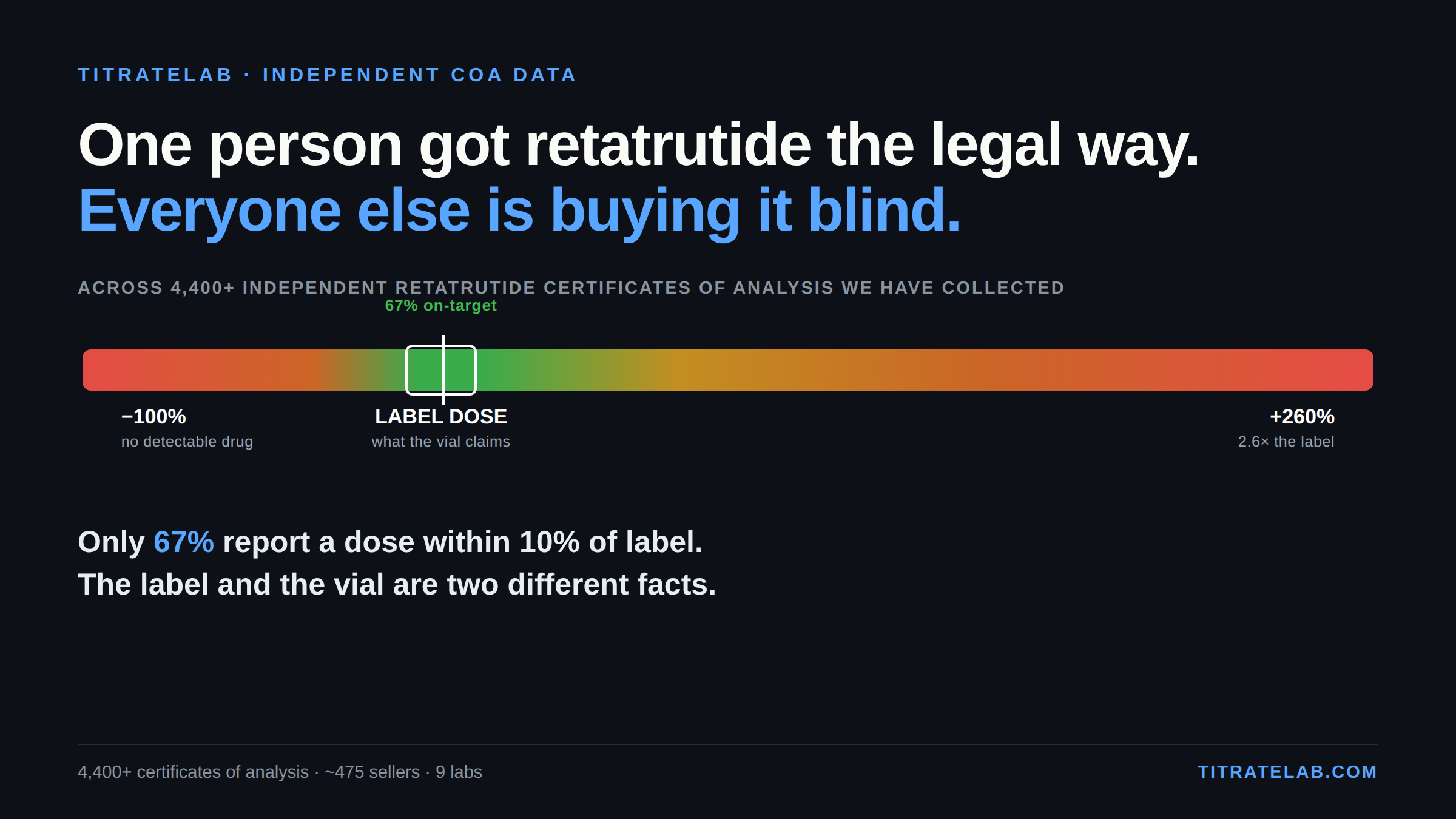
The problem with grey-market supply is not the molecule, it is the uncertainty around what is actually in the vial. There is no approved manufacturer, no label you can trust, and no guarantee that the powder is the right peptide, at the right amount, free of contamination. This is not hypothetical. Across the more than 4,400 independent retatrutide certificates of analysis we have collected from roughly 475 different sellers, only about two-thirds of the ones that report a measured dose came within 10 percent of label. The rest ran the full spread, from vials with no detectable retatrutide at all to vials that came back at more than double the label, and those extremes are not community guesses: they come from independent lab testing. With grey-market retatrutide, the dose on the label and the dose in the vial are two separate facts, and only one of them can be measured.
That measurement is the whole point of a certificate of analysis. An independent lab test tells you three things the label cannot: identity (is this actually retatrutide), purity (how much of it is the intended peptide versus byproducts), and fill (how many milligrams are really in the vial). Across the grey-market peptide space, independent testing keeps surfacing wrong-dose and wrong-identity vials. That is not a reason to panic, and it is not a sales pitch; it is just the one verifiable safety layer available when the regulated path is closed.
What this means for you
- Do not read the headline as confirmed. One patient got early access. Who it was is unknown, and there is an on-the-record denial. Hold the news and the speculation in two separate hands.
- Understand why you cannot legally get retatrutide. It is investigational and unapproved. A trial is the only sanctioned route, and the compassionate-use pathway is a rare exception that, by design, is not open to the general public.
- If you source grey-market retatrutide, the vial is the variable, not the molecule. Unknown identity, purity, and fill are the real exposure. Whatever else you do, verify a batch against an independent certificate of analysis before assuming the label is true.
- The access gap is the story, not the politics. The reason one person getting a vial early made headlines is the same reason a grey market exists at all: a drug this effective with a door this narrow.
Sources
- STAT News, original report: https://www.statnews.com/2026/06/23/eli-lilly-unusual-weight-loss-drug-trial-compassionate-use-retatrutide-trump/
- STAT News, follow-up on the Hassan letter to RFK Jr.: https://www.statnews.com/2026/06/25/senate-hassan-questions-rfk-jr-eli-lilly-retatrutide-trial-trump/
- MS NOW, White House denial: https://www.ms.now/news/white-house-trump-weight-loss-drug
- MS NOW, Hassan letter: https://www.ms.now/news/maggie-hassan-retatrutide-patient-white-house
- ClinicalTrials.gov listing: https://clinicaltrials.gov/study/NCT07629401
Research and education only, not medical advice and not a dosing protocol. This article summarizes third-party reporting; the patient’s identity is unconfirmed and the connection to any named individual is reported here as speculation met by an official denial, not as established fact. Retatrutide is an investigational drug and is not FDA-approved. Grey-market retatrutide is research-use-only material of unverified quality.
