The fear is getting shorted: paying for 10mg, injecting 6. In all 12 compounds we checked, more vials run over the label than under.
The fear that sends a grey-market peptide buyer hunting for a scale and a certificate of analysis is getting shorted: paying for 10mg and injecting 6. The data says that fear is mostly backwards. We collected 22,588 certificates of analysis and pulled the 15,167 that report a measured dose against the label. In every compound we looked at, the vials that miss the label miss it by running over, not under. We did not run these assays. Independent labs did. We collected them, parsed them, and counted.
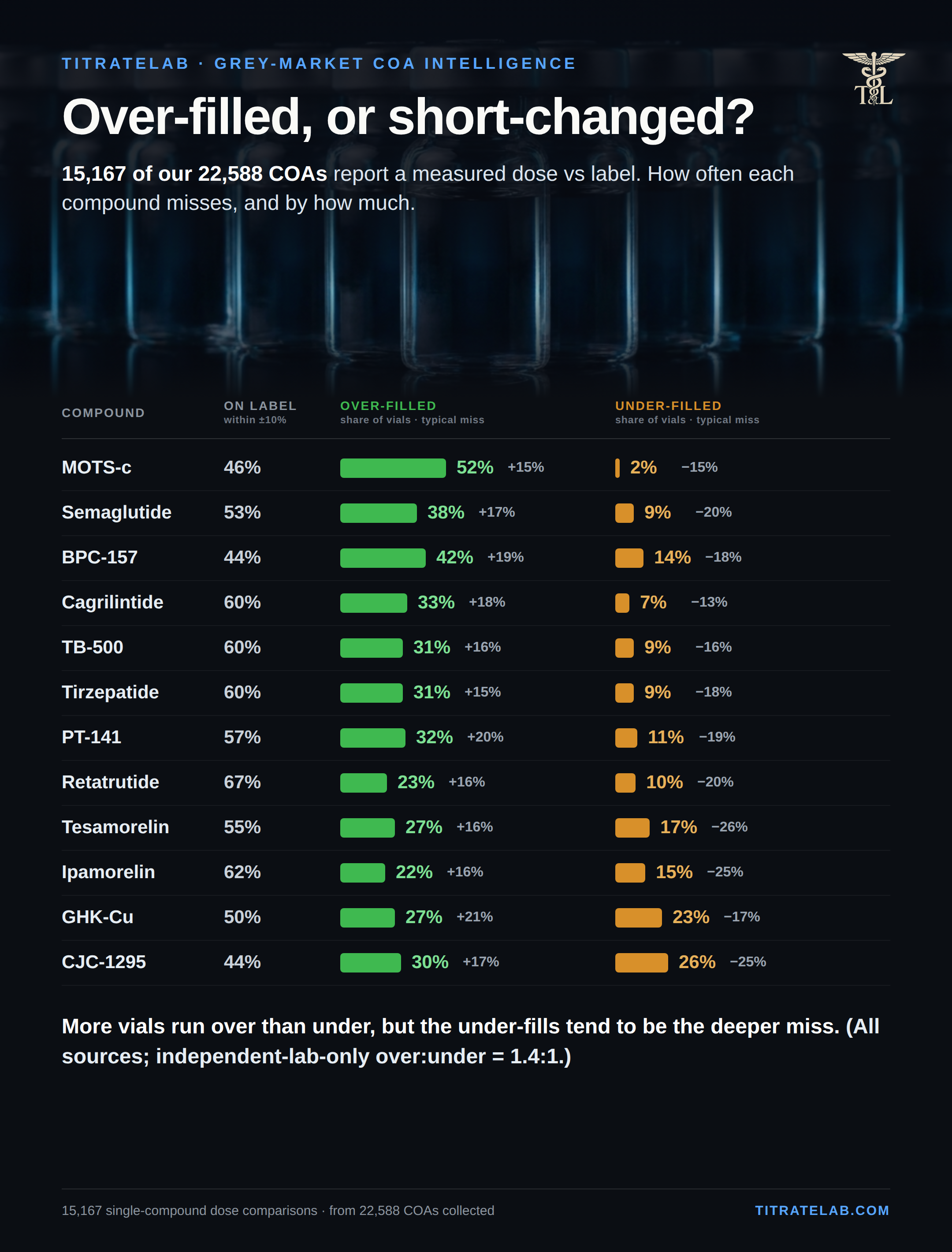
- The label is a starting point, not a fact. Of 22,588 collected certificates, 15,167 carry a measured single-compound dose against the label. The most common outcome is not on-label and it is not short. It is over-filled.
- Over-fills are common and shallow. When a vial runs over, the typical miss is 15 to 21 percent above label, depending on the compound. A nuisance for a careful titration, rarely dangerous on its own.
- Under-fills are rarer but deeper. When a vial comes up short, it tends to be short by more. The worst median under-fills reach 25 to 26 percent below label on tesamorelin, ipamorelin, and CJC-1295.
- The compound sets your odds. Retatrutide is the cleanest in the set, with 67 percent of vials within 10 percent of label. CJC-1295 is the messiest: only 44 percent on label, and 26 percent of its vials run short.
How we measured this, and the one caveat that matters
TitrateLab does not run assays. We collect certificates of analysis that independent labs produce, mostly Janoshik and Finnrick, with smaller volumes from MZ Biolabs and from community submissions. Each certificate reports, among other things, how much of the labeled compound the lab actually found in the vial. We parse that figure, store it as a percent deviation from the label, and aggregate it. Out of 22,588 certificates collected, 15,167 carry a usable single-compound dose-versus-label number. That is the set this article counts.
Here is the caveat, stated up front rather than buried at the bottom: a certificate of analysis is only as honest as whoever decided to publish it. A vendor can pay for several tests and post the one that came back generous, so a corpus that mixes vendor-published certificates with independent results tilts toward over-fill. Over-fill is the flattering miss. Short fills quietly stay in private chats.
The flattering number vs the honest one
Over-to-under, before and after you remove vendor-curated certs
↑ the cut a vendor could not choose to publish — closer to the truth
We can measure that tilt instead of waving it away. Pooled across every source, over-filled vials outnumber under-filled ones by about 2.6 to 1. Restrict the count to independent-lab certificates the vendor did not get to curate, and the ratio falls to 1.4 to 1. The real picture is closer to the second number, so read everything below knowing the pooled figures lean optimistic. We publish the prettier number and the truer one side by side. That choice is the whole point of the corpus.
Most vials over-fill, which is the opposite of the fear
Walk the chart below and the pattern holds without exception. In all twelve compounds, the green over-filled bar is longer than the amber under-filled one. Ranked cleanest to messiest, it doubles as a quality leaderboard: retatrutide lands on label most often, CJC-1295 least.
Per-compound, all sources pooled
Which way the vial misses
Share of vials over the label (green, right) vs under the label (amber, left), as a percent of all measured vials. The number at right is the share landing within 10% of label. Ranked cleanest to messiest.
For a buyer, the direction of the error is not academic, because the label is what you do dose math against. A grey-market vial arrives as lyophilized powder marked, say, 10mg. You reconstitute it, you draw what the label says is 2.5mg, and you inject. If the vial is over-filled by 17 percent, you did not inject 2.5mg. You injected closer to 2.9mg, and you have no signal that anything is off. For a GLP-1 that you are titrating slowly to keep nausea and gut side effects manageable, a quiet 17 percent overshoot is a faster ramp than you agreed to. For a research peptide it is overage you cannot bank on, because the next vial may not repeat it.
Over-fill is the gentler failure, and it is plausibly not an accident. In a market with no required testing, nobody has an incentive to under-fill on purpose, and a vendor who builds in overage ships a vial that tests well and a customer who feels a strong effect. But generous is not the same as accurate, and a dose you cannot predict is still a dose you cannot control.
Over-fills are shallow. Under-fills are deep.
The two directions of error are not mirror images. When a vial runs over it clusters in a narrow band: the typical over-fill ranges from 15 percent on MOTS-c and tirzepatide to 21 percent on GHK-Cu. When a vial runs short it tends to run further from the label, from a 13 percent median under-fill on cagrilintide at the shallow end to a 26 percent median on tesamorelin at the deep end. The rare miss is the bigger miss.
Median miss, by direction
Over-fills cluster shallow. Under-fills run deep.
Where the typical miss lands relative to the label across the twelve compounds. Over-fills sit in a tight band just above label; under-fills spread wider and reach further below it.
The hazard is not the average. It is the spread. A market that over-filled every vial by exactly 15 percent would be trivial to dose around: you would draw a little less and move on. What you actually face is a label that may be wrong by an unknown amount in an unknown direction, anywhere from a quarter short to a fifth over. You cannot dose precisely against that, and a batch that runs from near-empty to over-label cannot be dosed safely at any single setting, because you do not know which vial is in your hand until a lab tells you.
The cleanest compound, and the two messiest
The averages hide how much the compound matters. The high-demand injectables dose tightest, the older research peptides run loose, and the gap between the best and worst in the set is more than 20 points of on-label share.
Retatrutide
Cleanest in the set
CJC-1295
Messiest · worst short-fill share
Tesamorelin
Deepest under-fill
Retatrutide leads the set because it has the most buyers, the most independent testing, and the most competitive pressure to get the fill right, and it shows. CJC-1295 is the opposite end: only 44 percent of its vials land on label and 26 percent run short by a median of 25 percent, the worst short-fill share in the data. Tesamorelin is the deepest cutter, a 26 percent median on the vials that come up short. BPC-157 lands on label only 44 percent of the time too, but its misses skew over, so the failure mode there is overshoot rather than shortfall. If you buy CJC-1295 or tesamorelin, the printed milligrams are the least trustworthy number on the vial.
What this means if you are the one dosing
- Assume the vial is off, and assume off means over. Your label math is more likely undercounting the drug than overcounting it. Treat the printed dose as the vendor’s claim, not as the amount going into your body.
- The danger is variance, not direction. A steady 15 percent over you could plan around. An unknown miss somewhere between 25 percent short and 20 percent over you cannot. That is why a single certificate on a clean batch does not make the next batch clean.
- Let the compound set your caution. Retatrutide and tirzepatide dose tighter than CJC-1295 and tesamorelin. Weight how hard you verify by what is in the vial.
- A purity number is not a dose. Ninety-nine percent pure says the molecule is right. It says nothing about how many milligrams are present. Read the quantity line, not just the purity headline. We took that gap apart in our piece on pharma standards versus the grey market.
- One cert proves one vial. Dose accuracy is a property of the batch, and the only batch that matters to you is yours.
On a grey-market vial, the dose on the label and the dose in the vial are two different numbers. You paid for the first one. Only the second one goes into your body, and the only way to learn it is to read a certificate from a lab that had no reason to flatter the seller. Look up the vendor and the batch you are about to buy in our COA corpus, and run any certificate you already hold through the free COA verify tool before you draw a dose. The label is a claim. The assay is the fact.
Research and education only, not medical advice and not a dosing protocol. TitrateLab does not test peptides; we collect, parse, and aggregate certificates of analysis produced by independent laboratories and submitted by the community. Figures are computed from 15,167 single-compound dose-versus-label certificates out of 22,588 collected, as of June 27, 2026. The per-compound figures pool all sources and lean optimistic for the reason stated in the methodology; the independent-lab-only cut narrows the over-to-under ratio from about 2.6 to 1 down to 1.4 to 1. See our methodology. If we have a figure wrong, the contact link is in the footer, and we correct the record.
