On July 28, 2026, a grey-market peptide and steroid vendor told roughly 35,000 Telegram subscribers that their prices would now depend on whether they had posted public reviews. The post has been viewed 13,981 times.
From now on, promo prices will look different depending on who you are. Call it a loyalty discount. Call it a tax for the ungrateful. or whatever helps you sleep at night.
A few lines later:
I don’t need your private message “thank you”, I need something public that help us grow ! Forums, reddit, TG groups, discords, i don’t care.. Reviews that brings more customers .. !
The vendor is QSC, Qingdao Sigma Chemical, one of the larger suppliers in this market. Orders run through a sales persona called “Tracy”, who traded for years under the photograph of a Chinese actress and later conceded in a published interview that the avatar was “useful packaging” rather than fandom. The person on the other end of the chat was, in part, a construction. The grammatical errors in its quotes are QSC’s own, preserved throughout. Its stated reason for the surcharge was that customers had gone quiet: “And yet… crickets. Almost no public feedback. No reviews. No love on the forums.”
That premise is false, and it is checkable. In the thirty days before that post, QSC’s vendor thread on the MESO-Rx forum carried 382 posts from 128 distinct accounts, on 30 of 30 days, including at least twenty favourable reports from people saying their orders had arrived. The thread was running at about three times its own lifetime rate. Seven weeks earlier, on June 8, that same forum had permanently banned QSC as a source. Not over reviews. A signed administrator post says QSC published information that let third parties reconstruct a complaining customer’s home address, and disclosed the customer’s crypto payment address along with it.
Here is the part that makes this worth writing about, and the reason the headline is a question rather than an accusation.
Across 100 lab certificates that QSC did not commission and did not pay for, its product came back at a median 99.72% purity, with nothing below 93.9% and nothing at zero. Measured against vendors of comparable size, its worst result in three and a half years is better than almost all of theirs: four of them have sold vials that failed an identity test outright, meaning the compound inside was not the one on the label. It tests across ten independent laboratories while three of the vendors with better headline averages have never published a test they did not order themselves. And it sells at roughly a quarter of what Western retail brands charge for the same molecule.
So the vendor caught pricing its own reviews is also, on the evidence, one of the better-tested and cheaper suppliers in this market. That is the uncomfortable shape of this story, and it is why we went looking for the case in Tracy’s favour before finishing the case against him. There is a real one, and it is stronger than we expected.
There is also what it does not cover. Three disappearances in sixteen months, a cohort of customers from December 2024 still unrefunded, a $7,500 order abandoned mid-negotiation, and the ban above. The answer this piece arrives at is that the chemistry has earned the benefit of the doubt and the conduct has not — and that the failure people keep describing as a review scandal is really a trust-and-support failure with a review campaign laid over the top of it.
The distinction we are drawing is not incentive versus no incentive. It is whether the payment depends on what you say. QSC's did. Ours does not. We will not pretend the line is perfectly clean: our credit requires a photo, which is a content condition of a kind, and it is redeemable only against our own store, which is a retention mechanism as well as a thank-you. Readers can weigh that. What we do not do is pay more for praise, or charge more for silence.
Reader poll
Does Tracy deserve a break?
Unscientific poll of site visitors. One vote per browser, not verified.
Vote now if you like, or read on and vote after. The poll stays open either way, and the tally is hidden until you answer so it cannot lean on you.
Nine months of escalation before the surcharge
Read only the July 28 post and this looks like a bad week. The vendor’s own channel says otherwise. We archived all 520 surviving messages, November 2024 through July 2026, and the policy escalates in a straight line.
October 2, 2025. QSC is working through a backlog of missing tracking numbers. Buried at the end of an otherwise operational post:
The system demands feedbacks whenever you’re active (forums, discords, TGs…). Your silence is unhelpful.
November 11, 2025. Now the ask has something behind it. A stock announcement notes that customers order but rarely post, then:
so you still have some time to do some fair feedbacks because I have some HGH 40IU kits coming very soon and you might need that feedback link 😉
November 13, 2025. Two days later, the policy arrives with a number on it. This is the document, and it is eight months before the “tax” post:
As I told you before, many of you made multiple orders in the past 3 months, so for the buyers who shared their feedbacks in the Meso Rx Forums, will get a $15/kit discount, once you place your order, share the link for your feedback. The Feedback should be an honest feedback, from the recent purchases, with ETA for delivery, communication, what time you got tracking, packaging, a picture of goods will be nice too.
Three things happen in that paragraph. QSC prices the discount: $15 per kit on a $180 kit, roughly 8%. It specifies the review’s content: delivery ETA, communication, time to tracking, packaging, ideally a photograph. And it requires the buyer to send QSC the link to claim the discount, which means QSC reads and approves the review before the money moves.
The word “honest” appears in that post and in every later version of the scheme, and it can carry less weight than it seems to. A review can be entirely truthful and still be written to a specification, for a discount, by someone who knows the vendor will read it before paying. Truthfulness and independence are different properties. The first was requested. The second was structurally unavailable.
By July 28, 2026, the same idea had inverted. Instead of paying for a review, QSC charged for the absence of one.
The crickets claim, counted
QSC’s vendor thread on MESO-Rx runs to 4,509 pages at twenty posts a page, about 90,162 posts since October 2021. We fetched pages 4460 through 4509 contiguously, which gives complete unsampled coverage from June 6 to July 30, 2026.
For the thirty days immediately before the surcharge announcement, June 28 to July 28:
| Measure | Value |
|---|---|
| Posts | 382 |
| Distinct accounts posting | 128 |
| Days with at least one post | 30 of 30 |
| Busiest single day | 39 posts |
| Posts reporting an order outcome | 66 |
| Favourable received-order reports | at least 20, from about 18 accounts |
| Complaints | about 10 |
These are counts, not a sample: we retrieved every post in the window. The thread averaged 18.2 posts a day across the captured span, against a whole-life average near 5.3.
A few of them, all before the announcement:
- July 13: “I’ve placed three orders since the switch to QSC 2.0. Communication was very fast, and I received a tracking number within 24 hours. All orders arrived quickly and complete.”
- July 20: “Touchdown usa domestic npp. Landed 8 days after payment.”
- July 26: “Just to leave another review: I ordered from the EU warehouse. After payment, I received the tracking number within 2 days, and the package arrived in 5, 6 days.”
The factual basis for the surcharge does not survive its own vendor thread. QSC withdrew the claim itself, nineteen hours later, on July 29: “Alright, I’ll admit it—I was wrong. Yesterday’s flood of feedback caught me off guard. Turns out, you are willing to speak up.”
The archive contains no post rescinding or modifying the pricing policy.
The ban QSC does not mention
QSC’s account of what went wrong on MESO-Rx is that the forum turned on it over reviews. The dated record inverts that.
On June 8, 2026, at 08:22 EDT, a MESO-Rx administrator posted a signed notice in QSC’s own vendor thread, seven weeks before the surcharge announcement:
After reviewing the evidence, staff has concluded that this source committed one of the most serious customer-safety violations possible: the public disclosure of information that enabled the identification of a customer’s exact residential address. This was not a case of “soft doxxing.” … The combination of address fragments, ZIP code information, tracking details, map imagery, neighborhood geography, and other location-specific clues allowed third parties to reconstruct and identify the customer’s exact residence within minutes with minimal effort using publicly available tools.
Additionally, the source publicly disclosed the customer’s cryptocurrency payment information, including the USDC/ERC-20 payment address associated with the transaction.
Effective immediately, the source is permanently banned. This action is not being taken because of a shipping dispute or a disagreement over an order. It is being taken because the source engaged in severe and dangerous doxxing of a customer.
Set that against QSC’s own opening post in the same thread, from October 14, 2021:
the security of our customers is also a priority, which is why we are committed to protecting your identities
We are reporting the forum’s finding as the forum’s finding. We did not review the underlying screenshots, which appear to have been removed. What is documented is the notice: signed, dated, still in place, and seven weeks ahead of the review dispute QSC says caused everything.
The forum rule is a disclosure rule
The cleanest fact in this story is the one nobody involved is arguing about, because it was published six months before the surcharge.
MESO-Rx’s terms of service, §6, prohibit content that “Constitutes spam, shilling, astroturfing, coordinated campaigns, or incentive-driven posting.” On January 29, 2026, the forum published a dedicated policy, “Customers Are Not Advertising: Why Coordinated Posting Is Not Allowed.” It draws a distinction that matters:
Incentivized reviews are different because they involve one person’s opinion rather than manufactured consensus. When a member receives something in return such as a refund, discount, free product, store credit, or other compensation, that relationship must be clearly disclosed… Incentivized posts are only acceptable when the incentive is fully disclosed. Posting on behalf of a source without disclosure violates forum rules.
So the forum did not ban paid reviews. It required them to say so. A member who had written “QSC gave me a $15/kit discount for this review” would have been inside the rules. None of the burst posts carried any such line, and nothing in QSC’s nine months of review-solicitation posts ever asked a customer to include one.
That is the whole reframing, and it costs QSC its best argument. A compliant path existed. It was published in January, in plain language, in a thread anyone could read. QSC did not take it and did not tell its customers it existed.
The forum’s own July 30 notice makes the same point from the other side, and is careful about the customers:
MESO-Rx has never prohibited members from sharing positive experiences with a source. Nor has it prohibited honest reviews. What MESO-Rx prohibits is sources using customers as an undisclosed substitute for advertising.
Some participants in these campaigns inevitably respond by saying: “My review was honest.” Staff has never suggested otherwise. An honest statement can still function as undisclosed advertising. … The question is not whether a shipment actually arrived. The question is why the post was written.
The community caught it live
Within about half an hour of the Telegram post, forum members were describing what was happening to their own thread. At 16:33 EDT, one wrote:
Almost looks like bot accounts coming in for reviews, or people doing it to help promote the oils and get business back. In the last 30 minutes, QSC has had more positive reviews than I saw for them in the month prior. And almost every single one of them uses the same words / talking points.
At 18:25, another flagged it to staff: “heads up this source is incentivizing public reviews by giving discounts to reviewers, so you’ll be seeing a bunch of shill posts.”
The pushback deserves as much space, because it is a fair point and the moderators later conceded it. At 19:03 a member objected:
you can’t just automatically assume every post acknowledging successful receipt of an order is a ‘shill post’ - go through the history, I personally acknowledged positive experiences with QSC over the years. This isn’t something new because of an incentive.
He is right, and it is the reason the disclosure rule exists in that form. Once a vendor announces that public praise moves the price, honest reviews and solicited ones become indistinguishable from the outside. The damage is not that a particular review was false. It is that no reader can tell any more.
Thirty-two hours: the Denmark edit, then the exposure
QSC has a published rule about seizures: when an order is seized in a country, that country loses its reship guarantee. From May 23, 2026:
we had the first seized EU domestic order to Finland, so there will be no reship policy to this only EU country.
All other EU countries have guaranteed delivery.
On July 26, 2026, at 01:31 UTC, at the bottom of a routine stock post:
Denmark have no reship policy starting from now.
Thirty-two hours later, at 09:36 UTC on July 27, QSC published a four-message album about a named customer, accusing him of being “a lying ungrateful [nationality redacted by TitrateLab] buyer who is a reseller and who was spreading rumors about EU warehouse orders being seized, and claiming he no longer buys since he got a seizure which is a lie.”
That customer’s complaints, visible in QSC’s own screenshots, concerned seizures on the route to Denmark.
By QSC’s own published logic, withdrawing Denmark’s reship cover is an admission of the loss the buyer described. The withdrawal came first. The accusation of lying came second.
A second, quieter edit points the same way. QSC’s pinned announcement for its new order bot originally listed “Provide tracking numbers” among the bot’s functions. On July 26, QSC removed that line and added a condition: “Tracking number will only be sent if you have an existing conversation with me.” We captured the post before and after the edit and hold both versions. The buyer exposed the following day had complained in public that tracking from the new bot was slower than ordering directly. The vendor’s own silent edit corroborates him.
About the exposed buyer
We are not naming him, and we will not reproduce his handle, his business, his tracking numbers, his partial phone number, or anything about where he lives. That is not squeamishness. QSC masked the tracking numbers and the delivery address in its own screenshots, and left visible the things that actually identify a person: a Telegram display name and avatar, a profile bio, a link to a separate business he operates, and, in the fourth image, his MESO-Rx account with post numbers and dates. Whatever QSC believed it was publishing, what it published was a cross-platform identity linkage between a pseudonymous forum account, a named Telegram identity, and a commercial venture. In a market where buyers face legal exposure, that is the harm.
He is the target of retaliation here, not a subject of this investigation.
One merge would be easy and wrong. The customer in the June 8 doxxing ban was complaining about a missing order. The buyer exposed on July 27 was complaining about seizures. They may be two different people. The record does not settle it, and we are not treating them as one.
What QSC’s own evidence shows is narrower than its accusation. The tracking dashboard it published does show recent deliveries and parcels in transit, which rebuts the specific claim that the buyer had stopped ordering. It does not rebut the seizure claims, which were the substance of the complaint, and which nothing in the post addresses.
The bot-seeding we tested for and did not find
QSC’s Discord opened on July 28 and 29, 2026, immediately after the surcharge post, and QSC directed reviews there: “Our discord channel is open for reviews and touchdown feedbacks now, be wise.” A server filling with praise on the day a vendor starts pricing praise invites an obvious suspicion, and we tested it.
We measured QSC’s server against 33 other Discord servers over exactly the same 35-hour window, same capture path, same clock. Of twenty coordination metrics, only two fell more than two robust standard deviations from the peer median, and both dissolve on inspection.
The decisive test is not how many new accounts are present but whether new accounts carry the conversation. Seeded accounts have to talk; that is what they are for. QSC’s accounts under 30 days old were 9.7% of its authors and produced 4.3% of its messages, a ratio of 0.44 against a peer median of 0.41. They were quieter than the average participant, not louder. They lurk, which is what people who just made a Discord account to follow a vendor from Telegram actually do.
The rest points the same way. QSC’s daily rhythm is unremarkable, with a deep sleep trough between 06:00 and 14:00 UTC, which is night in the US timezone where most of its customers are. Duplicate content, the cheapest astroturfing tell, sits at the 12th percentile of the peer set. The reply graph is mutual rather than a set of parallel monologues, and no single account absorbs the conversation. The room argues with itself, including about the product.
We found no evidence of bot seeding, and we are not alleging it.
The limits are real. Capture began about fourteen hours after the main channel was created, so the opening hours are unrecoverable. We can see the 599 accounts that spoke, not the other 8,700 members who did not. We have no join events and no record of deletions, which means the one thing this data structurally cannot detect is whether complaints were posted and removed. A competent operation using aged, hand-driven accounts would be invisible to every measurement above.
But the negative finding is more interesting than the accusation would have been. Coerced real customers pass every test built to catch fake ones, because they are not fake. They bought the product, it arrived, and they wrote about it. The detection literature is built around finding accounts that do not exist. It has very little to say about accounts that do exist and were paid.
The complication: the product mostly tests fine
There is a version of this piece where the vendor turns out to be selling bad product and the review campaign is the cover-up. The lab record does not support that version, and we are not going to write it.
We hold 513 published certificates attributed to QSC. That number is inflated: the same physical tests appear repeatedly, and after deduplicating on Janoshik’s own task numbers, 513 rows collapse to 377 distinct tests. A quarter of QSC’s apparent certificate volume is re-publication. QSC posted one HGH assay to its own Telegram channel on eight separate occasions.
Strip out everything QSC or its customers handed us, keep only what our own independent scrape of the labs’ public listings produced, and 312 certificates remain. Then ask the question that matters: who chose the vial?
- 211 of those 312, or 68%, name QSC as the client. QSC ordered the test and paid for it, which means QSC selected the sample.
- The remaining 100 were commissioned by somebody else: 61 by buyers who paid Janoshik themselves, 39 by Finnrick, which buys product off the shelf.
Those 100 are the defensible set, and on purity they are good.
| value | |
|---|---|
| Median purity | 99.72% |
| Lowest result | 93.9% |
| Results at zero | none |
| Results below 90% | none |
That holds up under every cut, including the naive one. There is no hidden failure population in this corpus. If the thesis were “QSC’s purity numbers are fake,” the data refutes it.
Dose is where the picture changes, and the change tracks who picked the vial.
| Who commissioned the test | Tests with a dose figure | More than 10% under label |
|---|---|---|
| QSC | 136 | 3 (2.2%) |
| Buyer or Finnrick | 74 | 7 (9.5%) |
| Finnrick alone | 39 | 6 (15.4%) |
Fisher exact test, Finnrick against QSC-commissioned, at the 10% threshold: p = 0.0043.
The caveats ship with the number. Finnrick’s n is 39, which is small. Its coverage of QSC skews toward retatrutide, tirzepatide and GHK-Cu, large-milligram vials where a percentage underfill is easier to hit. And we compute the deviation ourselves from the printed label and tested quantity rather than lifting Finnrick’s own divergence headline, which is sometimes measured against a batch claim instead. The claim worth printing is not a precise multiplier. It is that underfills appear several times more often in vials QSC did not choose, and that the difference is statistically robust at this sample size.
One correction, because it is circulating. There is a certificate pattern in our corpus showing an HGH shortfall of about 62%. It does not belong to Qingdao Sigma Chemical. It belongs to Sigma Audley and Peptide Pole HK, which are different companies with a confusable name, and even there it is an artefact of a vial marked in international units being read as milligrams. Every QSC HGH certificate with a labelled dose in our corpus over-delivers, by a mean of about 16%. What is true, and defensible, is that QSC’s HGH runs at a mean purity of 96.86% against 99.26% for the rest of its line, a consistent gap of roughly two and a half points on every test we can verify. That is not fraud. rHGH is a harder analyte. It is a plausible seed for a complaint that then got expressed as a dosage allegation, which is a different thing from being one.
The shape of this, then: a vendor with a product that largely tests fine, spending money to buy the appearance of independent enthusiasm, then charging the customers who would not supply it.
Measured against its peers, the record is better than “fine”
Everything above is QSC judged against itself. That answers whether its numbers are honest. It does not answer the question a buyer actually has, which is whether they are good — and “good” only means something next to somebody else.
So we built a peer set: every vendor in our corpus with at least 200 certificates, ranked by how much of QSC’s 107-product catalogue they overlap. Two unattributed buckets were excluded, since they are collection artefacts rather than vendors. Counts here are raw for every vendor including QSC, so the comparison is internally consistent; QSC’s deduplicated figure of 377 physical tests is the right number for the section above and the wrong one for this one.
On averages, QSC loses.
| Vendor | Certificates | Mean purity | Labs used | Tests it did not commission |
|---|---|---|---|---|
| Alpha & Omega | 512 | 99.55% | 1 | none |
| Verified Peptides | 347 | 99.54% | 6 | 36 |
| Peptaris | 1,171 | 99.50% | 1 | none |
| Simple Peptide | 567 | 99.40% | 5 | 29 |
| Apex Peptides | 325 | 99.32% | 1 | none |
| Qingdao Sigma (QSC) | 523 | 98.96% | 10 | 39 |
That is last place among the vendors with clean records, and the much-repeated line that QSC has never posted a 0% result is less impressive than it sounds: five of the ten peers have never posted one either. On the metrics people usually quote, QSC is unremarkable.
The last two columns are why we did not stop there. Peptaris, Alpha & Omega and Apex Peptides — the three vendors beating QSC on mean purity — have never published a single test they did not commission themselves, and every one of them runs through the same single laboratory, Freedom Diagnostics. Between them that is 2,008 certificates, self-ordered, self-selected, one lab, no outside check. A vendor in that position does not need to falsify anything to produce a 99.5% average; it only needs to decide which vials to send and when to stop sending them.
That is not an accusation against those three. It is a statement about what their numbers can and cannot support, and the answer is: not much. A mean purity computed entirely from samples a seller chose is a measure of the seller’s selection, not of what arrives in the post.
Then look at the floor.
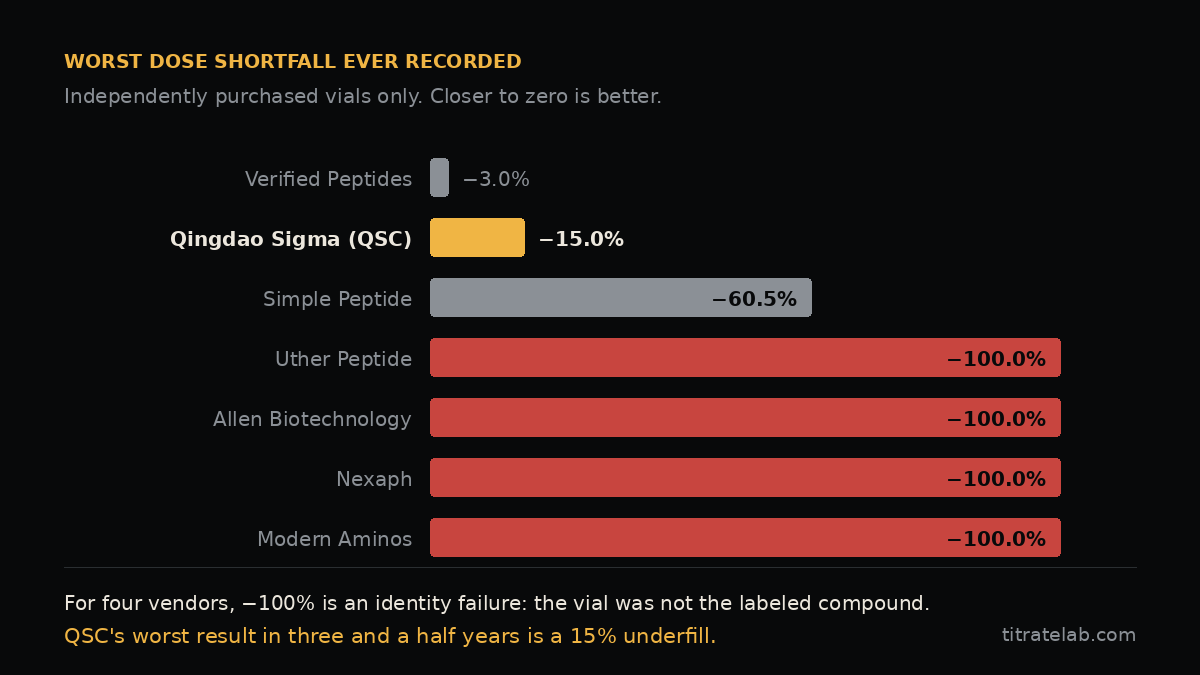
| Vendor | Lowest purity ever | Worst dose shortfall vs label | Labs used |
|---|---|---|---|
| Qingdao Sigma (QSC) | 90.17% | −15.0% | 10 |
| Verified Peptides | 96.75% | −19.0% | 6 |
| Alpha & Omega | 88.19% | −30.4% | 1 |
| Simple Peptide | 58.80% | −60.5% | 5 |
| Peptaris | 49.94% | −61.8% | 1 |
| Apex Peptides | 40.86% | −88.6% | 1 |
| Uther Peptide | 0.00% | −100% | 7 |
| Allen Biotechnology | 0.00% | −100% | 9 |
| Nexaph | 0.00% | −100% | 7 |
| Modern Aminos | 0.00% | −100% | 4 |
For four of these vendors, that worst case is an identity failure: an independent lab bought the product off the shelf, ran it, and found the vial did not contain the labeled compound at all. That is why the same rows read 0.00% purity and −100% versus label — both numbers come from the one fact that the substance was not what it claimed to be, which is arguably worse than an underfill, because the buyer injected an unknown. QSC’s worst day in three and a half years is a 90.2% vial and a 15% underfill — both bad, neither dangerous, and neither the kind of result that sends somebody to hospital wondering why nothing happened.
The same objection applies to QSC, and it has to be answered rather than waved away: only 7% of QSC’s certificates are tests it did not order. A clean floor drawn mostly from vials the seller picked is exactly as suspect as a clean average from the same source.
So here is the whole comparison again, thrown back to off-the-shelf purchases only — tests commissioned by Finnrick or published from public buys, where the vendor did not choose the vial:
| Vendor | Off-the-shelf tests | Mean purity | Lowest purity | Worst dose |
|---|---|---|---|---|
| Verified Peptides | 36 | 99.33% | 97.32% | −3.0% |
| Qingdao Sigma (QSC) | 39 | 99.29% | 93.90% | −15.0% |
| Simple Peptide | 29 | 99.18% | 96.33% | −60.5% |
| Allen Biotechnology | 69 | 97.63% | 0.00% | −100% |
| Nexaph | 253 | 97.08% | 0.00% | −100% |
| Uther Peptide | 74 | 94.33% | 0.00% | −100% |
| Modern Aminos | 5 | 79.87% | 0.00% | −100% |
| Alpha & Omega | 0 | — | — | — |
| Peptaris | 0 | — | — | — |
| Apex Peptides | 0 | — | — | — |
Reading the zeros: a 0.00% purity paired with a −100% dose is a single result, not two — it is an identity failure, where the independent lab found the vial did not contain the labeled compound. There was material in the vial; it was not what the label said.
QSC’s record survives the control. Strip out every vial it chose and the floor holds: 93.9% purity, 15% under label, no catastrophe. Four vendors fail the same test outright, and they fail it on independently purchased product, which is the only version that describes what a customer actually receives. Three more cannot be assessed at all, because there is nothing to assess.
Verified Peptides is genuinely better, on a near-identical sample — a 97.3% purity floor and a worst dose shortfall of 3%. It, not QSC, is the strongest vendor in this comparison, and the piece should say so. QSC is second, and second here is a long way clear of the field.
One caveat on our own arithmetic. This subset is Finnrick and public buys only, 39 certificates for QSC. The wider “defensible set” used earlier in this piece is 100, because it also counts tests individual buyers paid for themselves, which we can identify from the document but not from a single field. The narrower cut is the stricter one, and QSC passes it.
Two structural facts make that flat record harder to dismiss as luck or curation.
QSC uses ten labs. Peptaris, Alpha & Omega and Apex each publish through exactly one, and it is the same one. A vendor that routes every sample to a single laboratory controls its own narrative and can stop sending samples the moment results turn. Ten labs is not a thing you can quietly manage. It sits oddly beside a company that felt it needed to buy reviews.
The record is long. December 2022 to July 2026, and still current: controlling for our own collection pipeline — comparing only certificates discovered in the same July 2026 sweep — QSC’s median test date sits mid-pack among these vendors, and it holds the single most recent certificate of any of them.
What about price?
The purity table above invites an obvious question that we initially failed to answer: what do those vendors charge? The answer turns out to be the most useful thing in this section, because the vendors QSC loses to on purity are not selling into the same market.
QSC sells kits of ten vials to resellers and group buys. Most of the names above are Western retail brands selling single vials to end users. Comparing their headline prices to QSC’s is comparing wholesale to retail, and the gap is what you would expect.
Retatrutide, per milligram, is the cleanest comparison because it is stocked everywhere:
| Retatrutide, $/mg | |
|---|---|
| QSC, 50mg kit | $0.75 |
| QSC, 30mg kit | $1.05 |
| QSC, 10mg kit | $1.50 |
| Allen Biotechnology (ABC) | $1.10 |
| Western retail, cheapest of 3 surveyed | $2.70 |
| Western retail, dearest of 3 surveyed | $3.92 |
| Peptide Partners | $4.85 |
| Orbitrex Peptides | $8.00 |
A buyer taking QSC’s 50mg kit pays about a fifth of what Orbitrex charges and roughly a quarter of the cheapest Western retail vial we could find. That is the honest headline, and it belongs next to the lab record: QSC is one of the cheapest ways to buy a floor.
Two things stop that becoming a straightforward endorsement.
Inside its own tier, QSC is not cheap. Against the other China-direct suppliers we buy from, across 100 listings matched on compound, dose and destination, QSC is the more expensive option on 70, cheaper on 23, level on 7 — a median premium of 8.5% per vial, worse at the extremes. NAD+ 500mg into the UK costs twice what the cheapest rival charges. On the same public per-milligram board, several China-direct sellers undercut QSC’s retatrutide outright: $0.50, $0.57 and $0.68 against QSC’s $0.75 at its own best kit size. The premium is real; it is just a premium over other wholesalers, not over the retail brands with the better purity averages.
And Finnrick, which buys off the shelf, is markedly less impressed than we are. Its published vendor rating for QSC is 69%, from 9 passes and 6 fails across 15 tests, judged against a deliberately harsh standard: HPLC purity of at least 99.5% and fill within ±35% of label. That is a different question from the one our floor analysis asks, and both answers are true. Ours says QSC has never shipped a disaster. Finnrick’s says QSC misses a demanding target about 40% of the time. A reader is entitled to both numbers, and the second is the one QSC would rather we left out.
Tracy’s side of it
It is worth stating the vendor’s case at its strongest, because it is not weak — and because the strongest version is not our reconstruction of his reasoning. It is his own conduct, in his own channel, over two years.
We read all 520 surviving messages. Set aside the review campaign and the record shows a seller behaving considerably better than this market’s norm.
He corrects himself before anyone catches him. On November 7, 2025, a bug in the French warehouse system showed stock that did not exist and he quoted several buyers on it. He caught it himself, the same evening, and posted: “I sincerely apologize for the error. Luckily, I had only quoted 4-5 buyers before going to get dinner and catching the mistake… If you have already paid: Please send me your wallet information for a prompt refund, or you can opt to keep the balance as credit.” Eleven days later, having oversold Australian HGH by four orders: “we oversold 4 orders, buyers has been reached for refund / credit. Sorry for the inconvenience.” Nobody forced either disclosure. In a market with no chargebacks, quietly letting four orders sit unfilled is the cheaper option and the ordinary one.
He absorbed the risk that customers usually eat. On the December 2025 HGH group buy: “we decided to bear the customs risk for you given the number of orders, USA buyers will receive a domestic delivery tracking once the it’s in USA, no customs risk or seizures on your end.” Seizure is the defining hazard of this trade and the standard practice is to make it the buyer’s problem.
He repeatedly warned customers about a mistake that made him nothing. Four separate times across two years, he warned that sending funds over the Base network to an ERC-20 address destroys them irrecoverably — “your money will be lost, because it doesn’t match mine and Base Network money can never be recovered” — and warned again about impostor accounts using near-identical Telegram handles. There is no upside to either post.
And he disclosed a missing COA rather than implying one existed. The December 2025 retatrutide group buy advertises “High purity and accurate fill guaranteed” and then immediately says “Sample currently being tested, COA pending.” A vendor willing to fabricate reviews had an easier option here and did not take it.
The honest limit on all of this is severe, and reading the channel on its own is how you miss it. We can verify he said these things. In the two largest incidents on record, the promises did not land.
That is not a caveat we inferred. It is documented in our own vendor archive, and anyone weighing the paragraphs above has to read it alongside them: the QSC entry in the Peptide Vendor Graveyard. The short version is three disappearances in sixteen months. The December 2024 cohort went unrefunded through a seven-month silence and an “Official Comeback Announcement” that promised to make pending orders good. A MESO-Rx customer who wired $7,500 in November 2025 had the package returned by the destination country in February 2026, and Tracy went unresponsive on a reship he had already agreed to. And in mid-March 2026 QSC accepted hundreds of international orders during a sale window, stopped shipping, and then broadcast this:
No refunds, no order changes, no credits — not until you have a tracking number in hand… Every message asking for updates will go unanswered, because I can’t reply to everyone individually… You take a risk, we take a bigger one… Domestic operations (USA, UK, EU, AU, Canada) are running normally — no delays, no issues. Don’t make this harder than it already is. Shit happens in this business. Wait patiently.
This is the third time in sixteen months that the same explanation — a logistics partner or shipper detained by authorities — has been offered, and the second time to a cohort that had already paid.
One correction to an earlier version of this section, because it is the exact trap this piece is about. We initially cited an April 9, 2026 channel post — “I haven’t been able to keep my promise… I’ve decided to temporarily pause new international orders from China until all pending orders are fulfilled” — as evidence of a seller turning off his own revenue to fix a service failure. Read against the incident record, it is nothing of the kind. It arrives at the tail of the third disappearance, after hundreds of orders had been taken and not shipped and after a broadcast explicitly refusing refunds. Pausing new orders at that point is damage limitation. We had read the vendor’s own channel in isolation, which is precisely how a well-managed broadcast feed produces a flattering portrait, and we are leaving the error in the piece rather than quietly deleting it.
So the fair version of his case is narrower than the channel alone suggests, and it is this: a seller with real chemistry, real prices, and a genuine habit of small-scale honesty — the bug he caught himself, the warnings that earn him nothing, the COA he admitted he did not yet have — whose conduct collapses precisely when the sums get large and the customer is far away.
That is a coherent story and most of it is documented. The bans did happen. The asymmetry between happy and unhappy reviewers is a genuine feature of every review system ever built.
It is also the exact reasoning the FTC rule exists to refuse. A good product does not entitle a seller to manufacture the appearance of independent agreement about it, because the appearance is the only thing the next buyer has to go on. The remedy for “my honest reviews are invisible” cannot be “buy some more,” since that is precisely what makes the honest ones invisible.
The verdict splits, and it should. The lab record earns credit — more than we gave it, and more than most of the vendors currently trading on better averages deserve. On price the picture is genuinely good: against the retail brands that beat QSC on mean purity, it is a quarter to a fifth of the cost, and it has the better floor. What does not follow is the 8.5% premium over its actual competitors, the other wholesalers, or the conduct.
Which is what makes the review campaign such a bad trade. QSC had the two things this market almost never offers together — the best worst-case record among comparable vendors, at wholesale prices — and no way to make anyone believe it except the reviews. Then it bought the reviews, and spent the only asset that could have carried the claim. Tracy’s case was strong enough to make honestly, and the campaign is the reason it can no longer be made that way.
What the FTC’s review rule prohibits
The conduct is legible under an existing rulebook.
The FTC’s Rule on the Use of Consumer Reviews and Testimonials, 16 CFR Part 465, took effect on October 21, 2024, with civil penalties up to $51,744 per violation. Two sections bear directly:
- §465.4 prohibits providing compensation or other incentives conditioned, expressly or by implication, on the review expressing a particular sentiment. Incentivising reviews is not itself banned. Conditioning them on positivity is. A discount for a public post that helps the vendor grow, paired with a surcharge for people who stay quiet, is a sentiment condition stated in the vendor’s own words.
- §465.7 prohibits using intimidation or certain false public accusations to prevent reviews or cause their removal, and prohibits presenting a review corpus as representative while negatives are suppressed.
In the EU, where QSC ships heavily, the Omnibus Directive (EU) 2019/2161 added submitting or commissioning false consumer reviews, and misrepresenting consumer reviews, to the list of practices that are unfair in all circumstances. Member states were required to transpose it by May 28, 2022.
We are not saying QSC violated these rules. Jurisdiction, applicability to a pseudonymous seller of research chemicals, and enforcement are all unresolved, and no regulator is likely to act here. The point is the framework. This is conduct that a US regulator formally defined as unfair or deceptive in 2024 and that the EU blacklists outright, performed in public, by the party doing it, in writing, over nine months.
The academic literature says the same thing in a different register. Cabral and Li’s eBay field experiments found that feedback-conditional rebates suppress negative reviews precisely when the transaction went badly. Gao and colleagues, studying TripAdvisor’s review-solicitation program against an Expedia control, measured what a solicited corpus looks like: more reviews, higher ratings, shorter, blander, and a drop in organic reviews. None of that requires a single fake account.
What rests only on QSC’s word
Three of QSC’s claims are load-bearing for its own account and unsupported by anything we could find.
The forty bans. QSC says: “I personally counted at least 40 banned accounts yesterday—many of them well-known, years-old members.” That number appears in no moderator statement and in no forum artefact we examined. QSC’s own screenshot reproduces six users claiming bans. Bans did happen; the forum says so itself. The count is QSC’s.
The deleted reviews. QSC says its customers’ words “keep getting deleted faster than my patience on a Monday morning.” Across 55 archived pages we found no deleted-post markers, no gaps in post numbering, and no moderator reference to removing reviews. The favourable posts from the July 28 burst were still live and visible on July 31, and members noticed: “I still can see here a few recent TD or positive reviews. That’s why I’m surprised.” We report this as we found it, with the caveat that matters: XenForo hard-deletes leave no trace an ordinary member can see. We found no evidence of deletion. That is not the same as establishing that none occurred.
The commission motive. QSC says the forum acted “Because we built a massive customer base using their platform for free, and they couldn’t handle not getting a cut.” This is an accusation of commercial bad faith against a named third party, made by a vendor with an obvious interest in relocating reviews to a venue it controls. Nothing in the record supports it and nothing contradicts it. It is assertion.
One concession the vendor is due. Mass-banning pro-vendor accounts is exactly as consistent with routine anti-shill moderation as with anything worse, and routine anti-shill moderation is what the forum says it was doing. Both readings fit the visible facts. Only one of them is documented.
Why it matters that the product is good
In a market with no regulator, no escrow, no chargeback and no recall, reviews are the safety layer. A buyer deciding whether to inject something has a lab certificate, if one exists, and other people’s accounts of what happened when they ordered. That is the whole apparatus.
QSC did not need to corrupt it. Its purity numbers are strong, its certificates verify, and when we pulled 21 of its stored verify URLs and re-read the live documents, all 21 resolved and the purity figures matched to three decimals on every one we could image. Not a single vendor-posted certificate in our corpus contradicted our independently scraped archive on a purity figure.
What QSC did instead was make its own good record unreadable. Once the price of a kit depends on whether you posted, a favourable post stops being information. The favourable reports in that thread from the weeks before the announcement, at least twenty by our count, now sit next to a burst of posts written for a discount, and no reader can separate them, including the people who wrote the honest ones. The member who objected that he had been praising QSC for years was defending something QSC had already spent.
That is the harm, and it lands on the customers who liked the product.
So: does he?
On the product, yes, and by a wider margin than we expected when we started. Judged on tests he did not commission — the only version that describes what arrives in the post — QSC has a purity floor of 93.9% and a worst dose shortfall of 15%, while four vendors in the same comparison have sold vials that failed identity testing outright — the compound inside was not the labeled one. It is second in that group, behind Verified Peptides, and a long way ahead of everyone else. It does this across ten laboratories while the three vendors with better headline averages have never published a test they did not order themselves. And it sells at a quarter to a fifth of what the Western brands charge. On the two questions a buyer actually has — will it be real, and what does it cost — Tracy has earned the benefit of the doubt.
On the conduct, no — and the failure is not really about reviews at all. It is a trust-and-support failure with a review campaign layered on top of it.
Separate the two things QSC sells. The chemistry is good and cheap, and we have said so at length. What fails is everything that happens after the money moves: three disappearances in sixteen months, a December 2024 cohort still unrefunded, a $7,500 reship agreed and then abandoned, an international order book taken during a sale and frozen, and a support posture that in its own words amounts to “every message asking for updates will go unanswered.” Then, when the forum where those losses were documented turned hostile, a customer’s home address was made reconstructable and his payment address published — the conduct that got QSC permanently banned, and the point at which a support problem became a safety problem.
The review campaign is what a vendor does when it wants the first half of that sentence to be the only half anyone reads. And it worked in the narrow sense and failed in the broad one: it bought a burst of favourable posts, and it destroyed the evidentiary value of every honest post that came before it. Every genuine report in that thread now sits beside posts written for a discount, and no reader can separate them — including the people who wrote the honest ones.
The uncomfortable version, which we think is the correct one: he did not need the reviews and could not be helped by them. This piece was assembled from public certificates, a public price list and his own public channel, and it makes a better case for the product than the campaign ever did. What no volume of purchased enthusiasm can fix is the thing customers were actually complaining about, which was never the purity. Buy the chemistry if you like the price. Do not prepay for anything you cannot afford to lose, and do not send it overseas.
Methods and provenance
Telegram. All 520 surviving messages on QSC’s announcement channel, November 7, 2024 to July 30, 2026, captured read-only on July 31, 2026. The archiver never joined the channel, never posted, and never reacted. Every quotation is byte-exact from the stored JSONL, including emoji, spacing and errors; the only normalisation is that Telegram’s non-breaking spaces are rendered as ordinary spaces. 160 of 680 message ids are absent from the channel, most routinely, but ids 74 through 86 are missing across a seven-month silence QSC later described as “we got busted. We lost everything.” The channel’s own contemporaneous account of that period has been removed. We also hold pre-edit copies of four posts that were later changed, including the tracking-number line discussed above. A SHA-256 for the archive and all 291 media files is recorded and verifiable.
Cross-reference to the incident archive. The disappearance timeline, the unrefunded December 2024 cohort, the $7,500 loss, the March 2026 broadcast quoted here, and the June 2026 doxxing ban are all documented with primary sources in the QSC entry of the Peptide Vendor Graveyard, and this piece defers to it rather than re-litigating them. The two documents should stay consistent: the graveyard’s standing editorial position — that the batch-level chemistry remains useful while the trust question is separate, and that international orders carry material risk — is the same conclusion this piece reaches from the other direction.
The vendor’s case. “Tracy’s side of it” is sourced from the same 520-message archive as the rest of the Telegram analysis, and deliberately so. An earlier draft argued the vendor’s case by reconstructing his likely reasoning, which is a way of putting words in a subject’s mouth and flattering ourselves that we have been fair. It was replaced with what he actually did, in public, on the record: the self-corrections, the paused order book, the absorbed customs risk, the unprofitable warnings, the disclosed-missing COA. Where the claim is a promise rather than an act — reshipment, refunds landing — the piece says we can verify the statement and not the performance. Searching a subject’s own record for conduct that tells against our thesis is the minimum a piece like this owes him, and it materially changed the conclusion.
Forum. MESO-Rx captured read-only through an authorised member account. Every request was a GET except a single login POST. No post, reply, reaction, report, rating, message, follow or profile change was made. 55 pages archived with URL and UTC retrieval timestamp. The 30-day counts are exact and unsampled; the classification of 20 posts as favourable received-order reports is a judgement made by reading them, and the posts are quoted so anyone can redo it.
Certificates. 513 published records attributed to Qingdao Sigma Chemical, deduplicated to 377 physical tests on Janoshik’s own task numbers, classified by who commissioned the test as read off the document rather than off our own metadata. Analysis was read-only; no certificate record was created, altered, unpublished or re-attributed.
Who commissioned the test is the axis that matters, and it nearly broke this section. The first version of the peer comparison ranked vendors on mean purity and worst-case floor without asking who ordered the testing, which silently compared three incompatible evidence regimes: QSC’s mostly self-commissioned corpus, three vendors whose records are entirely self-commissioned through one laboratory, and two whose records in our corpus are Finnrick’s own off-the-shelf purchases. Vendors that get independently tested more show more failures, so the naive ranking rewarded whoever had been checked least. Every headline figure in this section is now reported twice — as published, and restricted to tests the vendor did not commission — and the second is the one the argument rests on. Classification is read from the certificate’s own client field, not from our metadata.
Peer comparison. Read 1 August 2026 against the full corpus of 62,777 certificates. The peer set is every vendor with at least 200 certificates, ranked by the share of QSC’s 107 distinct products they also carry; two unattributed buckets were dropped, being collection artefacts rather than companies. Vendor identity was resolved through the canonical manufacturer record rather than by name matching — QSC is Qingdao Sigma Chemical, whose alias set includes the Telegram handle used throughout this piece. This matters more than it sounds: the corpus contains ten other vendors with “Sigma” or “Qingdao” in the name, and at least one earlier draft of this analysis compared the wrong company. Certificate counts in the peer tables are raw and undeduplicated for every vendor including QSC, because we cannot deduplicate the peers on task numbers the way we can QSC. That makes the comparison internally consistent and means the 523 figure there is not interchangeable with the 377 used elsewhere.
Dose deviation is computed against the printed label, not against a batch claim. Floors are the single worst result on record, not a trimmed percentile: the argument is about tail risk, so trimming the tail would remove the finding.
Why there is no testing-cadence chart. An earlier version of this analysis reported that QSC’s testing had collapsed. That was wrong and is withdrawn. Every QSC certificate we hold was discovered inside a single window between 22 April and 31 July 2026, and corpus-wide discovery is heavily uneven — 40,022 certificates found in July against 1,567 in May. A time series built on test dates would therefore measure our own ingestion, not the vendor’s behaviour. Controlling for it, by comparing only certificates found in the same July sweep, QSC’s median test date is mid-pack among its peers and it holds the most recent certificate of any of them. Any future draft that reintroduces a cadence claim needs to clear this control first.
Prices. Three sources, because no single one covers both tiers, and they answer different questions.
- Within-tier. The live TitrateLab reseller catalogue, in-stock listings only, normalised to per-vial cost so kit sizes are comparable, matched on compound, dose and destination. 100 listings where QSC competes head to head with another China-direct supplier we carry. This is the 8.5% premium figure. It covers only vendors we resell and is not a market survey.
- Cross-tier, per milligram. Finnrick’s public per-milligram board, read 1 August 2026, which lists China-direct and Western vendors side by side on the same unit. QSC’s own per-milligram figures are computed from our catalogue kit prices, not taken from Finnrick, and are shown at three kit sizes because per-milligram cost falls steeply with vial size — quoting only the best or only the worst would be a choice, so both ends are printed.
- Western retail. A third-party price-comparison aggregator, three cheapest listed vendors for a 10mg retatrutide vial. Several of those figures carry discount-code asterisks, so the retail end of the comparison is if anything flattered.
The tier caveat is the finding, not a limitation. The peer set in this section was matched on certificate volume and product overlap, which are the right axes for judging a lab record and the wrong ones for judging price. Most of the vendors that beat QSC on mean purity are retail brands selling single vials; QSC sells ten-vial kits into a wholesale channel. Any comparison that puts their shelf prices next to QSC’s kit price without saying so is misleading, and an earlier draft of this section did exactly that by silently substituting a different vendor set for the price analysis than the one used for purity.
Finnrick’s own verdict on QSC — 69%, 9 passes and 6 fails across 15 tests — is quoted from its public vendor page, read 1 August 2026, against its stated standard of ≥99.5% HPLC purity and fill within ±35% of label. It is a stricter bar than our floor analysis applies and it produces a less flattering answer. Both are reported. Finnrick buys off the shelf, which is precisely why its result is not interchangeable with vendor-commissioned testing, and why the section above separates the two.
Discord. 10,620 messages, 599 authors, measured against 33 peer servers over an identical window.
Right of reply. QSC trades publicly through the Telegram contact @tracyfromqsc. At the time of publication we had not put these findings to it. We are doing so now, in writing, and this piece will be updated with the response or with the fact of a refusal. Three claims in the account above rest on QSC’s assertion alone — the count of banned accounts, the deletion of positive reviews, and the allegation that MESO-Rx wanted a commission — and QSC is the only party who can evidence any of them. Two would improve its position if it could.
