A vendor agreed to settle a dispute with one clean test. It chose the lab, wrote the chain-of-custody rules, paid the bill, and the vials came back holding the wrong drug. This is the dated, source-linked record of what the certificates show.
When we published this in June, XTP was refusing to accept the buyers' lab results and suggesting someone had tampered with the samples. So it ran a test of its own. XTP picked the lab, paid the bill, and wrote the rules: sealed vials, photographs at every step, three vials taken from three buyers.
The result came back on July 27. All three vials held about 2mg of tirzepatide — the wrong drug — in a product sold as 30mg retatrutide.
The next morning, XTP announced that no test had ever shown tirzepatide. As of July 30 it has refunded no one.
We have rewritten the opening, the timeline and the findings around that result. Two things we got wrong in June are corrected and listed at the foot of the piece. Nothing from the original version has been quietly deleted.
- The re-test XTP paid for returned the wrong molecule. On July 27, Janoshik test #202588 — ordered and funded by XTP, run under the tamper-seal and photograph protocol XTP itself specified, on three vials drawn from three randomly selected buyers — reported Tirzepatide at 2.11mg, 2.00mg and 2.07mg, at 90.573%, 90.547% and 89.824% purity, in a product sold as 30mg retatrutide. Wrong drug, about 93% short, and purity below XTP's own floor. It was run as a blind GLP-1 screen across semaglutide, tirzepatide and retatrutide, so the lab was not told what to expect.
- The next day, XTP said no such test existed. Its July 28 announcement states that "whether it is previously disclosed testing reports or our own internal testing reports, all test results have indicated Reta, and there has not been a single testing report showing a result of Tirz," and attributes the dispute to "human interference or malicious commercial competition."
- Batch XTP-R30-003 failed five different ways. Across five independent certificates the same batch produced a near-empty vial and an overfilled one on the same report, a correctly-filled vial that failed purity, and a vial of a different drug entirely. Endotoxin passed. The batch is not weak; it is uncharacterizable.
- The same late-May-to-June window produced more failing independent tests on other XTP products: a GHK-Cu underfilled by ~21mg, and Tesamorelin-10 at ~97.6% purity, below XTP's own published "under 99% = reship or refund" guarantee, and reported on two different cap colors.
- The pattern predates the R30. In May 2026 the same organizer ran a MOTS-C group test, #157218, which came back at 98.40% and 98.25% purity — under the guarantee on either threshold. XTP declined that result too, pending its own internal re-test. The R30 dispute followed the same script two months later.
- When buyers tried to invoke that guarantee, XTP's representative posted a new tiered refund table mid-dispute ("Below 90%: 20% refund ... Below 10%: full refund"), the exact mechanism that turns a 4mg-of-30mg vial (~13% of label) into a 20% refund instead of a reship, then walked it back hours later after group pushback. It re-tested its own hand-picked vials (which returned ~99%), dismissed the failing customer reports, and banned the dispute group's organizer, the agreed vial collector, out roughly $2,200 in product. It was removed from STG, a sourcing/trust group, for exactly this. Buyers are calling for a purchasing pause.
- The meta-point: until June 2026, TitrateLab's own corpus held 32 vendor-side XTP certificates, averaging 99.3% purity, with no recorded failures. None of the failing customer tests were in any aggregator. That is how the grey market launders trust: publish the passing tests, bury the failures. We are correcting our record now.
The lede
XTP did not lose this dispute to a hostile lab, a rival vendor, or a group it accused of tampering. It lost to a test it commissioned itself.
By late June the argument over batch XTP-R30-003 had stalled in the familiar place: buyers holding failing third-party certificates, the vendor refusing to accept any of them. So XTP proposed a re-test on its own terms, and the group accepted. XTP chose the lab. XTP paid the invoice. XTP wrote the chain-of-custody rules — photograph the outer box, photograph the cap, photograph the seal, apply a tamper-evident sticker to each vial, package each one separately, film the collector assembling the parcel. Three vials came from three separately-chosen buyers. The collector shipped them to Slovakia on July 7 and posted proof at every step.
The report came back on July 27. All three vials contained tirzepatide, about 2mg of it, in a product sold as 30mg retatrutide.
That single certificate collapses three defences at once. It cannot be a tampered sample, because XTP designed the seals. It cannot be a hostile lab, because XTP picked Janoshik and paid it. It cannot be a testing error, because the assay was a blind screen across semaglutide, tirzepatide and retatrutide — the lab was not told what the vial was supposed to contain, and it named a different drug from the one on the label.
The next morning XTP published a statement saying no test had ever shown tirzepatide.
Everything below this point was written in June, when the record was thinner and the vendor’s account still had room in it. It is preserved because the original dispute is the reason the re-test happened, and because the earlier failures explain what the re-test confirmed.
A customer-commissioned Janoshik test on XTP’s R30 retatrutide found roughly 4mg of mass in two of three vials of a product labeled 30mg. The third vial came back near label, at about 34mg. That is not a purity miss. Purity on the group’s vials was reported as good, around 99%. It is a fill problem.
This distinction is the spine of the whole story, and it is the thing buyers most often conflate. A Janoshik report has two halves. One is the HPLC purity assay: is this the right molecule, and how clean is it, the number everyone screenshots, the “99.2%.” The other is the quantity check: how many milligrams of peptide are actually in the vial. A vial can ace the first and fail the second. That is exactly what happened here. The R30’s chemistry was retatrutide, and it was clean retatrutide, but two of three vials held about a seventh of the dose on the label. Pure isn’t dosed. A 99%-pure 4mg vial sold as 30mg is still 26mg short of what the buyer paid for, and no purity number on the certificate fixes that. How often that second half of the report misses across the wider corpus is its own measurement, published in our grey-market dose-accuracy analysis.
The Janoshik result is verifiable at verify.janoshik.com/tests/170028; the group said Janoshik ran the test twice to be sure. One buyer in that group summarized it plainly: “out of 3 vials tested, 2 were 4mg and 1 was 34mg.” Another, on the safety implication: “it’s the variance that makes it dangerous. 30mg is a wild swing if you assume your vial had 4mg and it’s actually 34mg… you can’t safely assume the vial has 4mg and dose from there, which means the batch shouldn’t be used at all.”
XTP, known in channels as Xi’an Taiye Chemical Co., is a research-peptide vendor that, through early 2026, was treated as mainstream-trustworthy across GLP-1-adjacent Telegram channels, with China and US warehouses (a China-warehouse-to-US-domestic relabel is routine in this scene, and XTP ran both) and an active sales representative. It publishes a guarantee on its products: in its June 1 US warehouse launch, XTP stated it would refund or reship any vial testing below 98.5% purity or with fill under 90% of spec, contingent on an independent Janoshik report; buyers who purchased earlier recall the purity bar quoted as 99%. Either way, the failures below clear the bar. What happened when buyers tried to invoke that guarantee is the rest of this story.
A word on how trust gets established here, because it is the load-bearing detail. In these channels, a vendor’s own COA is table stakes: every serious seller ships one, and “send it to Jano” is the scene’s trust ritual. Janoshik (a Slovak lab) is the de facto reference, and a clean Jano report is the closest thing the grey market has to a credential. But not all Jano reports carry the same weight. A vendor-submitted test proves only that a vial the vendor chose was clean. A buyer-commissioned test, where a buyer pulls a random vial from their own order, pays the lab, and submits it, is the real signal, because it defeats cherry-picking. The vendor doesn’t get to pick which vial gets measured. The entire reason that norm exists is to catch a seller who tests well and ships poorly. As the failures below show, XTP’s rebuttal to the buyer-commissioned results was to re-test its own hand-picked vials, which is precisely the move the buyer-pays-the-lab norm was built to neutralize.
Timeline
-
May 29
2026ReportsFirst quality complaints surface
Buyers report cloudiness and reconstitution problems on XTP retatrutide and Tesamorelin in the channel. XTP's representative responds with vendor-submitted Janoshik COAs. Community chatter begins referencing earlier "bunk" and swapped-vial concerns.
-
Jun 1-2
2026TestsGHK-Cu and Tesamorelin failures posted
A buyer reports an independent test: "My GHK-CU was underfilled by 18mg. My tesa 10 was 97.6 purity." Both are below XTP's product expectations; the Tesa figure is below the vendor's own under-99% refund threshold. Community notes 2-3 failing tests across different products in recent weeks.
-
Jun 5
2026RefusalFreedom Diagnostics 93.77%: refund declined
A buyer who ordered three kits of R30 (batch XTP-R30-003) reports a Freedom Diagnostics purity result of 93.77% with an accession number, and says XTP declined a reship or refund because the test was not a Janoshik test. The buyer reports being out nearly $900 including testing costs.
-
Jun 5
2026DelistingRemoved from STG
Multiple community members report XTP was removed from STG, a sourcing/trust group, citing the pattern of failed third-party tests across products and XTP's refusal to honor its guarantee. "They have been removed from STG for a reason."
-
Jun 11
2026NoticeChina warehouse stops retail orders
XTP's representative posts that the China warehouse will "no longer accept retail or single-item orders," moving to bulk and group-purchase orders only, citing "business growth and operational restructuring."
-
Jun 15
2026TestsSecond Tesamorelin batch fails
A buyer reports a Janoshik result of ~97.7% on white-cap Tesa10. A separate account notes two different Tesa batches (black and white caps) testing at the same ~97.6-97.8%, and asks XTP directly for a refund.
-
Jun 17
2026ProofR30 group Janoshik results published
The R30 group test results circulate: two of three vials at ~4mg, one at ~34mg, on a labeled 30mg product. A group member asks XTP's representative directly how it will handle a refund or reship of the 4mg vials.
-
Jun 18
2026PauseVerify links posted; buyers call for a pause
In the dispute room, XTP's representative posts a new tiered refund table (a 4mg-of-30mg vial → 20% refund, not a reship), then reverts it hours later under group pushback; bans the group's organizer, the agreed vial collector, out roughly $2,200, and pushes to pick its own "random" re-test donors as the opened room floods 33→72 members. A buyer recommends "a complete pause on any XTP purchasing," citing the guarantee change, the ban, and the donor-stacking.
-
Jun 24
2026TestsA third failure mode on the same batch
Janoshik #193708, a blind GLP-1 screen on batch XTP-R30-003, returns retatrutide at 30.18mg — fill essentially perfect — at 89.723% purity. The batch has now failed on fill, and separately on purity, in the correct molecule.
-
Jun 29 - Jul 7
2026Re-testXTP pays; the group ships under XTP's rules
XTP orders the re-test from Janoshik on June 29 and pays for it. It issues a photograph and tamper-seal protocol: box label, cap, seal condition, cap colour, a tamper-evident sticker per vial, each vial packed separately. Three donors are drawn from the buyer group. The collector films the packing, ships on July 7, and posts tracking. XTP does not answer repeated requests to state, in advance, what result would trigger a refund.
-
Jul 27
2026ProofThe re-test returns the wrong drug
Janoshik #202588, analysed July 23, reports Tirzepatide 2.11mg, 2.00mg, 2.07mg at 90.573%, 90.547%, 89.824% purity, on three tamper-sealed vials of a 30mg retatrutide product. A group member: "WRONG DRUG - 2mg instead of 27mg+ - 90% purity. This is truly one of the worst batches of anything I've ever seen."
-
Jul 28
2026StatementXTP: no test ever showed tirzepatide
At 07:59 UTC, roughly thirteen hours after the certificate was posted to the group, XTP publishes an announcement stating that "there has not been a single testing report showing a result of Tirz," raising "the possibility of human interference or malicious commercial competition," and declining to address the refund. As of July 30 the group reports no refunds and no reships.
The re-test XTP paid for
The June dispute ended in a deadlock that had a clean exit: one more test, run so tightly that neither side could argue with it. XTP proposed it and the group agreed.
The conditions were XTP’s. Its representative posted them to the group as a numbered list: photograph the outer packaging label, photograph the vial cap in detail, show the condition of the cap, confirm each vial intact and untampered, photograph the cap colour, prepare three separate tamper-evident stickers, apply one to each vial, package each vial individually by its holder. Three donors were drawn from the buyer group. The collector filmed himself assembling the parcel, shipped it to Slovakia on July 7, and posted proof at each stage. XTP paid Janoshik directly.
One thing XTP would not do, despite being asked at least three times in the open channel, was say in advance what result would trigger a refund.
| Vial | Molecule found | Mass | Purity | vs. 30mg retatrutide label |
|---|---|---|---|---|
| #1 | Tirzepatide | 2.11 mg | 90.573% | wrong drug, ≈ -93% |
| #2 | Tirzepatide | 2.00 mg | 90.547% | wrong drug, ≈ -93% |
| #3 | Tirzepatide | 2.07 mg | 89.824% | wrong drug, ≈ -93% |
The word doing the work on that certificate is blind. Janoshik was asked to determine which of three GLP-1 molecules was present, not to confirm a label. It named tirzepatide, three times, on three independently sealed vials. The same blind assay, run on the same batch a month earlier as #193708, named retatrutide. One batch, one assay, two different drugs.
That is the fact XTP’s tampering theory has to survive, and it doesn’t. A buyer who wanted to fake a result would have to obtain 2mg tirzepatide vials, defeat three tamper seals chosen by the vendor, and do it across three donors who were selected after the protocol was set. And the group had no motive to fake a failure it had already demonstrated three times for free.
What XTP said the next morning
Thirteen hours after the certificate reached the group, XTP posted a statement, identically, from both of its representative accounts:
The statement is checkable, and on its central claim it is false. Test #202588 shows tirzepatide. XTP ordered it, XTP paid for it, XTP wrote the protocol it was run under, and it was posted to XTP’s own dispute group the previous day, where both representative accounts were active.
The rest of the statement is worth reading on its own terms, because it is a well-built document. It invokes “publicly listed company suppliers” with “FDA-related certifications,” then explains that the supply chain cannot be disclosed because the industry is grey — a claim to credentials paired with a reason no one can check them. It offers to welcome third-party testing “such as Janoshik” in the same breath as rejecting a Janoshik result. And it reframes a group of buyers who pooled money to test what they bought as a competitor running a campaign. As one of them replied: “These aren’t corporate attacks; they are decentralized groups of everyday researchers pooling funds to verify what they buy.”
We asked what XTP’s own answer to the refund question was. As of July 30, three days after the certificate and two after the statement, the group reported no refunds, no reships, and no direct reply.
What the batch actually contained
Five certificates now exist on batch XTP-R30-003, and no two of them agree:
| Date | Test | Molecule | Mass vs 30mg label | Purity |
|---|---|---|---|---|
| Jun 15 | #170028 | Retatrutide | 4.48 / 4.29 / 34.47 mg | 99.25-99.90% |
| Jun 16 | buyer submission | Retatrutide | 27.2 mg (-9%) | 92.8% |
| Jun 18 | #170029 | Endotoxin <10 EU/vial (2.018 est) — pass | ||
| Jun 24 | #193708 | Retatrutide | 30.18 mg (+0.6%) | 89.72% |
| Jul 23 | #202588 | Tirzepatide | 2.11 / 2.00 / 2.07 mg | 89.82-90.57% |
Read down that table and the “malicious competition” reading gets harder, not easier. A competitor fabricating evidence produces a consistent story. This is the opposite: every certificate fails differently, which is what a filling and sourcing process with no batch control looks like from the outside. A member of the group reached the same conclusion without the table: “Almost like the manufacturer had a bunch of random leftover shit and threw it in vials.”
The endotoxin pass belongs in the record too. Whatever went wrong here, the vials were not contaminated, and buyers who injected this batch faced a dosing and identity problem rather than a sterility one.
The failing tests
Each entry below is a statement about one tested batch on one date, not a verdict on XTP’s entire catalog. The proof is the Janoshik verify link; the prose only restates what buyers reported and what the link shows.
R30 retatrutide: the underfill batch XTP-R30-003
The headline failure. A buyer-organized group, described in-channel as roughly 26-33 buyers, pooled vials of XTP’s R30 retatrutide and sent samples to Janoshik. This is the standard group-buy-to-Janoshik pipeline: members of a purchase pool chip in for testing, a random subset of vials gets sent to the lab, and the result is shared back to the group. It is the buyer-commissioned mechanism working as designed; nobody at XTP picked which vials went to the lab. The result: two of three vials assayed at roughly 4mg of mass on a product labeled 30mg (the SKU tracked in-channel as the R30, “R30 purple cap” in cap-color shorthand), with the third near label at ~34mg. Purity on the tested vials was reported as good, ~99%; the defect is fill, not chemistry. The certificate itself is the proof, purity column passing and quantity column collapsed, and it is reproduced below.
| Vial | Measured mass | vs. 30mg label |
|---|---|---|
| #1 | 4.48 mg | ≈ -85% |
| #2 | 4.29 mg | ≈ -86% |
| #3 | 34.47 mg | ≈ +15% |
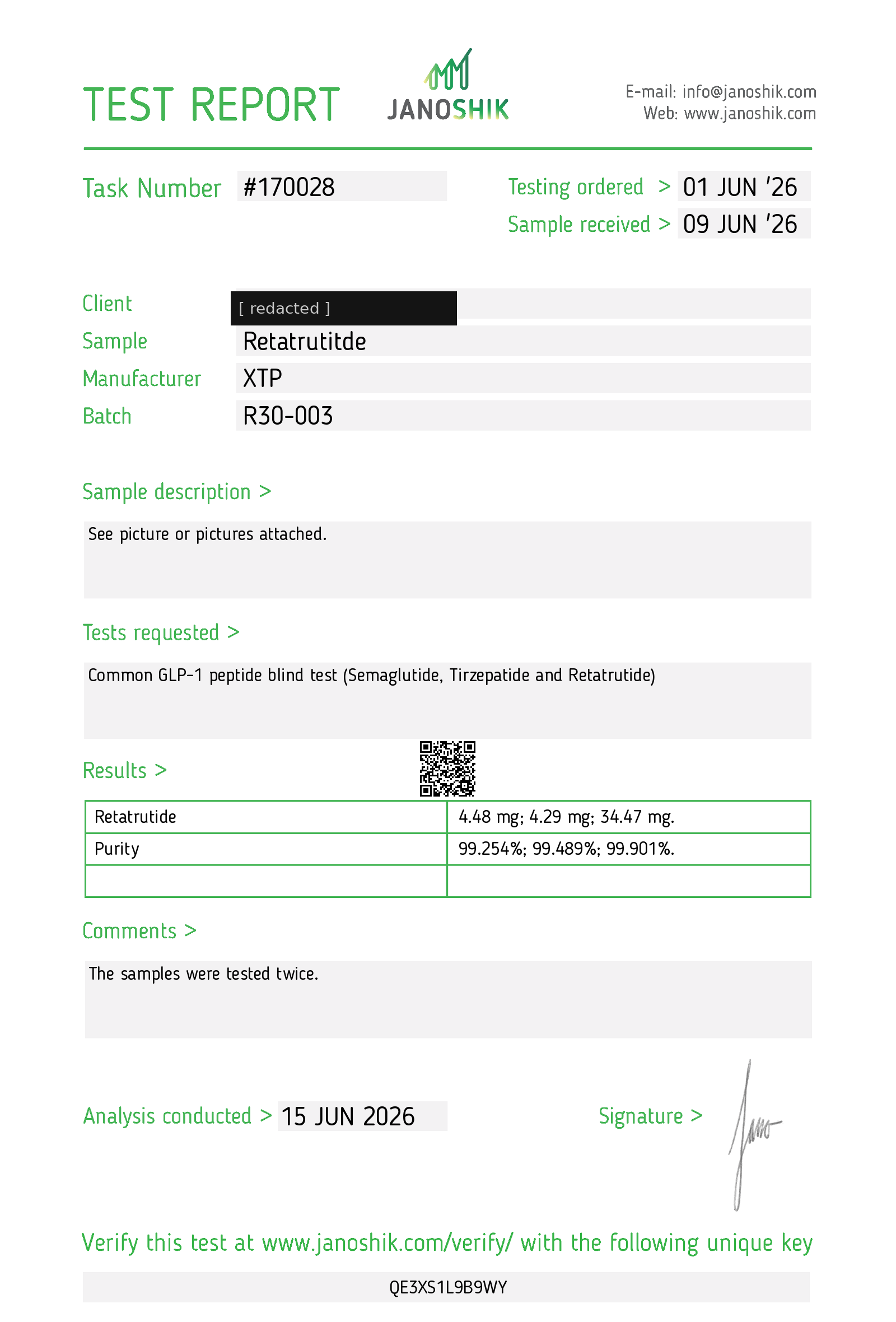
The danger here is not the average; it is the variance. A buyer cannot look at this batch and conclude “my vial has 4mg, so I will dose accordingly,” because the same batch also produced a near-label vial. As one group member put it, the spread alone means “the batch shouldn’t be used at all.” The two underfilled vials represent an underfill on the order of -86% against the label; one buyer in the group asked XTP’s representative directly to address “my refund or reshipment of the 4mg vials of Reta 30mg from your batch XTP-R30-003.”
XTP’s response, attributed: In the dispute room on June 18, XTP’s representative publicly refused the result outright: “Our R30 could not possibly exhibit such a basic error … we do not recognize their testing conclusions, nor do we accept any reports issued by them.” The stated grounds were a “long-standing dispute” with the group’s organizer (“long been banned by XTP,” the representative wrote), paired with XTP’s own rebuttal certificate, submitted by the vendor (handle [email protected]) and returning ~99%. That rebuttal cert is XTP’s own sample, not an independent check, which is the whole problem the buyer-pays-the-lab norm exists to neutralize. We note, separately and for balance, that a genuinely independent buyer did post a clean Janoshik result on an XTP R30 (verify.janoshik.com/tests/173311, ~99.5% purity at 33.26mg, a slight overfill on the 30mg label), so this is a batch-level failure on XTP-R30-003, not a claim that every XTP R30 vial is underfilled. The honest distinction is that 173311 is a buyer-commissioned test on a different vial; XTP’s rebuttal cert is the vendor measuring itself.
Proof: verify.janoshik.com/tests/170028
GHK-Cu: underfilled ~18mg
A separate buyer reported an independent test on XTP’s GHK-Cu showing it underfilled by approximately 18mg, posted alongside the Tesamorelin failure on June 2: “My GHK-CU was underfilled by 18mg. My tesa 10 was 97.6 purity.” A buyer group later said it ran three separate Janoshik tests on the GHK-Cu and posted the verify links. The certificates are the proof; the buyers’ descriptions are theirs.
One of those certificates, test #156287, makes the underfill concrete: a GHK-Cu labeled 100mg assayed at 79.37mg of GHK content at 99.690% purity, about 21mg short, again the purity-passes-fill-fails pattern. A separate certificate, #165814, showed the same shortfall on another vial (87.81mg of content, roughly 12mg under label), while a third (#164894) confirmed the chemistry was clean at ~99.6% purity. The fill is the problem, not the molecule.
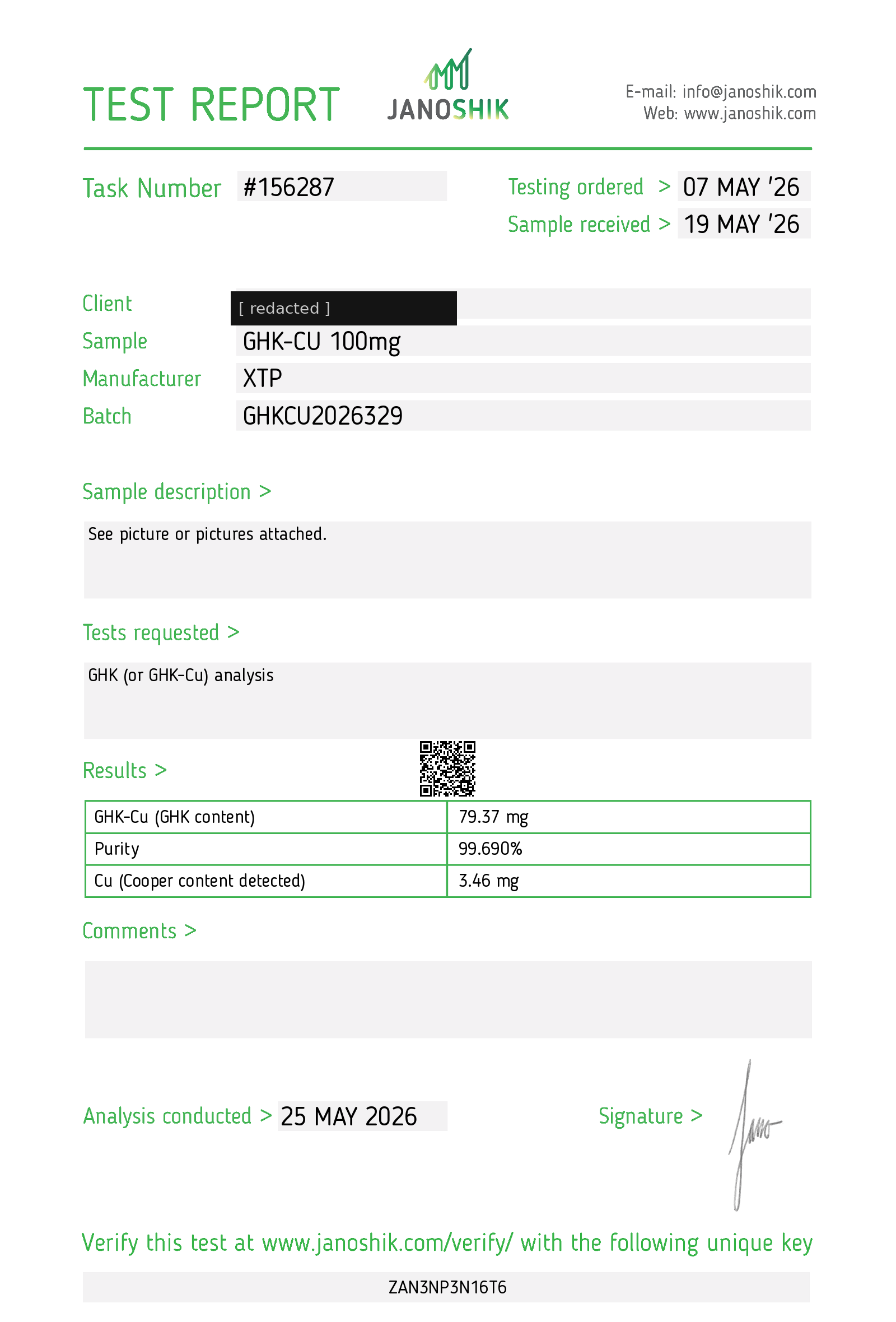
Proof: verify.janoshik.com/tests/156287 · verify.janoshik.com/tests/164894 · verify.janoshik.com/tests/165814
Tesamorelin-10: ~97.6% purity, below the vendor’s own threshold
XTP’s published guarantee is reship or refund on any vial testing under 99% purity. A buyer reported Tesamorelin-10 at 97.6% purity, under that bar. A later buyer reported white-cap Tesa10 at ~97.7%, and a separate account documented that two different Tesa batches (black and white caps) tested at the same ~97.6-97.8%, asking the vendor directly: “Even when you have two different 3P tests showing you low purity? Refund us please?”
The cap colors are not incidental. In these channels, buyers track batches by cap color and SKU code the way you’d track a lot number (“blue-cap R10,” “white-cap Tesa10,” “black-cap”) because that is the only handle they have on which production run a vial came from when the vendor doesn’t print a clean lot stamp. Two different cap colors landing at the same ~97.6-97.8% is therefore a meaningful signal: it points at a systematic purity ceiling on the Tesamorelin line across production runs, not a one-off bad vial. That is the cleanest illustration of the guarantee problem in the whole story: a product testing below the vendor’s own stated refund threshold, on more than one batch, with the refund still not honored.
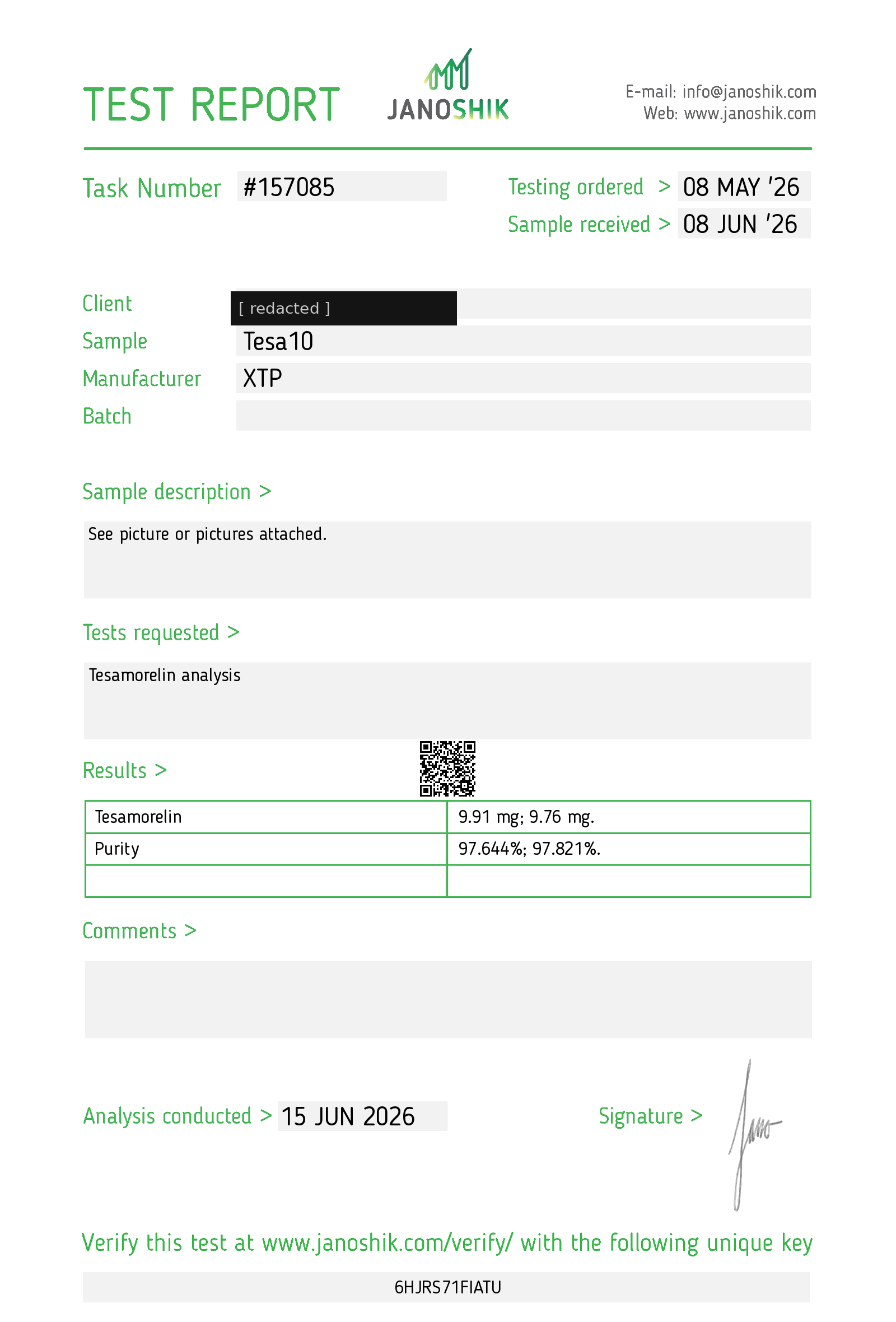
Proof: verify.janoshik.com/tests/156288 · verify.janoshik.com/tests/157085
A product reported with no detectable peptide
Among the cluster of complaints, community accounts also referenced an XTP product, discussed in the channel as a tirzepatide (T30), that buyers said tested with no detectable peptide at all, described as a “mystery powder.” The explanation XTP reportedly offered is itself a familiar move: it attributed the zero-peptide vial to a repack at a freight forwarder, the third-party reshipper that consolidates parcels and relabels them for the domestic leg, a routine step in the China-to-US-domestic path and a convenient place to locate blame, since it sits outside the vendor’s own four walls. Notably, one buyer reported this was the one product XTP did refund (“only been refunded for the 0 pep tirz”), a zero-peptide vial being harder to argue with than a merely-underfilled one. We flag this as a community report rather than a confirmed result: unlike the R30, GHK-Cu, and Tesamorelin failures above, we do not have a third-party verify link in hand for it, so it sits below the evidentiary bar of the certificate-linked entries. We note it because it is part of the pattern buyers were reacting to, and we will upgrade or remove it as the documentation resolves.
MOTS-C, two months earlier: the same script
The R30 dispute is not where this pattern starts. In May 2026 the same organizer ran a MOTS-C 10mg group test on XTP product. The certificate is #157218, client ObviousReelTests, manufacturer XTP, batch MOTS2026319, analysed May 20.
The fill was fine: 9.99mg and 10.12mg against a 10mg label. Purity was 98.396% and 98.253%, an average of 98.32% — under XTP’s 99% guarantee, and under the 98.5% floor it later published for the US warehouse. The paired endotoxin test, #157219, passed at under 1 EU/vial.
XTP declined that result too, pending its own internal re-testing. Two months later, on the R30, it ran the same three moves: question the validity of the test, raise the possibility of tampered samples, and insist on internal re-tests before discussing remedy.
The organizer has since put his account on the record with us and asked to be named. He goes by ObviousReel, and his client name is on both certificates, which is how anyone can check the claim independently. On why his name recurs on failing reports, he notes he runs “anywhere from 5 to 30 independent testing groups across various vendors at any given time,” and that the two other XTP products tested in the same May round “came back completely clean — so it’s certainly not a case of uniform negativity.”
His account of why he left the R30 process is the part that matters most, because it is the reason the July re-test was run by someone else. When a participant proposed bringing XTP directly into the testing, he objected and offered to lead a follow-up only on the condition of zero vendor involvement: “Independent third-party testing only works if it remains completely independent.” When the group formed with vendor participation, he stepped back.
He turned out to be wrong about the risk, and the group said so. By July 27, after the vendor-run re-test failed worse than anything he had produced, a member wrote: “They really had me questioning ‘the one who shall not be named’ and thinking maybe he did mess with it, but at this point, after like 6 failing tests, it’s extremely obvious this was just a bad batch.”
One number in his account differs slightly from the certificate: he recalls the MOTS-C averaging 98.36%. The certificate reads 98.396% and 98.253%, averaging 98.32%. We use the certificate.
The guarantee, and what happened when buyers tried to use it
XTP’s stated policy is straightforward, and worth pausing on because XTP wrote it: a vial under 99% purity (or, in the June 1 US-warehouse version, under 98.5% and under 90% fill) gets a reship or refund if the buyer provides a Janoshik report. That ~98.5% threshold was XTP’s own bar, not an industry standard imposed on it, but a guarantee it set to signal confidence. The failures below didn’t just miss some external grading curve; they missed the line the vendor drew for itself, on both axes: purity (the 97.6% Tesa) and fill (the 4mg R30). According to the dispute-room record, the practice then diverged from the policy in five documented ways.
It re-tested its own vials. Several buyers reported the same pattern: when they submitted a failing third-party COA, XTP responded by sending its own hand-picked vials to Janoshik, which returned ~99%, and then denied the claim on the strength of its own number. One buyer’s characterization: the vendor would “send a test of her own to janoshik and basically say ‘[expletive] your xx%, I got 99% on mine.’” Another: “when their own tests come back at 99%, they deny the refund.” This is a structural defeat of the guarantee: a vendor that gets to substitute its own sample for the customer’s can clear any threshold it likes.
It declined a non-Janoshik lab. The buyer with the 93.77% Freedom Diagnostics result, an accredited US lab, reported being refused a reship or refund specifically because the test was not run at Janoshik, despite supplying an accession number and offering the receipt. That buyer reported being out nearly $900 including testing costs. (This is a different person from the banned organizer, who was out $2,200 in product. Two separate buyers, two separate exposures; we name neither.)
It rewrote the guarantee mid-dispute, on the record. This is the part the secondhand summaries flattened, and the dispute-room log makes it concrete. On June 18, with the 4mg result in front of the group, XTP’s representative posted a brand-new tiered refund schedule: “The product purity standard is 98.5% or higher … Below 90%: 20% refund of the order amount … Below 10%: full refund.” Under that table, a 4mg-of-30mg vial, about 13% of label, is not a reship; it is a 20% refund. A buyer flagged it immediately: “This is the reason you were kicked from STG. Your guarantee does NOT SAY THIS.” Hours later the representative reverted: “If the test result shows that the active ingredient content is less than 90% of the agreed specification, a full refund will be provided.” That is the documented “tried to change the guarantee twice,” a tiered haircut floated, then withdrawn once the group caught it. The group’s own one-line summary of the sequence: “First, you tried to change the guarantee twice so you wouldn’t have to pay. Then, you banned [the organizer] … and now you are trying to stack the donors. How is anyone supposed to trust you?”
It banned the dispute’s organizer. The group’s organizer was its agreed vial collector, and — per buyers in the room — out roughly $2,200 in product, the largest single exposure of anyone present. Mid-dispute, XTP banned him. “Why are you banning [the organizer]? He spent $2,200 on this product,” one buyer asked. Another, on why he mattered: “he is the one who got this group started in the first place.” The group spent the following two days asking for him back.
It tried to re-pick the re-test donors, and the room got flooded. XTP agreed to a re-test but would not draw the donor vials from the original buyer group; it insisted on choosing “random” donors itself. Buyers refused, on a precise logic: a vendor that selects the “random” sample defeats the entire point of an independent test. As one buyer put it, “if it’s a re-test, the donors should come from the original test group. Bella and Emma choosing them ‘randomly’ could be Bella and Emma choosing themselves … you could be Bella for all I know.” This is the cherry-picking defeat, live: it is the same move that makes a vendor-submitted COA weak, applied to the chain of custody itself. Then the private room, opened to the public for the re-test, filled overnight: “Why are there 72 people in here when this was supposed to be a retest of the original private group of 33?” and “20 people joined overnight during ‘China working hours’ … seems like planted bots.” The membership ran from 33 toward 72 in hours, exactly the dilution buyers had predicted would swamp any “random” draw.
The buyer’s summary that ties it together, posted June 18 with a recommendation of “a complete pause on any XTP purchasing”: XTP was “forcing a re-test”; the group agreed, “but then they tried to change the guarantee twice”; and “the first offer was that they’d give us a 20% refund for underfilled vials.”
Separately, multiple community members reported that XTP was removed from STG (Stairtogray), a sourcing/approved-vendor trust group, over the pattern, with one account placing the delisting specifically on failed tests for “Mots-c, Tesamorelin, GHK-CU.” A delisting from a group like STG functions less like a ban and more like a credit downgrade: the vendor can keep selling, but it loses the implied underwriting of a curated list, and the buyers who relied on that list to filter sellers now route around it. The trigger, by these accounts, was not the failed tests alone (bad batches happen to everyone) but the refusal to honor the guarantee on them. As one member put it: “XTP refuses to honor the Jano reports in every case and will not refund or reship. There are other vendors who have instantly issued refunds in these types of cases. This is why XTP was kicked off of STG.” We report the delisting as attributed community consensus; we have not independently confirmed STG’s internal decision.
We have included XTP’s side of the public record where it exists: its representative has consistently maintained that its products are tested and accompanied by Janoshik reports, and posted vendor-submitted COAs in response to complaints. The dispute is precisely about whose sample the guarantee is measured against.
The meta-point: how a clean record gets manufactured
Here is the part that implicates us, and every aggregator like us.
Until this week, TitrateLab’s corpus held 32 vendor-side XTP certificates, averaging 99.3% purity, spanning 13 compounds, with no recorded failure. If you had asked our data, on June 18, whether XTP was a clean vendor, the answer would have been an unqualified yes. The R30 group’s 4mg vials were not in our corpus. The 18mg-underfilled GHK-Cu was not in our corpus. The 97.6% Tesamorelin was not in our corpus. The 93.77% Freedom Diagnostics result was not in our corpus. None of the failing customer tests were in any aggregator.
That is not an accident of coverage. It is the mechanism. When the only certificates that flow into the public record are the ones the vendor chooses to submit, the public record becomes a marketing surface. A vendor can run a hundred internal tests, publish the dozen that pass, and bury the rest, and the aggregate “99.3% average, no failures” is technically true and completely misleading. The failures live in private Telegram groups, in buyer screenshots, in test pools that never get indexed. Selective testing isn’t fraud; it’s curation. And curation, at scale, launders trust.
The antidote is not a better vendor. It is a multi-source corpus that ingests customer-commissioned and third-party tests alongside vendor submissions, weights them, and refuses to let a vendor be the sole author of its own certificate record. A single failing independent test, properly ingested, is worth more to a buyer than a hundred passing vendor submissions, because it is the one the vendor did not want indexed.
We are correcting our record. We are adding the failing third-party tests on XTP (the R30 group result, the GHK-Cu underfill, the Tesamorelin batches) into the corpus alongside the 32 vendor-side certificates, so that the vendor page reflects the whole tested reality and not just the curated half. If you are reading our XTP vendor page after this, the failing tests should sit beside the passing ones. That is the only honest version of the page.
Update, July 31. Five more certificates are now in the corpus: the re-test (#202588), the June 24 blind screen (#193708), the two endotoxin passes (#170029, #157219), and the May MOTS-C purity test (#157218). Four of the five name XTP as manufacturer on the certificate itself. The fifth, #193708, records its manufacturer as “Unknown” — the buyer submitted it blind — and is attributed to XTP on the strength of its batch field, XTP-R30-003, which is XTP’s own batch code and matches the re-test exactly. That is an inference rather than a reading, and it is stored in our database flagged as one, so that anyone auditing the vendor page can see which attributions rest on a certificate and which rest on our judgment.
What a buyer should take from this
- Read all three: identity, purity, quantity. The June version of this list said two — purity and fill — because that was the whole failure we had then. The re-test added a third. A certificate tells you which molecule was found, how clean it was, and how much of it was there, and this batch failed on each in turn. If a report says “Tirzepatide” where your label says retatrutide, no purity figure on the page is relevant. Ask for a blind screen when identity is in doubt; it costs the same and answers the question that matters first.
- Read both halves of the certificate, purity and quantity. The number everyone screenshots is the HPLC purity. But a vial can be 99% pure and still hold a fraction of the labeled dose. Pure isn’t dosed. The R30 passed purity and failed fill; if you only check the purity column, you’ll bless an underfilled vial. Always read the quantity/fill line against the label.
- A vendor’s own COA is a starting point, not a verdict. A vendor-submitted Jano report proves a vial the vendor picked was clean; a buyer-commissioned test on a random vial from your own order is the signal that defeats cherry-picking. XTP’s published guarantee was sound on paper; what failed was the practice of measuring it against the vendor’s own hand-picked sample. Test the batch you bought, with a lab the vendor will accept, before you trust it.
- Variance is the silent hazard. The R30 batch’s ~4mg-to-~34mg swing is more dangerous than a uniform underfill, because it defeats the obvious self-correction (“my vial is weak, so I’ll dose more”). A vial-to-vial spread that wide means the batch is uncharacterizable, not merely weak.
- Run any certificate you’re holding through an independent check. You can OCR and structure a COA, vendor-supplied or your own, with the free COA verify tool, and read it against the corpus before you dose.
- Watch the pattern, not the single test. The reason this story is in our archive is not one failed vial; it is multiple failing third-party tests across multiple products in a single month, paired with a guarantee that didn’t hold. For the longer arc of vendor failures, exit scams, and batch-quality scandals, see the Vendor Graveyard, and the compound-level picture on the retatrutide research hub and in the published retatrutide lab reports.
Methodology and independence. This article is built from primary community-channel records dated May 29 through July 30, 2026, and from the linked Janoshik verify pages, which anyone can open and check. Every certificate figure quoted here was read off the certificate image itself, retrieved from Janoshik’s verification site, not taken from a buyer’s summary or a screenshot. Adverse claims are attributed to specific tests, anonymized buyer accounts, or community consensus; we do not assert XTP’s legal identity as confirmed, and we do not characterize the vendor as a scam. Buyer identities are withheld except where a participant has asked to be named. TitrateLab takes no vendor money, sells no placement, and publishes its method; see our methodology. If we have a fact wrong, the contact link is in the footer, and we correct the record; this piece exists because we had to correct our own.
XTP’s response. XTP’s July 28 statement is quoted at length in the re-test section, including its central claim and its account of why it believes it is the target of malicious competition. We have not paraphrased it in place of quoting it. XTP has not responded to the buyer group’s refund requests as of July 30; if it responds, or disputes anything here, we will publish that and amend accordingly.
Corrections and updates
- 2026-07-31 — Substantial update. XTP commissioned, funded and set the protocol for a re-test of batch XTP-R30-003. Janoshik #202588 returned tirzepatide at ~2mg in all three tamper-sealed vials of a product sold as 30mg retatrutide. XTP’s July 28 statement asserting that no test had shown tirzepatide is contradicted by that certificate. The lede, key findings, timeline and buyer guidance were rewritten around this; the June text is retained below the new lede. The title and social card were changed to match: the story is no longer principally an underfill.
- 2026-07-31 — Correction. The June text described the banned group organizer as “XTP’s own Discord admin until the day before.” That detail is not supportable and has been removed. The ban, his role as agreed vial collector, and his ~$2,200 exposure remain sourced to buyers in the room.
- 2026-07-31 — Attribution added. The group organizer has asked to be named and is identified as ObviousReel, the client of record on Janoshik #157218, #157219, #170028 and #170029. His May 2026 MOTS-C group test is added as documented precedent.
- 2026-07-31 — Not published. A buyer reported vials from an unrelated vendor with matching caps, stoppers, cases and labels from the same period, also low-milligram tirzepatide, and suggested a shared upstream manufacturer had shipped mislabelled product to several sellers. If true it is a larger story than this one. We have a single account and no certificates, so it is recorded here as an open line of inquiry and nothing more.
