What men reported
The study compared 237 men who reported injectable trenbolone use in the previous year with 909 other anabolic-steroid users. One man could report several concerns.
| Reported concern | Trenbolone237 men | Other steroids909 men |
|---|---|---|
| Anger/ | 21.1%50 men | 9.2%84 men |
| Depression/ | 23.6%56 men | 12.0%109 men |
| Rapid fluctuation in mood | 23.6%56 men | 9.5%86 men |
| Irrational excitability/ | 22.4%53 men | 8.7%79 men |
| Restlessness/ | 29.1%69 men | 12.9%117 men |
| Loss of interest in other things | 23.2%55 men | 8.0%73 men |
| Relationship difficulties | 20.7%49 men | 7.6%69 men |
| Other | 8.0%19 men | 5.2%47 men |
Bonenti et al. (2026), Table 3. Global Drug Survey 2024. These are reported concerns, not clinical diagnoses.
Loss of interest was almost three times as common in the trenbolone group: 23.2% versus 8.0%, or about 15 more reports per 100 men. Restlessness or irritability was the most common named concern, reported by 69 of 237 men.
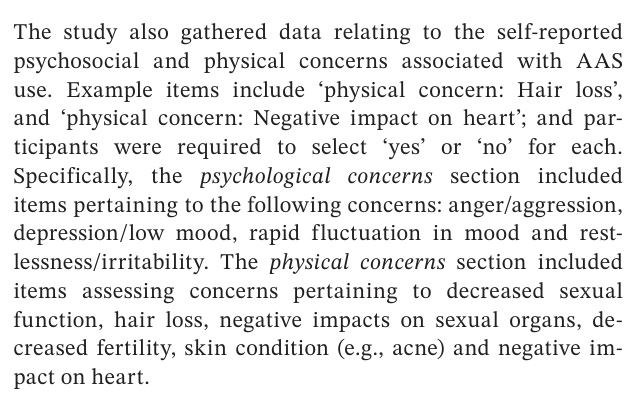
Participants answered yes or no to each concern. The figures measure how often people reported a problem, not how severe it was, how long it lasted or what caused it.
All 1,146 men used anabolic steroids, and trenbolone users could also take other steroids. This was a voluntary online survey conducted in 2024 and published in 2026, not a controlled experiment. Study methods.
For someone starting at 19, this study cannot estimate the effects on brain growth or the risk of bipolar disorder, anxiety or narcissistic personality disorder. The sample averaged 31.5 years old. Researchers did not measure brain development or establish permanent injury.
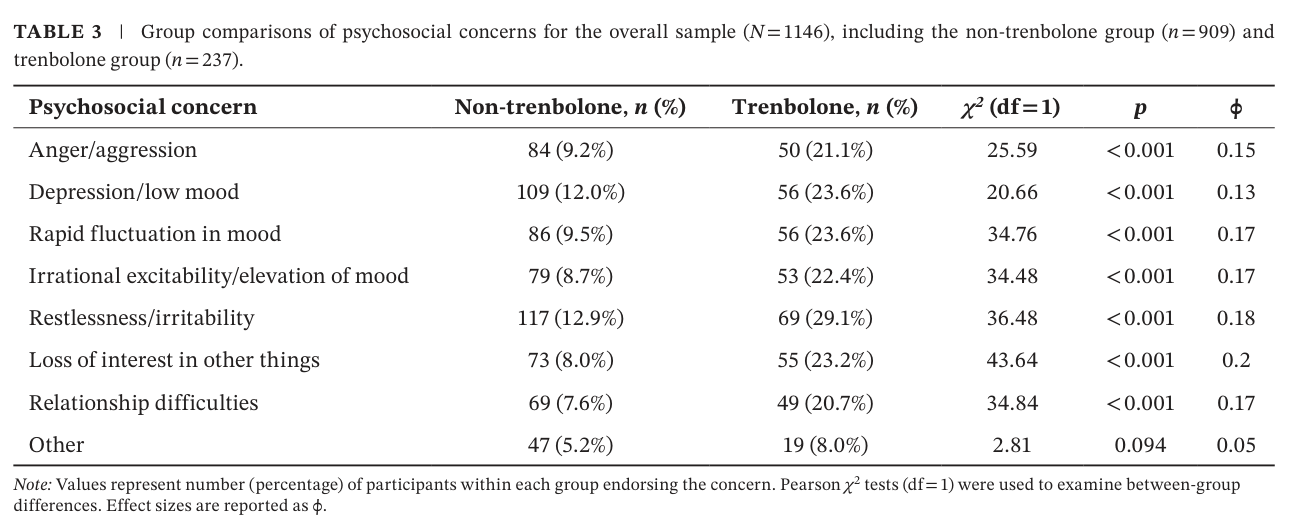
All seven named concerns met the study’s statistical threshold (p < 0.001); “other” did not (p = 0.094). This does not account for differences in dose, other drugs or pre-existing symptoms. Study results
Download the data · Download the comparison graphic
What could explain the difference?
The 2026 comparison cannot separate the effects of trenbolone from the other differences between these groups. People chose to take part, reported their own drug use and symptoms, and could use several steroids. The analysis did not account for differences in dose, cycle duration or drug combinations. Table 1
Oral steroids were reported by 189 of 237 trenbolone users (79.7%), compared with 349 of 909 comparison users (38.4%). That difference helps explain why we cannot attribute the entire gap in symptoms to one compound.
Researchers did not assess participants’ mental health before they began using steroids or follow them to see whether the concerns resolved. Pre-existing symptoms, other substances, selection into trenbolone use and differences in exposure can complicate interpretation. “Reported more often among users” is the supported observation. How much trenbolone itself contributed remains unresolved.
An earlier study provides a useful check on the interpretation. In 2024, a survey of 282 male AAS users included 93 current, 156 past and 33 never-users of trenbolone. Higher reported trenbolone dose was associated with verbal aggression after adjustment for age and BMI. The reported dose analyses did not find significant associations with psychological distress, physical aggression, anger or hostility. Piatkowski et al.
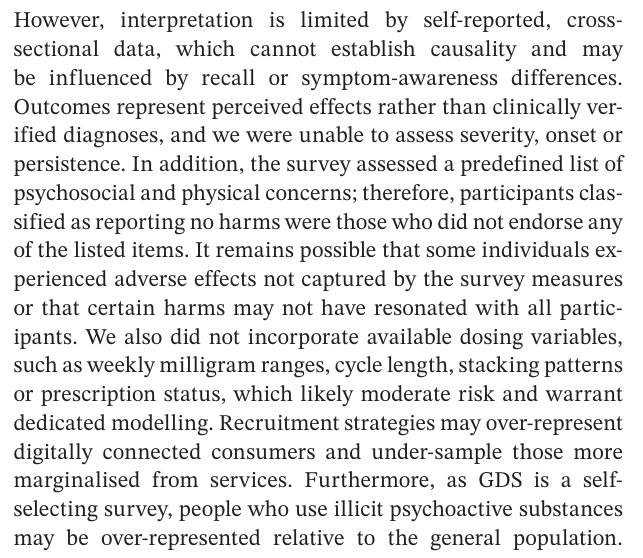
That narrower result belongs beside the larger 2026 comparison. The studies measured different things with different questionnaires and analyses. They cannot be treated as identical replications, and a nonsignificant result in one survey cannot establish absence of harm.
What users described in interviews
A 2023 qualitative study involving 16 Australian strength athletes explored perceptions and experiences of trenbolone. Accounts described aggression, difficulties regulating impulses and strain on social relationships. Interviews can reveal experiences a fixed questionnaire may miss. They cannot estimate how often those experiences occur in all users, and the interview sample should not be represented as 16 independently verified trenbolone exposures. Piatkowski, Neumann and Dunn
The useful connection is thematic: accounts of changes in social and emotional functioning resemble the kinds of concerns later surveyed. This adds context, not a third numerical risk estimate.
What other steroids tell us
There is experimental human evidence for psychiatric effects from an anabolic steroid, although it concerns testosterone, not trenbolone. A randomized crossover trial enrolled 56 healthy men aged 20–50 and compared escalating testosterone exposure with placebo. Among 50 evaluated testosterone periods, the authors classified 6 responses as moderately hypomanic and 2 as markedly hypomanic, based on mania-scale scores. During placebo periods, 1 response was moderate and none marked. Most testosterone responses were minimal. Pope, Kouri and Hudson, 2000
That is 8/50 versus 1/50 crossing the authors’ response thresholds. These post-hoc categories are not new diagnoses of lifelong bipolar disorder, and the result cannot supply a trenbolone-specific percentage.
Studies that follow users over time also show that responses vary. The 100-person HAARLEM study followed men before, during and after AAS cycles. Although participants reported adverse effects, average depression, wellbeing and quality-of-life scores did not change significantly. Group averages can coexist with difficult individual reactions. Smit et al., 2021
Together, these studies support taking possible mood effects seriously without claiming that every user experiences the same change.
Does trenbolone damage the brain?
Direct measurements of trenbolone’s effects on neural cells and brain chemistry come from experimental models, where translation to people is uncertain. A 2021 experiment in immature rat cortical cells found reduced neurite outgrowth with testosterone, nandrolone and trenbolone; trenbolone also reduced neuronal viability under the tested conditions. Neurites are the processes through which neurons form connections. This was a cell-culture experiment, not a measurement of a young person’s brain development. Zelleroth et al., 2021
More recently, a 2026 study in 32 male rats compared testosterone, nandrolone and trenbolone prodrugs and found compound-specific changes in neurotransmitter and brain-lipid profiles. This supports investigating differences between steroids. It does not establish a human psychiatric diagnosis, a safe exposure threshold or permanent injury. Zelleroth et al., 2026
Human MRI studies raise a broader AAS concern. A 2017 comparison of 82 long-term AAS users and 68 nonusing weightlifters found smaller average cortical and gray-matter volumes in users. But it was not a trenbolone-only study and had no pre-use scans showing the change within each person. “Smaller group-average volumes” cannot be rewritten as “trenbolone destroyed a percentage of the brain.” Bjørnebekk et al.
The evidence supports biological concern. It does not yet show that trenbolone causes permanent damage to a developing human brain.
What does this mean for someone starting at 19?
The central human comparison averaged 31.5 years of age. Its headline percentages are not estimates for 19-year-olds. Brain structure continues changing through adolescence and early adulthood, but normal developmental research does not identify a birthday after which high-dose AAS become neurologically safe. Mills et al., longitudinal developmental research
A small study of 71 adult AAS users, with cognitive testing in 22, associated adolescent initiation with greater impulsivity and some differences in on-cycle attention. It did not establish the effects of starting specifically at 19, and lacked measurements before first use. Hildebrandt et al., 2014
The diagnostic distinctions matter:
- Bipolar disorder: rapid mood changes and elevated-mood questionnaire responses do not establish an enduring bipolar disorder. The surveys do not provide the clinical history needed to separate a substance-associated episode from an independent condition.
- Narcissistic personality disorder: relationship problems, aggression or reduced empathy cannot establish NPD. A 2025 questionnaire study of 319 male bodybuilders linked AAS use with higher narcissism and aggression scores, but did not establish that steroids caused a personality disorder. It was not a trenbolone-specific causal study. Ceto et al.
- Anxiety: the table’s restlessness/irritability category is not an anxiety-disorder diagnosis. The 2024 trenbolone dose study’s distress result was nonsignificant; neither result establishes an individual person’s diagnosis or cause.
Answering the developmental question would require prospective measurements beginning before exposure, reliable information about compounds and co-use, and repeated psychiatric and brain assessments afterward. That is the missing evidence, not proof that early exposure is harmless. These studies cannot retrospectively explain one person’s personality or establish whether a particular change is permanent.
For the broader evidence on anabolic steroids, brain scans and starting young, read our anabolic steroids and the brain article.
Sources and methods
TitrateLab conducted a targeted review of primary papers and indexed primary-source records on September 29, 2026, searching for trenbolone, aggression, mood, adolescent AAS initiation and brain effects. This is a narrative synthesis, not a systematic review or pooled analysis. Human surveys, interviews, a testosterone trial, human imaging and animal and cell experiments remain separate evidence categories.
The on-page comparisons and downloadable infographic reproduce aggregate counts from Table 3 of Bonenti et al., checked against the full text. The downloadable graphic shows all seven named concerns; the on-page comparisons and dataset also retain the nonspecific “other” response. The original paper is published under CC BY 4.0; TitrateLab created the visualization and added descriptive calculations.
Each percentage is the number of men reporting a concern divided by the size of that group, multiplied by 100. “Times as common” is (trenbolone count ÷ 237) ÷ (comparison count ÷ 909). The percentage-point difference is 100 × [(trenbolone count ÷ 237) − (comparison count ÷ 909)] percentage points. Calculations use counts before rounding, so subtracting rounded percentages can give a slightly different last digit. They are unadjusted comparisons, not probabilities of harm caused by trenbolone.
Prepared with AI assistance for the TitrateLab Research Desk; no clinical review is claimed. See our evidence methodology, research library and corrections/contact page. Primary papers are linked beside the claims they support. The downloadable data include the published counts and our comparison calculations.
Source excerpts are unaltered rectangular crops from Bonenti et al., The Trenbolo(g)ne Sandwich, © 2026 the authors, CC BY 4.0. Original open-access PDF.