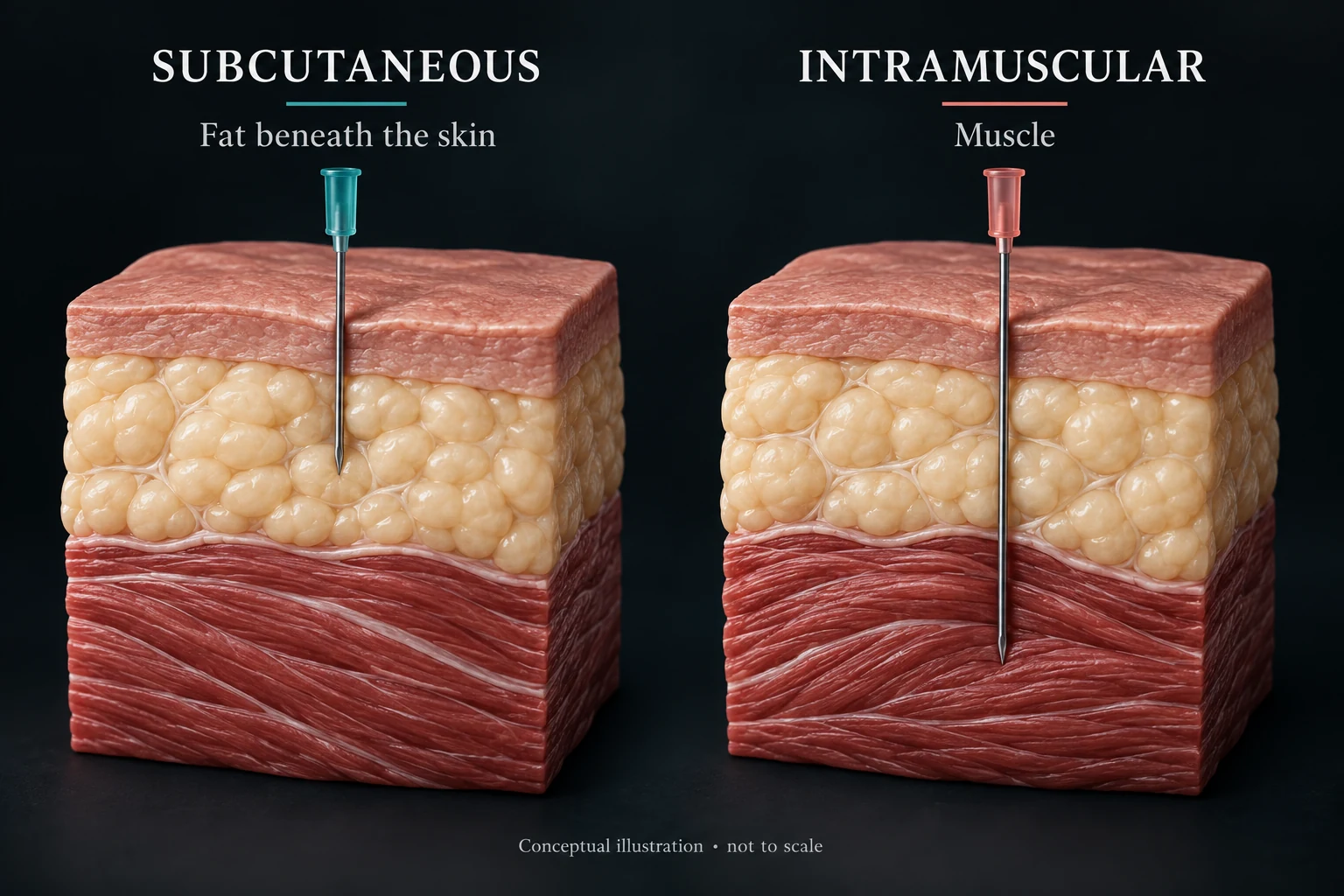
1. Similar exposure does not mean identical absorption
In a 2018 crossover study of 14 transgender men, mean dose-normalized testosterone exposure was 1.7 ± 0.6 with subcutaneous versus 1.9 ± 0.6 nmol·days/L/mg with intramuscular injections (p > 0.05). This measurement, the area under the concentration-time curve, describes exposure over time rather than absorption speed. Participants reported less injection anxiety and pain with subcutaneous delivery. The small study found no statistically significant exposure difference; it does not prove equivalence for everyone. Wilson et al.
One curve. Two different questions.
Exposure (AUC) measures the area under the blood-level curve over a sampling interval. Time to peak (Tmax) measures how long it takes to reach the highest level.
There is no single absorption rate for either route. For the subcutaneous enanthate product Xyosted, 137 participants with pharmacokinetic data reached peak testosterone a median 11.9 hours after injection at week 12; steady state was reached by week six. Those are product-specific findings, not an IM comparison or a percentage absorbed. Dose, formulation and schedule complicate comparisons. Prescribing information
2. Shorter needles offer a practical advantage
Needle length at a glance
Published examples illustrate the difference:
| Feature | Subcutaneous | Intramuscular |
|---|---|---|
| Target tissue | Fat beneath the skin | Muscle |
| Example injection needle | 25 gauge, 5/8 inch | 23 gauge, 1–1½ inches |
| Practical benefit | Shorter needle; less discomfort in some studies | Established labeled route for testosterone cypionate |
| Trade-off | Local lumps, redness or irritation | Deeper injection; potentially more discomfort |
These needle examples appear in Vanderbilt’s clinical handbook, updated August 2026; the subcutaneous size also appears in Spratt’s 2017 study. Higher gauge means a thinner needle. Selection depends on the product, injection site and tissue depth.
Subcutaneous injections are not irritation-free: 9 of 63 participants in Spratt’s cohort reported minor, temporary local reactions. Study abstract
3. The product matters as much as the route
In the U.S., Xyosted is labeled for subcutaneous use; Depo-Testosterone cypionate is labeled for IM use, making subcutaneous use of that product off-label. Approval for one formulation does not transfer to every testosterone injection. Xyosted label, Depo-Testosterone label
A 234-man comparison associated subcutaneous treatment with lower estradiol and hematocrit (the proportion of blood made up of red blood cells), but compared different esters and delivery systems. It cannot establish that route alone caused the difference. Choi et al., 2022
Both routes still require clinical oversight: testosterone can increase hematocrit and blood pressure and suppress sperm production. Route, needles and monitoring belong in the prescribing discussion. Current safety information
Sources reviewed September 28–29, 2026. AI-assisted literature synthesis; no independent clinical review. Educational information, not individual treatment instructions. Methodology and corrections.