What the bill requires
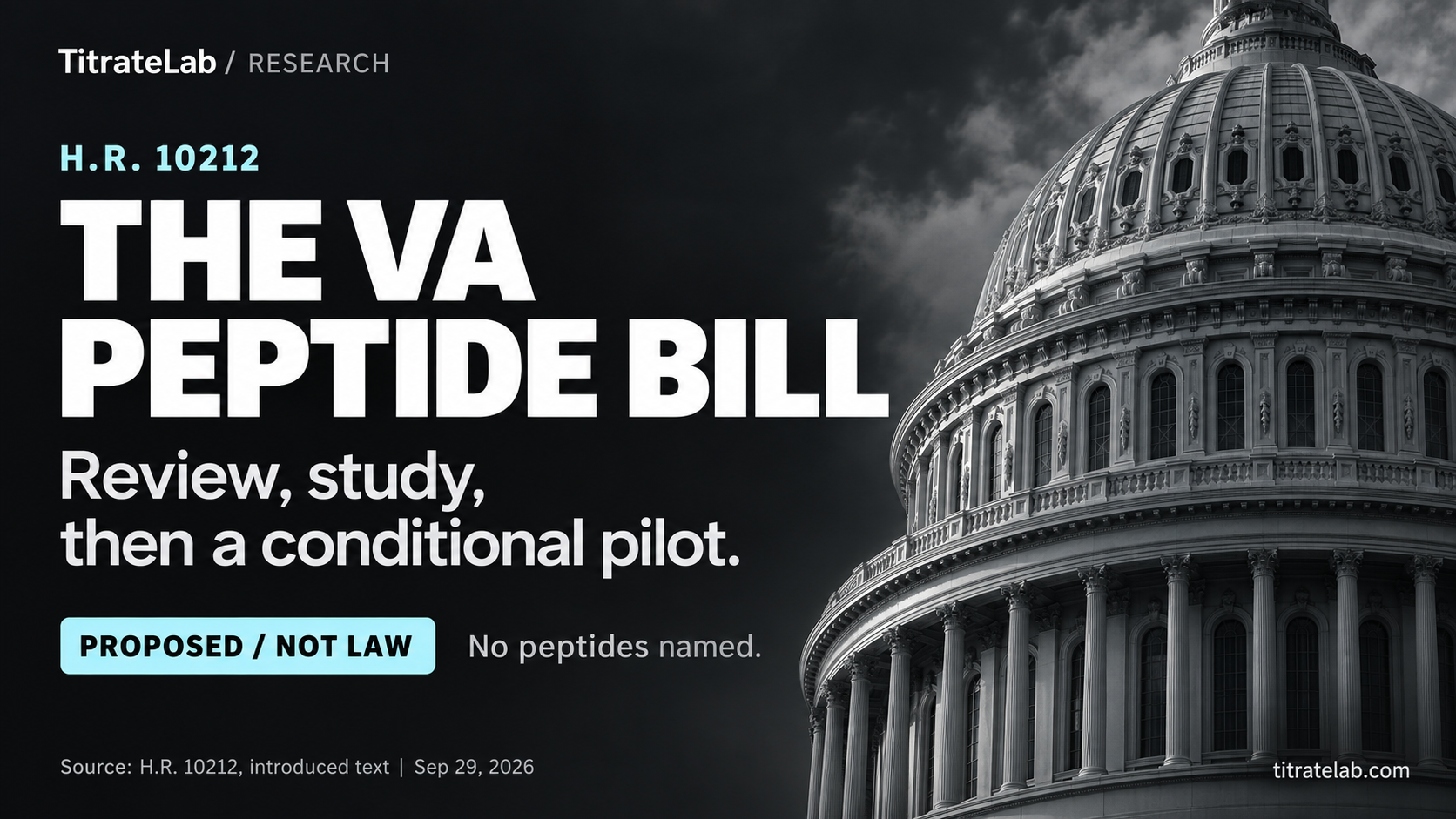
H.R. 10212 is the PEPTIDES for Veterans Act, introduced by Representative Nancy Mace on September 1, 2026. Its full title is the Providing Evidence-based Peptide Therapies to Improve Delivery and Expanded Services for Veterans Act. All of its operative provisions fit into two sections: a regulatory review, followed by a study and a conditional pilot.
The official bill-status record, retrieved September 29 and last updated September 24, lists referral to the House Veterans’ Affairs Subcommittee on Health on September 8 as the latest action. It records no passage or enactment. The deadlines below would begin only if the bill became law.
The agenda for the September 17-18 PepMed conference in Washington also references the proposal in its “Serving Those Who Served” veterans panel description. The agenda provides context for discussion of the bill; it does not establish a new legislative action or a change in VA treatment availability.
| Stage | What VA would have to do | Deadline or condition |
|---|---|---|
| Regulatory review | Review existing rules and guidance; define peptide and peptide-based therapy for this Act; explain the definitions to Congress. | Report within 180 days of enactment. Section 2, pages 2–3. |
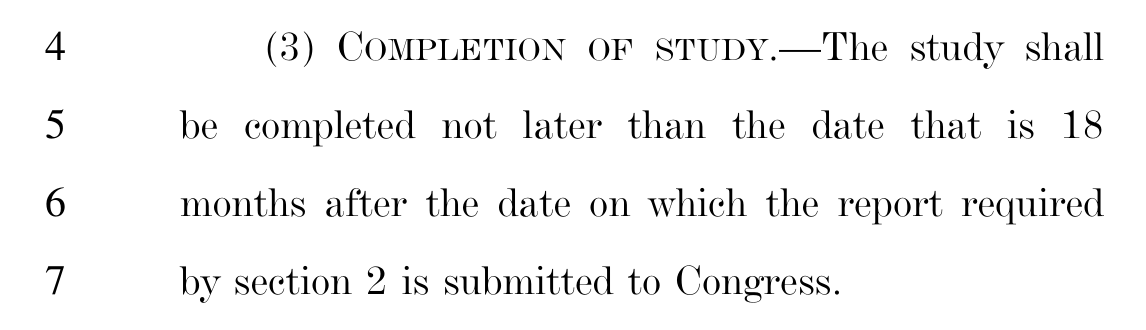
| Study | Review medical research, establish clinical protocols, assess safety and potential benefits, and decide whether therapies should be provided. | Starts when the regulatory report is submitted; completed within 18 months of that submission. Section 3(a), pages 3–4. |
| Treatment pilot | Make therapies available to participating veterans and assess outcomes. | Required if the Secretary’s study report determines that therapies should be provided. Section 3(b), pages 4–5. |
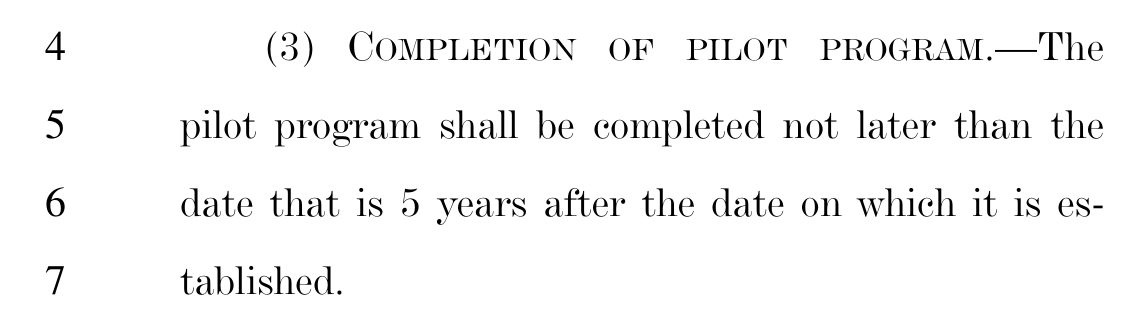
| Pilot completion and report | Report effectiveness, conditions improved, implementation guidance and challenges to Congress. | Pilot completed within five years of establishment; report upon completion. Section 3(b)(3)–(4), page 5. |
Those are maximum completion windows, not mandatory waiting periods. If VA used the full review and study windows, the study would finish roughly two years after enactment. The bill sets no separate deadline for establishing the pilot, so it does not supply a firm treatment-start date or an overall seven-year completion deadline. Read the timing provisions on pages 2, 4 and 5.
Which peptides would qualify? VA would decide the scope
The introduced text names no individual peptide. BPC-157 and TB-500, for example, do not appear anywhere in its five pages. Nor does it contain a list of eligible products, suppliers or treatment indications tied to specific compounds. Full introduced text.
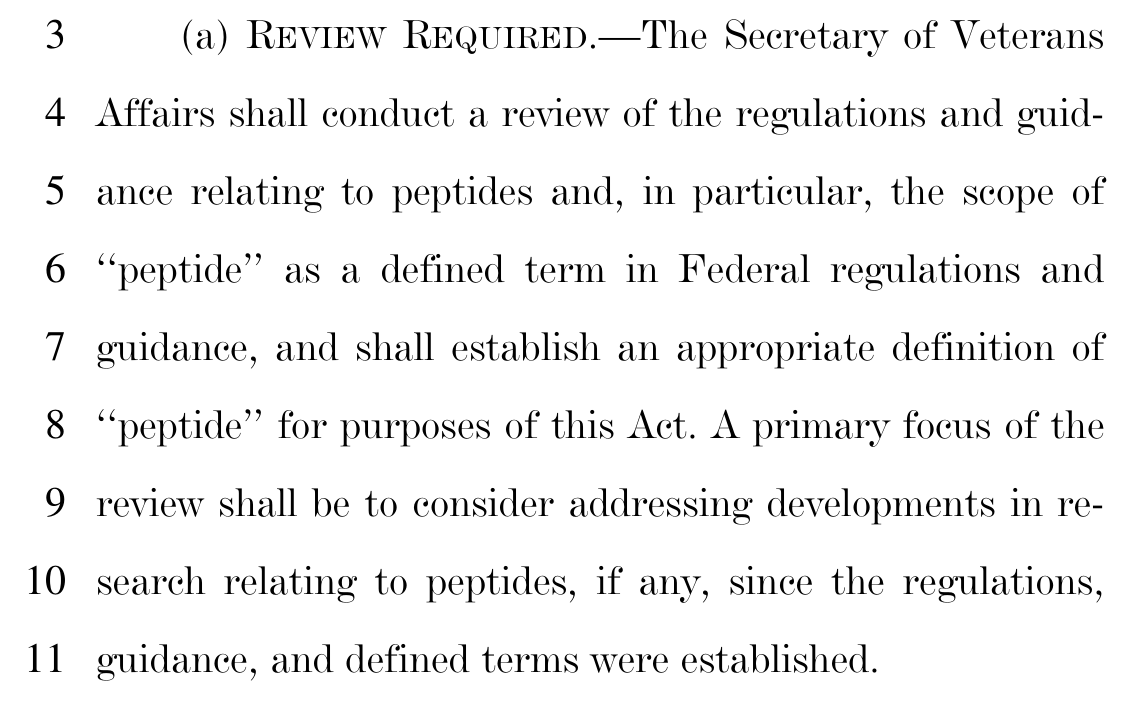
Instead, Section 2 requires VA to establish a definition of peptide for this Act and report a definition of peptide-based therapy. VA would have to consider research developments and explain any differences from definitions used elsewhere in federal regulations and guidance. The text confines these definitions to the Act; it does not say that VA can rewrite FDA rules generally.
That makes the scope decision substantive. Until VA defined the category and selected therapies, attaching a particular compound to this proposal would be speculation.
The study has a broad remit and an unspecified design
Section 3(a) directs VA to examine safety, efficacy and potential therapeutic benefits for veterans receiving care at VA medical facilities. It identifies recovery, rehabilitation, chronic pain, mental health, physical wellness and other service-connected conditions as areas for potential applications. It also requires a review of medical research and the establishment of clinical protocols. Section 3(a), pages 3–4.
The bill does not specify a randomized trial, participant count, comparator, dose, route of administration, outcome measure or statistical success threshold. It would therefore be premature to describe the proposal as a funded clinical trial of any named peptide. There is no appropriation or specified funding amount in the introduced text.
Our assessment is that the research mandate could create a useful decision process, but the eventual methods would determine what its findings could establish. A review of existing papers and a controlled clinical trial answer different questions. The legislation does not resolve which methods VA would use for each therapy.
Treatment access depends on the Secretary’s determination
The pilot is conditional on the Secretary’s study report determining that peptide-based therapies should be provided to veterans receiving care at VA facilities. If that condition is met, the text requires VA to carry out the pilot. The press release summarizes this as moving forward if therapies are found safe and beneficial; the actual bill uses the Secretary’s determination as the trigger.
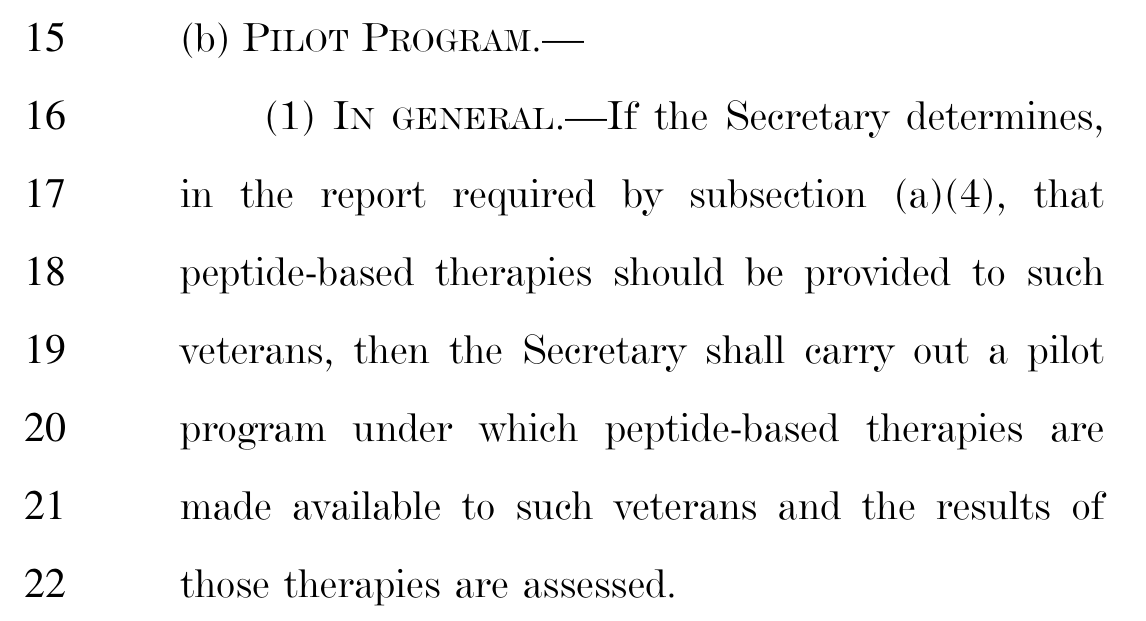
Participation would be voluntary. VA would also impose geographic, clinical or other limitations it considered appropriate. The bill specifies neither the number of participating facilities nor the number of veterans, and it creates no general enrollment offer that a reader can act on today. Section 3(b)(2), pages 4–5.
The pilot would end within five years of its establishment. Its final report would describe effectiveness, identify conditions improved, give guidance on large-scale implementation across VA facilities and explain challenges. Guidance on expansion is not a requirement to expand nationwide. The text also requires reports to Congress without expressly requiring public release of those reports or participant-level data. Section 3(b)(3)–(4), page 5.
What this proposal means for the peptide market
The concrete development is a proposal to make VA review the category, assess the evidence and explain whether access should follow. It contains no FDA approval, amendment to compounding eligibility or general authorization for commercial peptide sales. Its treatment provisions concern a VA pilot, subject to the Secretary’s determination and program limits. Sections 2–3.
FDA approval is a separate question from compounding access. The FDA explains that compounded drugs are not FDA-approved. Nothing in this proposal establishes the clinical effectiveness or quality of a vendor’s current product.
For TitrateLab readers, this is also a useful evidence distinction: a bill records proposed policy; a clinical study evaluates outcomes; a certificate of analysis reports measurements on a submitted sample. Our guide to verifying a peptide COA explains the last of these. Laboratory documentation cannot supply the clinical outcomes that this legislation asks VA to investigate.
The next meaningful developments would be an amended bill, committee or floor action and, if enacted, VA’s definitions, protocols and reports. Those documents would show whether the proposal becomes a specific research program and which therapies it actually covers.
Sources, method and evidence limits
TitrateLab Research Desk reviewed all five pages of the September 1, 2026 introduced bill, compared its requirements with the sponsor’s announcement, and checked the official legislative-status record on September 29. We also checked the PepMed conference agenda for the later discussion context; we did not review a recording or transcript of the panel. This is a document review, not a systematic review of peptide efficacy. Neither the bill nor the linked announcement supplies results from the proposed VA study or cites a completed study as its supporting paper.
The images are direct crops rendered from the official Government Publishing Office PDF. The text and printed line numbers are unchanged; captions identify the page and link back to the complete document. A legislative screenshot substantiates what the proposal says, not whether a therapy works.
- Official introduced bill, five-page PDF, September 1, 2026. This is the source for the requirements and omissions discussed above. Accessible HTML text is also available.
- Official bill-status data, updated September 24 and retrieved September 29, 2026. Congress.gov bill page. Status may change after this review.
- Mace’s announcement, September 1, 2026. This is the sponsor’s account of the proposal, not independent clinical evidence.
- PepMed 2026 conference agenda, for September 17-18 in Washington, checked September 29, 2026. The organizers’ veterans panel description references the bill. This supports the agenda reference, not any claim about remarks delivered or subsequent legislative progress.
- FDA: Understanding the Risks of Compounded Drugs, checked September 29, 2026. Used only for the distinction between compounding and FDA approval.
Prepared with AI-assisted document retrieval and drafting, with claims checked against the cited sources. See TitrateLab’s methodology. Send corrections with the relevant source to [email protected].