
Editor’s note, October 1, 2026: this URL first went up on July 2, 2026 as a pre-meeting draft. It was not marked as published in our system, but it was publicly reachable, showed a July 2 publication date and was listed on our research index with a Draft label. That draft forecast one or two favorable votes; the committee recommended six of seven. Its share card gave the committee’s 2024 record as “0-for-7” on peptides, but two of those seven substances are not peptides. It described lab entries reporting 0% purity as fraud and counterfeits, which a reported result does not establish, and it attributed motives to the panel without a source. It also promised a market-impact update 90 days after the vote; we have withdrawn that promise. We removed all of these and replaced the page with the post-vote record below.
What FDA proposed
FDA proposed that none of the 14 substances on the agenda be added to the 503A Bulks List. Each of the seven peptides was reviewed as two bulk drug substances, a free base and an acetate salt, and FDA’s briefing documents say of every one that FDA “is proposing that [it] NOT be included on the 503A Bulks List” (FDA briefing document introduction, section III).
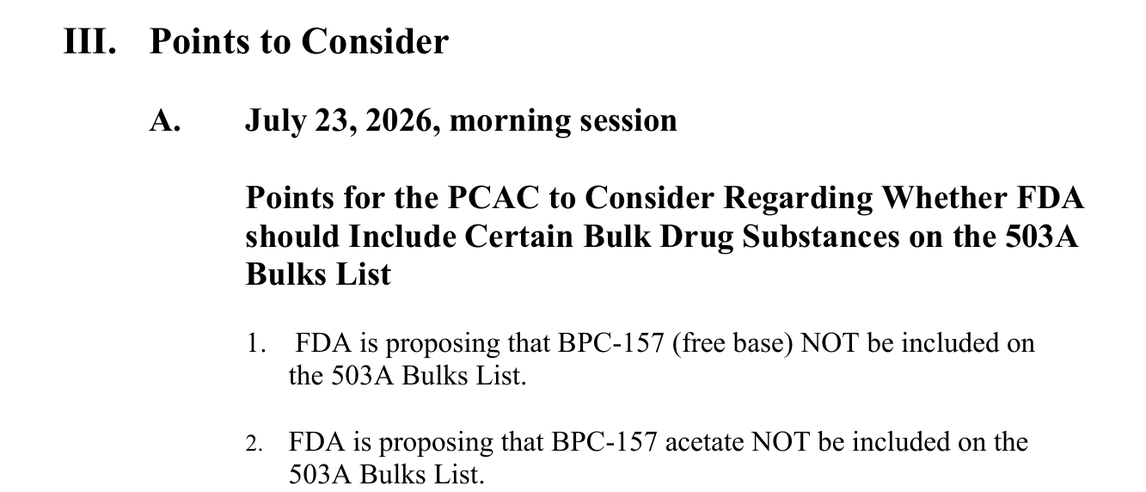
The agenda itself came from a Federal Register notice published April 16, 2026: FR Doc. 2026-07361 (91 FR 20465, docket FDA-2025-N-6895). It scheduled BPC-157, KPV, TB-500 and MOTS-c for July 23 and emideltide (delta sleep-inducing peptide, DSIP), Semax and Epitalon for July 24, and it named the use FDA reviewed for each. FDA does not evaluate a peptide in general. It evaluates the substance for named uses against four criteria set by its 2019 rule: physical and chemical characterization, safety, evidence of effectiveness, and historical use in compounding.
The briefing documents also show who asked. Wells Pharmacy Network nominated all seven, and LDT Health Solutions, on behalf of the International Peptide Society, nominated BPC-157, emideltide, Epitalon and Semax. Every one of those nominations had been withdrawn. FDA’s footnotes say it was “electing to proceed” with the presentations anyway.
| Peptide | Use FDA reviewed | What FDA’s review found |
|---|---|---|
| BPC-157 | Ulcerative colitis | FDA identified five small, short human studies. The only ulcerative colitis trial, a two-week enema study that randomized 53 patients, was reported only in a meeting abstract. The others gave enemas to healthy volunteers, knee or bladder injections, or IV infusions to two people. None used four of the proposed routes: by mouth, under-the-skin injection, nasal spray or skin. (briefing) |
| KPV | Wound healing and inflammatory conditions | The nomination did not include, and FDA did not find, any information on KPV given to humans. (briefing) |
| TB-500 | Wound healing | FDA found no report of TB-500, a seven-amino-acid fragment of thymosin beta-4, being given to patients for any condition. (briefing) |
| MOTS-c | Obesity and osteoporosis | Studies were limited to cell and rodent models. FDA found no clinical studies of safety or effectiveness in humans. (briefing) |
| Emideltide (DSIP) | Opioid withdrawal, chronic insomnia, narcolepsy | No studies used the proposed under-the-skin route. Small intravenous studies did not establish effectiveness; withdrawal studies reported headache, nausea, vertigo and some low blood pressure. (briefing) |
| Epitalon | Insomnia | FDA found no studies in patients with insomnia and no clinical data on safety in humans. (briefing) |
| Semax | Cerebral ischemia, migraine, trigeminal neuralgia | Evidence of effectiveness was insufficient, and FDA found no human pharmacokinetic studies by any route. Semax is registered as a nasal drop in Russia. (briefing) |
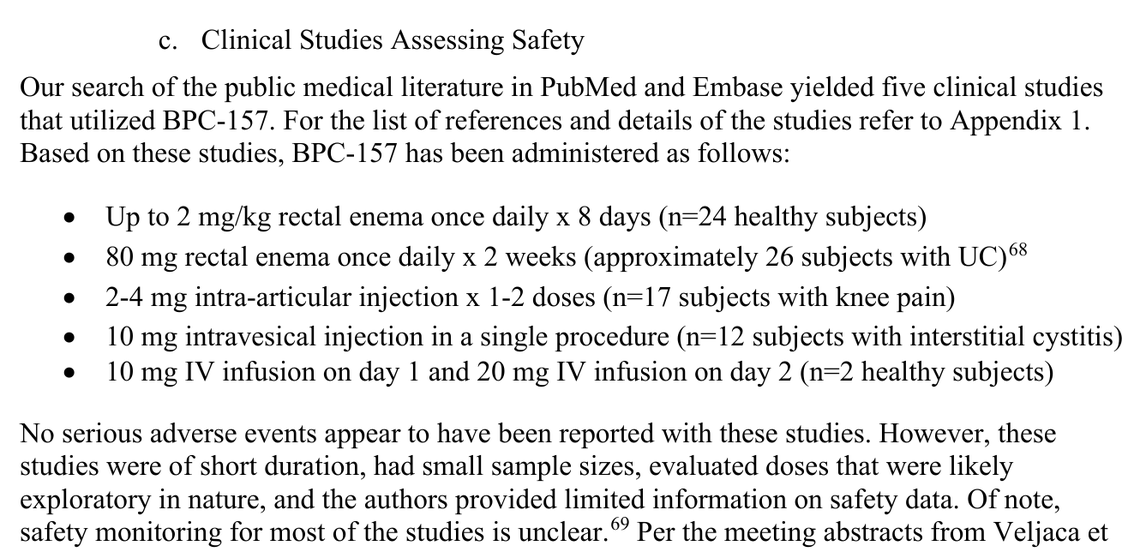
Three points recur across all seven documents. FDA judged every substance not well characterized physically and chemically, partly because names are used inconsistently and partly because tests for impurities, aggregates and microbial quality were missing or inadequate. For the injectable forms, that included bacterial endotoxin. FDA also raised the risk of an immune reaction to injected peptides and pointed to FDA-approved treatments for the conditions under review. Each morning, an FDA quality official also presented on substances that share a common name but differ in chemical form (FDA presentations, July 23). The documents were public by June 30, when NBC News reported that FDA scientists had found insufficient evidence to add any of the seven (NBC News, June 30, 2026).
Who sat on the committee
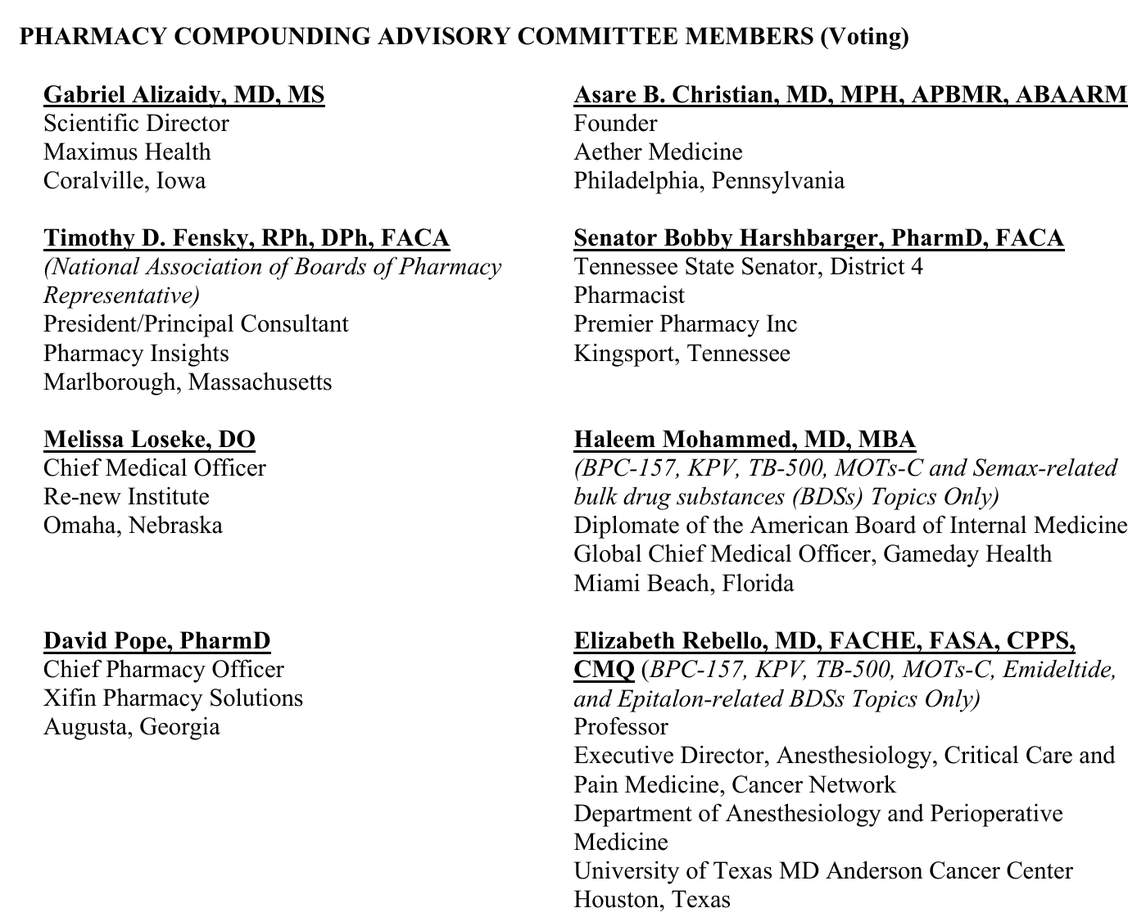
Nineteen people held votes, though not all on every peptide. FDA’s final meeting roster lists 11 standing voting members, eight temporary voting members brought in for some or all topics, one non-voting industry representative (Donnette D. Staas, PhD, of Jazz Pharmaceuticals) and a non-voting designated federal officer. The committee’s April 2026 charter renewal (FR Doc. 2026-08378) requires a core of at least 10 voting members and allows temporary voting members when expertise is needed.
| Voting member | Affiliation on FDA’s roster | Seat | Topics |
|---|---|---|---|
| Brian Serumaga, PhD | United States Pharmacopeia | Acting chair; USP representative | All |
| Gabriel Alizaidy, MD, MS | Maximus Health, Coralville, Iowa | Standing | All |
| Asare B. Christian, MD, MPH | Aether Medicine, Philadelphia | Standing | All |
| Timothy D. Fensky, RPh | Pharmacy Insights, Marlborough, Massachusetts | Standing; National Association of Boards of Pharmacy representative | All |
| Bobby Harshbarger, PharmD | Tennessee State Senate; Premier Pharmacy Inc, Kingsport, Tennessee | Standing | All |
| Melissa Loseke, DO | Re-new Institute, Omaha | Standing | All |
| Haleem Mohammed, MD, MBA | Gameday Health, Miami Beach | Standing | All except emideltide and Epitalon |
| David Pope, PharmD | Xifin Pharmacy Solutions, Augusta, Georgia | Standing | All |
| Elizabeth Rebello, MD | University of Texas MD Anderson Cancer Center | Standing | All except Semax |
| Joshua Starbuck, MD | Makena Health, Wailea, Hawaii | Standing | All |
| Kris H. Wusterhausen, DO | The Resurge Clinic, Weatherford, Texas | Standing | All |
| Todd Durham, PhD | Foundation Fighting Blindness | Temporary; consumer representative | All |
| Josh Mailman, MBA | NorCal CarciNET Community | Temporary; patient representative | All |
| William C. Zamboni, PharmD, PhD | University of Pittsburgh | Temporary | All |
| Brian P. Lee, MD | Keck School of Medicine of USC | Temporary | BPC-157 only |
| Maral Kibarian Skelsey, MD | Dermatologic Surgery Center of Washington; Georgetown University | Temporary | KPV and TB-500 only |
| Kevin L. Zacharoff, MD | Stony Brook University | Temporary | Emideltide only |
| Costantino Iadecola, MD | Weill Cornell Medicine | Temporary | Semax only |
| Friedhelm Sandbrink, MD | Veterans Health Administration | Temporary | Semax only |
Eight of the 11 standing voting members were new to these reviews. Alizaidy, Christian, Harshbarger, Loseke, Mohammed, Pope, Starbuck and Wusterhausen do not appear in FDA’s minutes of the committee’s two 2024 peptide meetings (October 29, 2024; December 4, 2024). Fensky, Rebello and Serumaga are listed as standing members in both sets of minutes. NPR also reported that eight new members were appointed before the meeting (NPR, July 23, 2026).
Reporting before and during the meeting described several members’ business ties. On June 29 the Associated Press reported that more than a half-dozen panelists run clinics, online businesses or pharmacies specializing in peptides. It named three: Mohammed, who runs Florida clinics in a chain that sells peptide, vitamin, testosterone and weight-loss injections; Alizaidy, who charges $500 for peptide and hormone consultations and promotes BPC-157 and other peptides on Instagram and TikTok; and Harshbarger, a pharmacist at his family’s pharmacy, which sells compounded medications (AP via PBS NewsHour, June 29, 2026). AP reported that Mohammed and Alizaidy did not immediately respond and that a Harshbarger spokesperson could not immediately comment. During the meeting AP put the count at at least seven doctors or pharmacists with financial ties to the peptide industry, and reported that FDA had added academics without industry ties that week (AP via PBS NewsHour, July 23-24, 2026). NPR reported that an HHS spokesperson said every member went through the standard ethics and vetting process.
How each vote went
Six peptides passed by two or three votes each. Emideltide failed by one. FDA’s tallies were not in the meeting materials we could check, so the table uses the full tally table published by the law firm McDermott Will & Schulte on July 27 (McDermott). STAT reported the same July 24 yes-no counts (STAT, July 24, 2026), Time reported the BPC-157 tally (Time, July 23, 2026), and AJMC reported the July 23 tallies and the emideltide result (AJMC, July 31, 2026).
| Peptide | Day | Use FDA reviewed | Yes-No-Abstain | Committee result | Voters listed for the topic |
|---|---|---|---|---|---|
| BPC-157 | July 23 | Ulcerative colitis | 8-6-1 | Recommended | 15 |
| KPV | July 23 | Wound healing, inflammatory conditions | 8-6-1 | Recommended | 15 |
| TB-500 | July 23 | Wound healing | 8-6-1 | Recommended | 15 |
| MOTS-c | July 23 | Obesity, osteoporosis | 7-5-2 | Recommended | 14 |
| Emideltide (DSIP) | July 24 | Opioid withdrawal, chronic insomnia, narcolepsy | 6-7-1 | Not recommended | 14 |
| Epitalon | July 24 | Insomnia | 7-4-1 | Recommended | 13 |
| Semax | July 24 | Cerebral ischemia, migraine, trigeminal neuralgia | 8-5-1 | Recommended | 15 |
The last column is our count of voting members the roster lists for each topic. Five tallies match it exactly. The Epitalon and Semax tallies, both from July 24, each account for one vote fewer than the roster lists (12 of 13 and 14 of 15). FDA has not posted the minutes that would show why.
FDA’s question list also provided separate votes for each peptide’s free base and acetate, while the published reports give one tally per peptide. In 2024 the committee first voted on whether to take a single vote for a group of related forms, and the minutes recorded that step. We could not confirm how the July 2026 votes were taken.
The discussion split along the lines the briefing documents set up. NPR reported that some panelists and industry speakers criticized FDA’s presentations for leaving out newer human data, and that FDA staff said they had considered everything submitted by the deadline and would weigh new information. Rebello, after casting a no vote, said she was concerned the committee was responding to market demand rather than science. Lee said he could not in good conscience vote yes. Christian, one of the new members, said “I think it’s about patient access,” NPR reported. NPR also reported that the new members voted in favor in almost all cases. FDA has not published member-by-member votes in the materials we could check.
The result reversed the committee’s 2024 pattern. FDA’s minutes show that in its two 2024 meetings on peptide-related nominations the committee agreed with FDA’s proposal every time: L-theanine 1-12, ibutamoren mesylate 1-13, ipamorelin 0-12 with one abstention, and kisspeptin-10 0-11 on October 29, 2024; then CJC-1295 forms 0-13 or 1-12, AOD-9604 0-12, and thymosin alpha-1 4-17 on December 4, 2024. Ibutamoren and L-theanine are not peptides.
What happens next
FDA decides, and adding a substance takes rulemaking. FDA’s meeting page states that advisory committees make “non-binding recommendations to the FDA, which generally follows the recommendations but is not legally bound to do so.” The 503A Bulks List is a regulation, 21 CFR 216.23, so FDA would have to publish a proposed rule, take public comments and then issue a final rule. Holland & Knight’s August 4 analysis lists that rulemaking, or an amendment to the statute by Congress, as the only ways to put these peptides on the list (Holland & Knight). FDA’s briefing introduction adds that its final determination may be affected by issues not discussed at the meeting.
Where the record stood when we checked:
| Record | What it showed | Checked |
|---|---|---|
| 21 CFR 216.23 on eCFR | Six substances, none of them peptides, all from FDA’s February 19, 2019 final rule (84 FR 4696) | Version current through September 29, 2026 |
| FDA Category 2 page | All seven under “Bulk drug substances nominated but withdrawn,” a list of substances “previously in category 2” whose nominators withdrew them, each still with FDA’s statement of potential significant safety risks | Internet Archive copy of June 8, 2026, marked “Content current as of 04/22/2026” |
| Federal Register API | No proposed rule naming these peptides, and no PCAC meeting notice after FR Doc. 2026-07361 | October 1, 2026 |
| Docket FDA-2025-N-6895 on regulations.gov | A non-rulemaking docket holding the April notice and 2,641 posted public comments | October 1, 2026 |
| FDA meeting page | Briefing documents, questions, agenda, roster and FDA slides; no minutes or transcript. FDA’s page could not be loaded by our tools, so we used the Internet Archive copy of September 14, marked “Content current as of 08/06/2026” | September 14 copy, read October 1, 2026 |
Latham & Watkins wrote on August 6 that FDA was reviewing the six recommendations and had not made a final decision (Latham & Watkins). Timing is uncertain. McDermott said rulemaking could occur in 2027 or take several years, and NPR reported it could stretch into 2027 or 2028. NPR also reported that Kennedy could possibly use special authority to make the peptides available sooner. We found no Federal Register document taking that step as of October 1.
A second meeting covers five more peptides. FDA announced in April that the committee would review cathelicidin (LL-37), GHK-Cu, dihexa acetate, melanotan II and PEG-MGF at a meeting before the end of February 2027 (RAPS, April 16, 2026). The July meeting’s notice ran about 14 weeks ahead. No notice for the second meeting had been published by October 1.
What the vote means for buyers
Nothing about these peptides’ legal status changed on July 24. None of the six is on the 503A Bulks List. Before the meeting, FDA’s Category 2 page, marked current as of April 22, 2026, already listed all seven as withdrawn nominations “previously in category 2”; leaving Category 2 did not put them on the list either. Holland & Knight wrote on August 4 that they still cannot be lawfully compounded and that FDA can continue to take enforcement action against pharmacies that make them. Section 503A governs drugs compounded by licensed pharmacists and physicians (FR Doc. 2026-07361). A listing would change what those pharmacies may compound; it would not address products sold online outside that system.
A future listing would not make a compounded peptide an approved drug. FDA’s opening presentation on July 23 set out what listing means. A product compounded from a listed substance is not FDA-approved. It need not carry a label telling patients and prescribers how to use it. It need not meet current good manufacturing practice, although the ban on insanitary conditions still applies. A 503A compounder is not required to report adverse events to FDA. Unless the entry is limited, the substance can be compounded for any use and by any route. The regulation itself states that there are inadequate data to show the safety or efficacy of any drug compounded from a listed substance, and that calling such a drug FDA-approved makes it misbranded (21 CFR 216.23(d)).
The vote did not create the human evidence FDA said was missing. For KPV and TB-500, FDA found no human use at all in the record it reviewed. For MOTS-c it found no clinical studies, and for Epitalon no studies in insomnia. Those gaps stand whatever FDA decides about compounding. This article reports the regulatory record; it is not medical advice.
Lab reports answer a narrower question. FDA’s characterization concerns name specific tests. None of the example certificates of analysis its reviewers examined for TB-500 and Semax reported aggregate testing, most did not report bacterial endotoxin, and the free-base examples reported no impurity results. TitrateLab’s archive shows how rarely grey-market lab reports for these seven compounds include an endotoxin result.

| Compound (FDA name) | Published report entries | Median reported purity (results) | Within 10% of labeled amount (results) | Entries reporting 0% purity | Endotoxin pass/fail results |
|---|---|---|---|---|---|
| BPC-157 | 4,055 | 99.4% (4,001) | 39% (3,517) | 58 | 173 (4.3%) |
| MOTS-c | 3,815 | 99.5% (3,814) | 51% (3,305) | 8 | 155 (4.1%) |
| TB-500 | 2,092 | 99.3% (2,084) | 47% (1,765) | 33 | 67 (3.2%) |
| KPV | 1,645 | 99.7% (1,628) | 41% (1,444) | 0 | 93 (5.7%) |
| Semax | 1,468 | 99.5% (1,466) | 33% (1,265) | 0 | 49 (3.3%) |
| Epithalon (Epitalon) | 1,220 | 99.6% (1,215) | 50% (1,037) | 1 | 48 (3.9%) |
| DSIP (emideltide) | 898 | 99.3% (898) | 43% (772) | 0 | 30 (3.3%) |
| All seven | 15,193 | 100 | 615 (4.0%) |
Source: TitrateLab compound lab-report pages, aggregates calculated at about 00:31 UTC on October 1, 2026, covering published entries with a purity or measured-amount result through September 24-29, 2026 depending on the compound. Percentages in the last column use the entries column as the denominator.
Every one of the 615 classifiable endotoxin results was a pass. Counting every entry with any recorded endotoxin value raises the total to 647 of 15,193 (4.3%). The other 32 are 16 numeric readings with no stated verdict, 13 entries marked only “reported”, 2 marked “borderline” and 1 marked “Conforms”; our method does not classify these as pass or fail. Median purity is high for all seven, but between 33% and 51% of the results with a measured amount fall within 10% of the labeled amount, depending on the compound. These figures describe what was tested and published, not the market as a whole. A report covers one sample, the archive counts entries rather than unique certificates, and buyers and sellers choose which vials to test. A 0% purity entry is a reported result, not a confirmed identity failure. For how to read a report against its vial, see How to verify a peptide COA; for endotoxin evidence specifically, see our endotoxin review and the endotoxin findings ledger.
What we could not verify
- FDA’s own vote record. The tallies come from reporting that agrees across McDermott, STAT, Time and AJMC, not from FDA minutes or a transcript. FDA’s December 2024 minutes said transcripts usually follow 10 to 12 weeks after a meeting.
- How the forms were voted. FDA’s questions called for separate free base and acetate votes; reports give one tally per peptide.
- The Epitalon and Semax counts. Each reported tally is one vote short of the roster.
- Individual votes and conflict-of-interest statements. We have not seen member-by-member votes or the conflict-of-interest statement read into the record. Statements about members’ business ties are AP’s and NPR’s reporting, and HHS’s response is as NPR reported it.
- The live FDA page. FDA’s site refused our automated requests on October 1, so the status of the meeting page comes from the Internet Archive copy of September 14. FDA may have posted minutes since.
- Lab-report coverage. The archive is a convenience sample of published reports. It does not measure clinical safety, effectiveness or the quality of compounded products.
Method, sources and corrections
We read the Federal Register notice in full and FDA’s meeting documents: the briefing introduction, the conclusions and selected evidence sections of all seven substance reviews, the questions, final agenda, final roster and the opening FDA presentation of July 23. FDA’s site blocked automated access on October 1, 2026, so we read these documents from Internet Archive copies of the same fda.gov addresses linked here, captured between July 24 and September 15, 2026 (the 2024 minutes from January 15 and September 14, 2026 captures), and FDA’s Category 2 page from a June 8, 2026 capture. The page images in this article are crops of those archived FDA files, rendered on October 1, 2026; each caption gives the page and capture date. We compared the July 2026 roster with the attendance lists in FDA’s October 29, 2024 and December 4, 2024 minutes. On October 1 we queried the Federal Register API for FDA documents from June 1, 2026 onward, read 21 CFR 216.23 through the eCFR API (Title 21 current through September 29, 2026), and read the regulations.gov API record for docket FDA-2025-N-6895. Lab-report figures come from TitrateLab’s public compound pages; the “any endotoxin entry” count is a read-only query of the same published records.
Primary sources:
- Federal Register, FR Doc. 2026-07361, meeting notice, April 16, 2026.
- Federal Register, FR Doc. 2026-08378, committee charter renewal, April 30, 2026.
- FDA, July 23-24, 2026 meeting page and its materials: briefing introduction; briefing documents for BPC-157, emideltide, Epitalon, KPV, MOTS-c, Semax and TB-500; questions; final agenda; final roster; FDA presentations for July 23 and July 24.
- FDA, Certain Bulk Drug Substances for Use in Compounding that May Present Significant Safety Risks (Category 2 page), content current as of April 22, 2026.
- FDA, PCAC summary minutes for October 29, 2024 (approved January 15, 2025) and December 4, 2024 (approved February 21, 2025).
- eCFR, 21 CFR 216.23.
- Regulations.gov, docket FDA-2025-N-6895.
Reporting and analysis:
- AP via PBS NewsHour, panel composition, June 29, 2026, and meeting coverage, July 23-24, 2026.
- NPR, FDA advisers vote to ease peptide restrictions, despite agency concerns, July 23, 2026, updated July 24.
- STAT, July 24 votes, July 24, 2026.
- Time, July 23 votes, July 23, 2026, updated July 24.
- McDermott Will & Schulte, tally table and next steps, July 27, 2026.
- AJMC, FDA Panel Backs 6 Peptides for Compounding, July 31, 2026.
- Holland & Knight, legal status after the vote, August 4, 2026.
- Latham & Watkins, FDA’s review of the recommendations, August 6, 2026.
- RAPS, second meeting scope, April 16, 2026.
- NBC News, FDA staff findings before the meeting, June 30, 2026.
TitrateLab takes no position on whether these peptides should be compounded. This article was prepared with AI-assisted document retrieval and drafting, with each claim checked against the sources above; see our methodology. We will update it when FDA posts the minutes or transcript, publishes a proposed rule, or notices the second meeting. Send corrections with the relevant source to [email protected].
