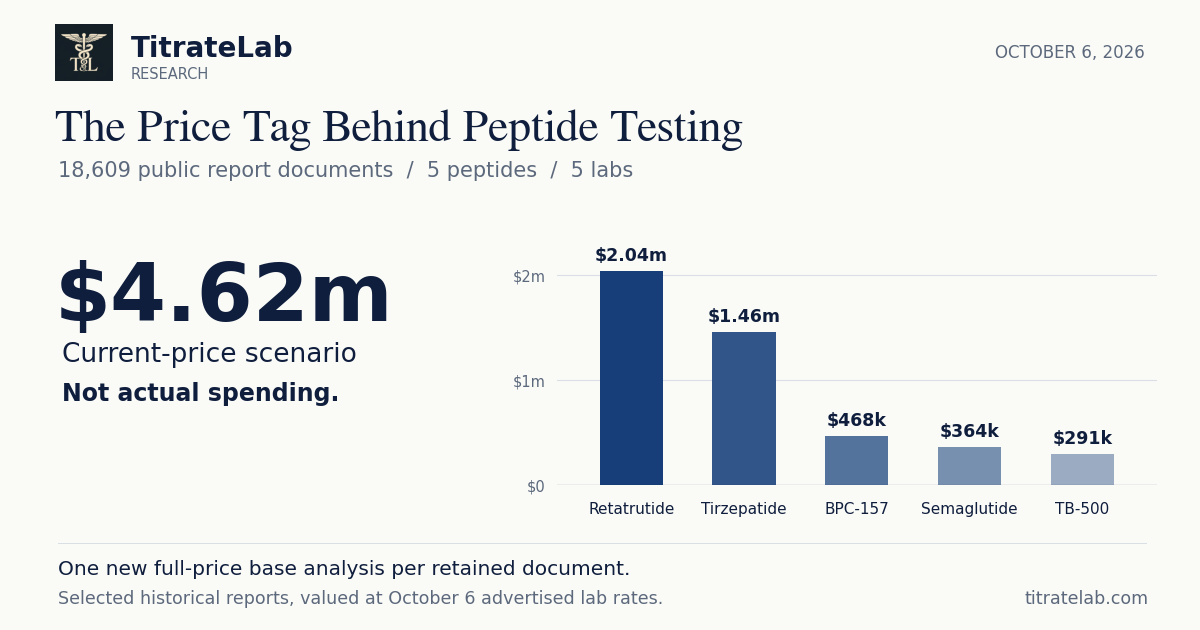
Five peptides account for the $4.62 million scenario
Retatrutide contributes $2,036,115, the largest amount in this selected record. Tirzepatide follows at $1,456,535. BPC-157, semaglutide and TB-500 account for the remaining $1,123,610.
We matched each retained document to its named laboratory and compound, then applied that laboratory’s current advertised base rate. This prices the published record under one assumption: every document represents a new full-price base analysis.
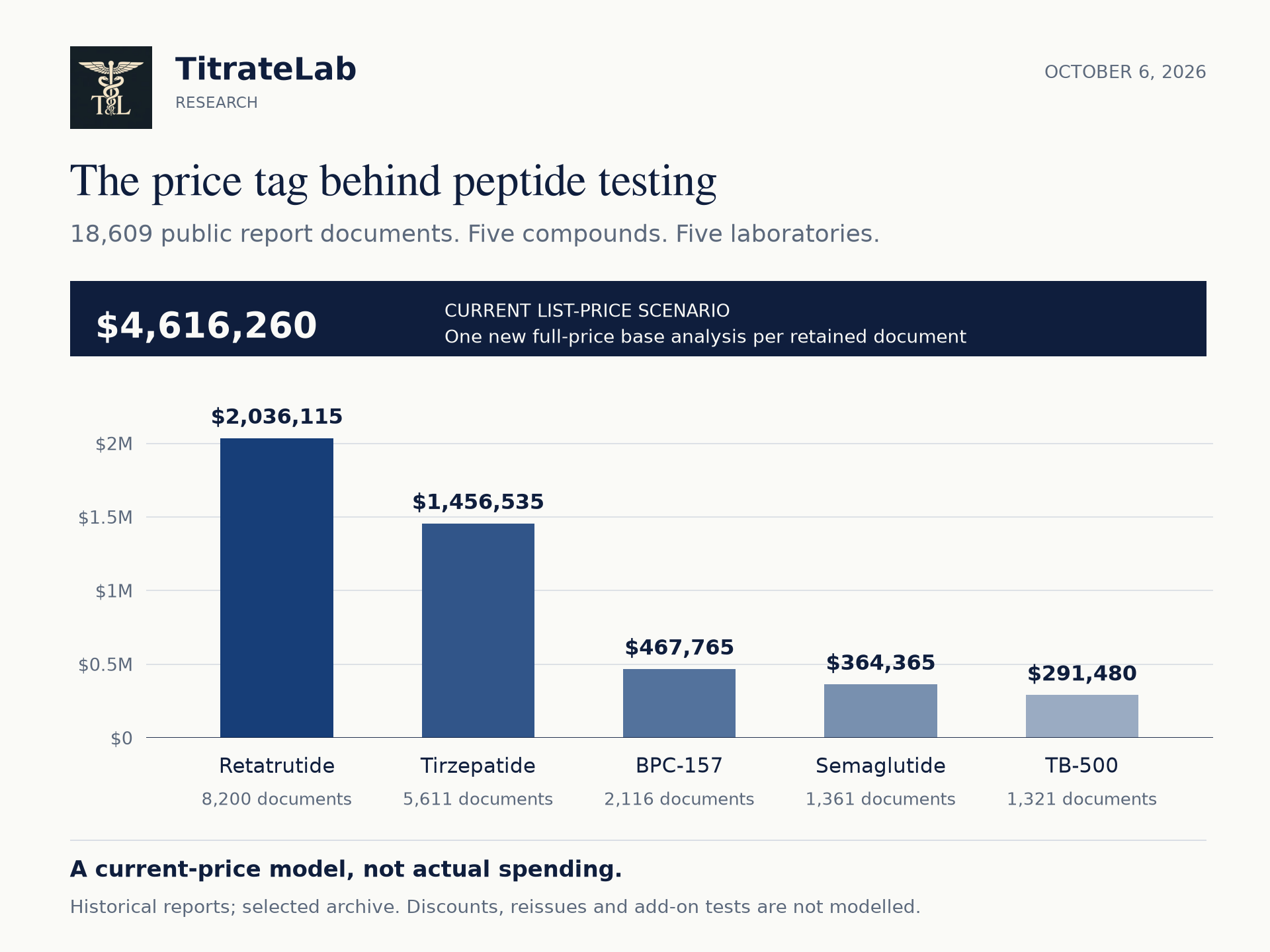
| Peptide label group | Retained documents | Current-price scenario, USD |
|---|---|---|
| Retatrutide | 8,200 | $2,036,115 |
| Tirzepatide | 5,611 | $1,456,535 |
| BPC-157 | 2,116 | $467,765 |
| Semaglutide | 1,361 | $364,365 |
| TB-500 | 1,321 | $291,480 |
| Total | 18,609 | $4,616,260 |
These are documents, not unique batches or confirmed new paid tests. Each priced document appears once. Named blends and reports covering multiple compounds are excluded. Download the 25-cell calculation and price sources.
What the laboratories currently charge
The selected base services range from $180 to $360. Their scopes differ, so the cheapest price is not automatically an equivalent test.
| Laboratory | Reta | Tirze | Sema | BPC-157 | TB-500 |
|---|---|---|---|---|---|
| Janoshik | $360 | $360 | $360 | $215 | $215 |
| Freedom Diagnostics | $225 | $225 | $225 | $225 | $225 |
| Chromate | $300 | $300 | $300 | $180 | $180 |
| Vanguard | $250 | $250 | $250 | $250 | $250 |
| ILS Laboratories | $200 | $200 | $200 | $200 | $200 |
Janoshik’s $360 GLP-1 service includes blind identification among retatrutide, tirzepatide and semaglutide, plus quantity and purity. Its BPC-157 and TB-500 family analyses list $215. Older named-compound reports need not have used today’s blind-test service.
Freedom’s $225 combines $200 for purity and identification with $25 for measured content. ILS lists HPLC retention-time identity, purity and quantity; LC-MS is a separate custom option. Chromate lists qualitative and quantitative HPLC. Vanguard’s $250 Silver package lists identity, quantity and purity without specifying the identity instrument in its price table.
Our testing-lab comparison explains the methods and contamination panels. Use the dated menus here for current prices, and confirm the exact compound, form and service with the lab.
Retatrutide’s $2.04 million breaks down like this
Most retained retatrutide documents name Freedom Diagnostics. That collection pattern drives the result as much as the rate charged.
| Laboratory | Documents | Rate used, USD | Current-price scenario, USD |
|---|---|---|---|
| Freedom Diagnostics | 6,641 | $225 | $1,494,225 |
| Janoshik | 1,314 | $360 | $473,040 |
| Chromate | 184 | $300 | $55,200 |
| ILS Laboratories | 32 | $200 | $6,400 |
| Vanguard | 29 | $250 | $7,250 |
| Total | 8,200 | $2,036,115 |
For example, 1,314 × $360 = $473,040 for Janoshik. The arithmetic is exact under the assumption. The reports do not establish that each was a new full-price order. Laboratory totals also reflect which sources we collected and parsed successfully.
Two certificates can come from one physical test
This is the main obstacle to calling the result “money spent.” A second branded certificate can document the same analysis without a second full-price test. Janoshik’s GLP-1 menu makes the distinction visible:
Freedom’s submission system also distinguishes extra-company certificates from new physical tests. ILS lists $100 additional-brand COAs and $50 conformity samples. Janoshik lists a $75 same-batch variance option.
Removing duplicate document copies cannot resolve all those relationships. Our archive generally lacks order links, historical rates and invoices. Volume discounts also depend on order size or invoicing terms; we have not applied a blanket discount.
Conversely, the model excludes separately ordered contamination panels, rush work, shipping, tax and submitted vials. Private tests are outside the archive. The $4.62 million scenario is neither a spending floor nor a ceiling.
What to ask when a vendor says it spends heavily on testing
A certificate library provides evidence to inspect. To connect it to a spending claim, ask for the details certificates cannot supply.
Separate new analyses, extra sampled vials, additional-client certificates and contamination panels. Each can carry a different price.
Ask for dated invoices or order summaries. Today's menu cannot reveal a historical negotiated rate or who commissioned the work.
Connect reports to the sampled stock, release decisions and rejected lots. Show what the work accomplished.
Spending more does not guarantee every vial matches its label. Our retatrutide substitution advisory shows why identity and measured amount belong beside the purity percentage.
How we built the calculation
This is an October 6 archive snapshot valued at October 6 menu prices. Recorded dates span November 27, 2020 to October 5, 2026; 11 priced records lack one unambiguous valid date. It is not annual 2026 spending.
The broader archive includes unresolved seller attribution. A parallel subset restricted to reviewed seller cohorts contains 3,616 priced documents, producing $951,660 under the same assumption. Neither is a verified census of gray-market transactions.
Inspect the selection rules and exclusions
We started with 114,309 published rows, grouped into 113,493 report groups under existing deduplication rules. Of those, 30,623 intersected the five selected compounds and five named laboratories.
There were 18,737 initial candidates with numeric purity, measured mass, supporting artifact metadata or a report reference, and one eligible compound and laboratory. Another 128 documents were held: 116 in unresolved duplicate-identifier groups and 12 labelled endotoxin-only despite populated purity and quantity fields. That leaves 18,609 priced documents and 12,014 unpriced groups within the selected population.
Blends, multiple analytes, conflicting laboratory labels and unsupported evidence were excluded. Strong certificate identities and hashes remove supported copies. No exhaustive certificate-reissue or invoice audit was performed.
Finnrick is a report publisher and testing coordinator, not a laboratory price category. We do not guess the lab behind an anonymous code. Other labs and compounds remain unpriced, not zero-cost.
The formula is retained document count multiplied by the current base rate for the named laboratory and compound. TB-500 forms must still be checked against the source certificate; a fragment and a full-length peptide are not interchangeable.
Prepared by TitrateLab Research Desk, reviewed October 7, 2026, with AI assistance for source collection, calculation and drafting. See our evidence methodology, download the calculation or submit a correction.
