October 13 update: two deaths reported after products sold as retatrutide
Two original FDA case reports describe deaths after people used products represented as retatrutide. We obtained and read the redacted PDFs that CBS published alongside its FOIA reporting. They confirm the existence and contents of the reports; they do not establish what was in the products or what caused the deaths. FDA case 26994067 · FDA case 27232662.
- Case 26994067: event dated July 10, 2026, received by FDA July 12. The report describes cardiac arrest and lists both retatrutide and kava as suspect products. Its narrative describes an unreliable retatrutide source without establishing a supplier. The kava entry is additional reported context, not a finding of cause. Report, pp. 1–2 and 4.
- Case 27232662: event dated September 3, 2026, received by FDA September 9. The submitter alleges that a nurse supplied a product link, sold vials and recommended doses. The narrative names AlphaLabs; an attached photo shows an AlphaLabs vial labelled retatrutide 30 mg. These are submitted allegations and a label photograph, not FDA verification of the supplier or contents. Report, pp. 1–3 and 9.
Go Alpha Labs disputes that the material establishes it supplied the product. In its published response, the company’s lawyer cites packaging differences, missing legible lot and order information, and an undocumented chain of custody. The company says it cannot confirm that the patient or nurse was its customer. The report and response do not resolve that dispute. Read the full company response.
These reports do not establish that retatrutide caused the deaths. FDA explains that adverse-event reports can be incomplete, duplicated or unverified and cannot establish causation or an event rate. Reading the released files is not independent clinical verification. Neither file establishes a connection to the 13 businesses profiled below. FDA’s adverse-event data limitations.
FDA already says retatrutide is unapproved and cannot be used in compounding under federal law. Its current guidance describes warnings to telehealth marketers, ingredient distributors and outsourcing facilities. Our assessment: continued scrutiny is plausible, but we found no newly announced FDA enforcement campaign tied to these two reports. They are a reason to investigate, not evidence of a particular future prosecution. FDA’s current position.
This is a separately dated news update. It does not add two enforcement cases to the 89-matter collection ending October 10 or change its compound counts. The company profiles and source-linked outcomes follow below.
These 13 company profiles bring together the shop’s known names, dated activity, products, evidence and recorded outcome. The historical activity window ends October 10, 2026. An October 13 document check added the original FDA reports, Striker’s defense and scheduling filings, and a clarification about conflicting ITC records. Texas Peptides’ reported settlement remains separately attributed. We checked sources for all 13 profiles, but incomplete public dockets and agency records prevent a complete current-status certification. Activity observations, corporate formation and legal milestones remain distinct. Historical website names identify the source’s business; they are not verified current contacts.
Milestone Purity: a new storefront and a 21-month sentence
Known as: Milestone Purity, also styled MilestonePurity, at milestonepurity.com. Named operator: Brandon Piper. The information describes his earlier work for an unnamed Canadian business from at least October 2023 to around August 2024, followed by the establishment of Milestone Purity around August 2024. The Canadian business’s earlier history should not be assigned to the new shop. The charged conspiracy continued to around May 2025; that is not a verified storefront closure date. Information, paragraphs 6–7, 15 and 22.
Products and evidence: semaglutide and tirzepatide. DOJ describes China-sourced drugs sold without prescriptions, false American-origin claims and research-only statements despite known personal use. FDA’s criminal investigators prepared the case, but the reviewed documents do not establish the original tip or trigger. DOJ announcement.
Outcome: DOJ announced 21 months in prison on July 23, 2026 for a conspiracy to introduce misbranded drugs with intent to defraud and mislead. The announcement does not independently give the hearing date or complete financial sentence. This record does not name retatrutide. Sentencing announcement.
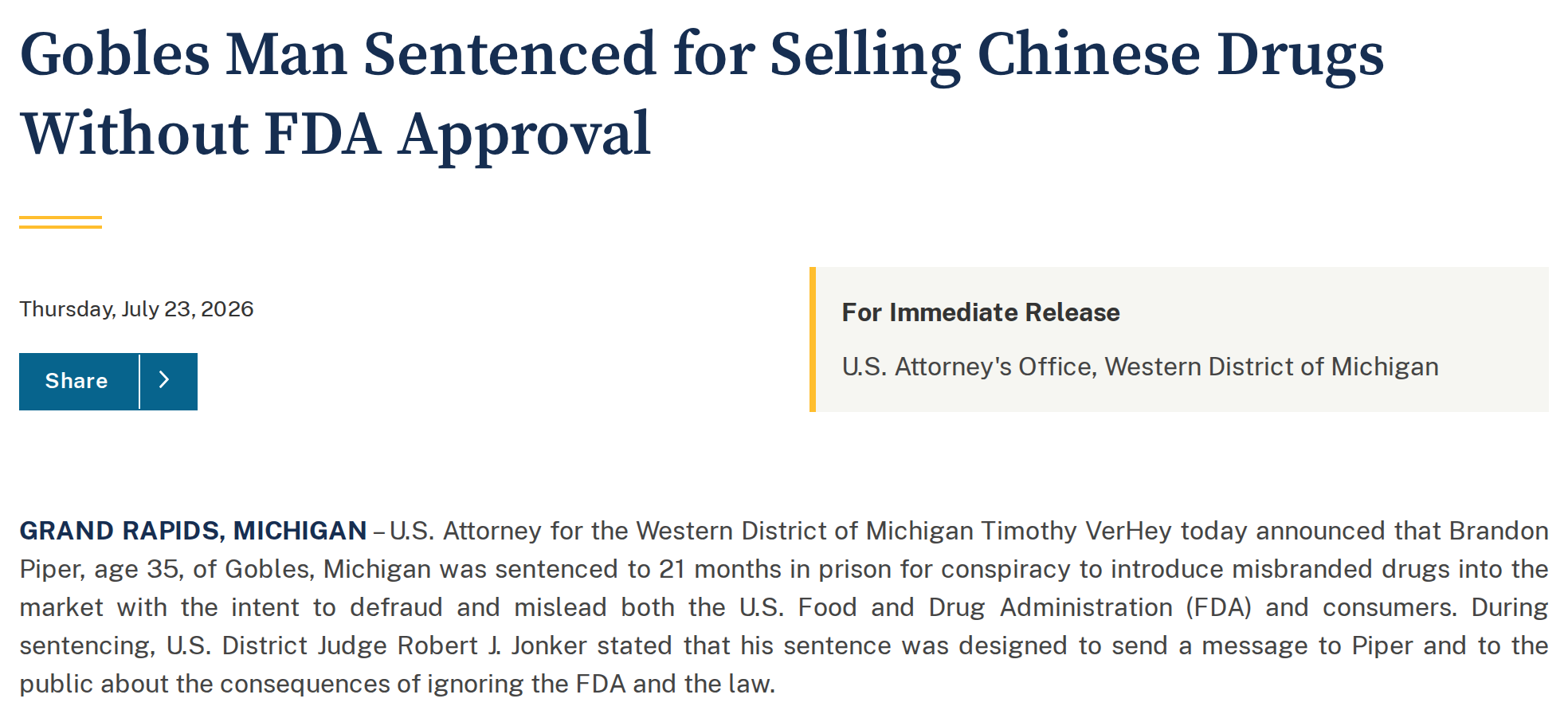
Read the Milestone Purity case study and timeline.
Paradigm Peptides: forged COAs, prison and $5 million forfeiture
Known as: Paradigm Peptides, Paradigm RE LLC or Paradigm R.E. LLC, at paradigmpeptides.com. Named people: owner Matthew J. Kawa and employee Jennifer L. Stechkober. Documented sales period: approximately April 2019–March 2024, admitted in Stechkober’s plea; her own employment began around February 2020. These dates describe conduct and sales, not corporate formation or dissolution. Plea, pp. 4–6 · DOJ case page.
Products and evidence: a mixed catalog of peptides, hCG and SARM-labelled products. Stechkober admitted forged certificates of analysis and false manufacturing, purity and FDA-registration representations. The plea says marketing continued after a March 30, 2022 FDA warning until March 20, 2024. It does not establish the original criminal-investigation trigger. Plea, pp. 4–7.
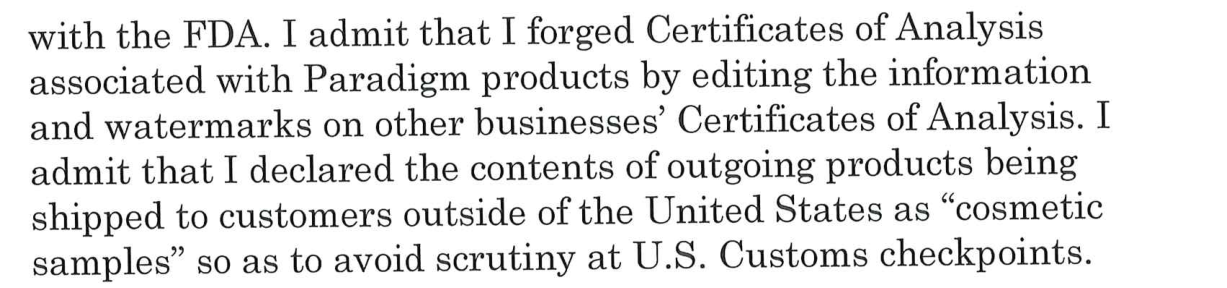
“I admit that I forged Certificates of Analysis associated with Paradigm products”
Stechkober expressly admitted forging certificates of analysis in her filed plea agreement. DOJ later reported a 16-month prison sentence imposed on July 30, 2026. Read the original · p. 6 · Enlarge excerptThe plea lists products advertised under research-chemical names that instead contained testosterone. It also lists BPC-157 and thymosin alpha-1 samples whose reported results matched their labels. The record does not support calling every Paradigm peptide substituted testosterone. Our COA verification guide explains why the original laboratory record matters more than a seller’s attractive screenshot. A lab result still does not establish permission to sell a medicine. Plea, pp. 6–7.
Outcome: on July 30, 2026, Kawa received 70 months in prison and Stechkober 16 months. Each received one year of supervised release, and they share a single $78,317.52 restitution obligation. Kawa’s 36- and 70-month terms run concurrently; his import count concerned hCG. DOJ · Judgment · Information.

“a term of 70 months on Count 2, to be served concurrently.”
Kawa’s July 30, 2026 judgment imposed 70 months in prison. The 36-month term on the other count runs concurrently. Read the original · p. 2 · Enlarge excerptKawa’s judgment also orders $5 million in forfeiture and expressly imposes no fine. Money ordered and money recovered are different facts; collection was not verified. No retatrutide-specific conviction is established here. Judgment, pp. 5 and 11.

Read the Paradigm Peptides case study and timeline.
Separate trade proceeding: Paradigm Peptides also appears in ITC investigation 337-TA-1377. The Commission notice records denial of the specified trademark and false-origin summary-determination requests against Paradigm, followed by withdrawal of the remaining allegations. That trade record is separate from Kawa and Stechkober’s criminal case. Commission notice, pp. 2–3 · Read the trade case file.
Pinned Aminos / Project Aminos: two storefronts, different outcomes
Known as: Pinned Aminos and Project Aminos, associated with Pinned Aminos LLC. Named operators: Ryan Fields and Lisa Mahan; the indictment identifies Fields as the LLC’s sole member. DOJ describes the overall operation from September 2021 to June 2023. The indictment separates the websites: pinnedaminos.com was operational by November 24, 2021 and stopped around February 14, 2023; projectaminos.com was operational by April 7, 2023 and stopped around June 29, 2023. Those detailed dates remain indictment allegations. DOJ trial account · Indictment, paragraphs 3 and 17.
The LLC’s reported formation in July 2022 was later than the documented activity. Domain creation, website operation and company formation are separate milestones; the two sites did not operate throughout the same period.
Products and discovery: the mixed drug/research-compound inventory included thymosin alpha-1. An FDA affidavit records an August 31, 2022 Customs and Border Protection notification about an intercepted shipment, followed by investigative purchases. This is a documented early trigger, not a claim that we know every agency’s first inquiry. Affidavit, paragraph 69 onward · Indictment.
- CBP notificationFDA affidavit records an intercepted shipment.
- Indictment filed342 days after the documented notification.
- Jury verdict1,137 days after indictment. Sentence not verified.
Outcome: Mahan received three years of probation on August 13, 2026. Fields was convicted by a jury on September 18, 2026; his sentence was not established at the evidence cutoff. DOJ describes human-use advice despite research-use wording. The indictment-to-verdict interval was 1,137 days, but it does not measure the whole investigation or a period without enforcement. DOJ verdict announcement.
Read the Pinned Aminos / Project Aminos case study.
Pivotal Peptides: website inactivity was not business closure
Known as: Pivotal Peptides LLC, using pivotalpeptides.com. Lilly’s complaint names Elizabeth Gately and Hannah Swayne as the LLC’s two members, on information and belief. A founding date was not established. Complaint, paragraph 5.
Documented activity: Lilly describes finding a tirzepatide offering earlier in 2024, sending a letter on July 12, and a customer email from Gately around July 22 saying the business remained open after its website became inactive. The complaint alleges continuing offers. An inactive website therefore cannot supply the shop’s operating end date. The original lead that drew Lilly’s attention remains unknown. Complaint, paragraphs 18 and 37–46.
Outcome: the court approved a settlement on May 20, 2025, containing admissions concerning tirzepatide sales and representations. Pivotal agreed to stop selling or distributing tirzepatide and not sell products involving semaglutide or retatrutide. The case was dismissed with prejudice, with enforcement jurisdiction retained. The wider restriction does not prove prior sales of all three compounds; no payment amount or company dissolution date is established. Approved agreement.

Read the Pivotal Peptides case study and timeline.
Triggered Brand: a sales stop and conditional financial liability
Known as: Triggered Brand. Connecticut names Sam Stolt as CEO. Its reviewed releases do not establish the shop’s launch, full operating period or last sale; the lawsuit and settlement dates are legal milestones. Lawsuit announcement · Settlement announcement.
Products and conduct: the state alleged direct-to-consumer sales of research-grade semaglutide and tirzepatide. Its May 21, 2025 announcement described unlawful drug sales and licensing issues. The original investigation trigger is not established in the collected record. Attorney General announcement.
Outcome: on August 5, 2025, the state announced a GLP-1 sales stop and a $300,000 judgment suspended after an $18,500 payment, with the full judgment applicable on breach. Those are the announced terms; payment completion and the signed underlying judgment were not verified. A restriction on these products is not proof that the whole company ceased operating. Settlement announcement.
Read the Triggered Brand state case study.
Separate trade proceeding: We also reviewed the April 9, 2025 ITC cease-and-desist order against Triggered Supplements LLC doing business as The Triggered Brand. Its scope covers specified tirzepatide or purported tirzepatide products involving trademark infringement or false designation of origin. It is not a general prohibition on every peptide, and it is separate from Connecticut’s August settlement. Order bundle, PDF pp. 27–35 · Read the trade case file.
Striker Pharmacy: retatrutide-labelled vials in a civil complaint
Known as: Striker Pharmacy LLC, a Katy, Texas compounding business associated with strikerrx.com. Lilly’s complaint identifies Philip Brown III as managing member and alleges he is the sole member. It reports incorporation on June 13, 2018. That is not a retatrutide-sales start date. Complaint, paragraph 13.
Documented activity and products: the complaint cites an archived March 13, 2026 webpage, a May 2 customer review and August 6 website observations. It alleges supply of retatrutide through medical practices and shipments to consumers. The filing reproduces Striker-branded vial photographs and a pricing list; the photos show labels, not laboratory-confirmed contents. Complaint, paragraphs 49–55.
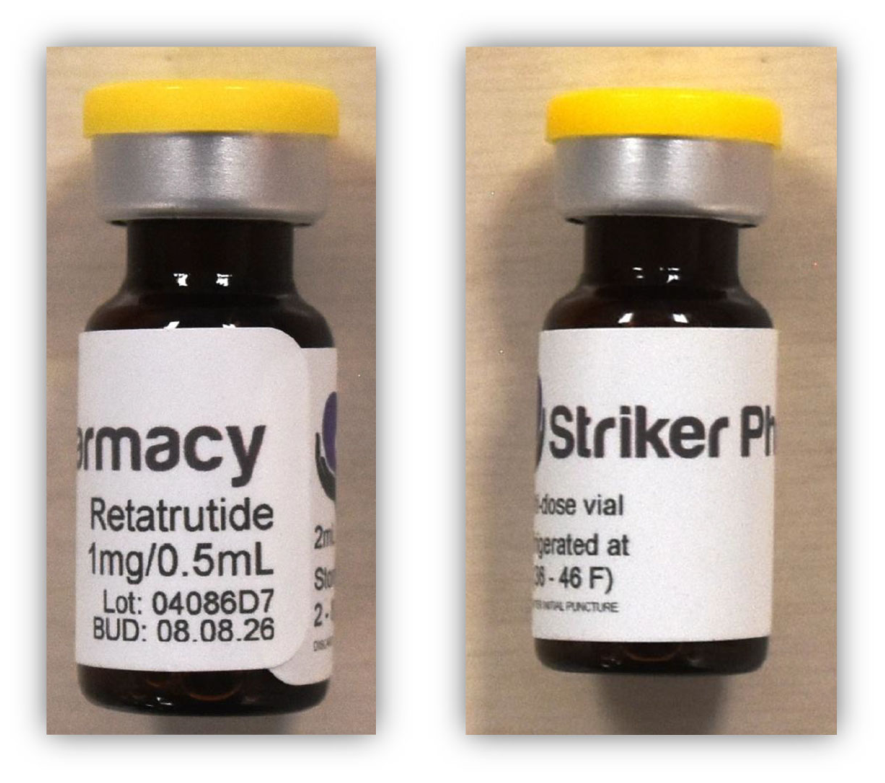
Defense and procedural update, checked October 13: Lilly filed on August 12, 2026. In an October 5 joint case-management filing, Striker disputes unlawful conduct and says it intends to challenge Lilly’s ability to bring the claims and obtain the requested remedies. The filing reports settlement discussions, not a completed settlement. Those are the defendant’s arguments, not court findings. Joint filing, pp. 1 and 3–4.
A court order that day set initial disclosures for October 30, 2026, discovery and dispositive-motion deadlines for August 10, 2027, and docket call for November 1, 2027; the order does not set a trial date. These procedural dates do not establish liability, a sales prohibition or a monetary award. The public docket mirror was last retrieved October 7, so later activity remains unverified. Scheduling order, pp. 1–2 · Docket mirror.
Read the Striker Pharmacy case study and evidence.
Texas Peptides: health claims beside a research disclaimer
Known as: Texas Peptides Inc., using texaspeptidesinc.com. Lilly describes a Wyoming corporation with Texas operations and identifies Richard Moke as a co-founder and Director of Sales and Business Development. That is not a finding that he is the sole owner; the reviewed sources do not give a verified opening date. Complaint, paragraph 11.
Documented activity and products: a January 20, 2026 social post promotes “RETA GLP-3,” which the complaint connects to retatrutide. The filing reproduces health-benefit claims alongside a research disclaimer, customer questions about ordering, and a seller reply providing its website. Other pages were observed August 6. These are dated marketing observations, not a continuous operating period or clinical evidence for the seller’s product. Complaint, paragraphs 44–45.
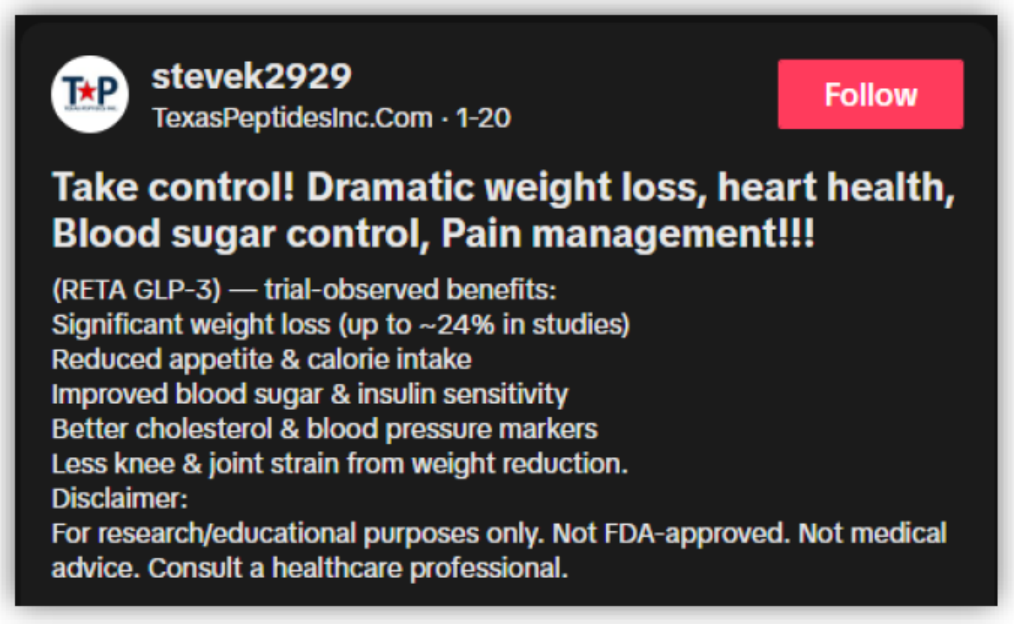
Original case record: Lilly filed on August 12, 2026, alleging consumer drug marketing behind research language. The complaint supplies examples of the evidence used, but not the original investigative trigger. Complaint.
October 13 reporting update: Becker’s relays a Lilly spokesperson’s account of a Texas Peptides settlement: stop selling the products, advise customers to stop using them and make an undisclosed donation to America’s Poison Centers. We have not obtained the signed agreement or a corresponding court order, so these remain reported terms, not independently verified judicial findings. They do not establish that the whole business closed. Reported settlement.
Read the Texas Peptides case study and evidence.
LiveWell Peptides: the named owner behind “GLP-1 R”
Known as: LiveWell Peptides, using livewellpeptides.com. Lilly sued William “Ian” Brown doing business as LiveWell Peptides, describing a sole proprietorship. The complaint says the business was founded in 2023 and cites a profile describing Brown’s ownership from June 2024. Those are attributed history claims, not independently verified first-sale dates. This is a different business from Live Well Drugstore LLC / TruLife Pharmacy. Complaint, paragraphs 1 and 11.
Documented activity and products: Lilly cites product pages observed September 30, 2026, including purported retatrutide sold as “GLP-1 R.” It alleges human-use marketing through consumer shopping features, affiliates, customer stories and the owner’s health-benefit posts. The owner-post screenshot is general peptide marketing; it does not itself name retatrutide. The first retatrutide sale, closure date and original investigative lead remain unknown. Complaint, paragraphs 42–51.
Outcome: the complaint was filed October 8, 2026. Its requests for restrictions and financial relief are not awards, and no later disposition was verified. Generic adverse-event posts discussed in the complaint are not established injuries to LiveWell customers. Original complaint · Our detailed LiveWell analysis.
Read the LiveWell Peptides case study and timeline.
Aesthetic Envy: retatrutide allegations followed by dismissal
Known as: Aesthetic Envy Cosmetic Centers LLC, trading as Aesthetic Envy. The complaint describes a Sacramento-area medical-spa business and identifies Darsh Gosal, DO, as medical director, not necessarily its owner. Its website was observed August 6, 2026. Business opening and closure dates are not established. Complaint text, paragraph 13.
Products and allegations: Lilly challenged a purported retatrutide service called “Triple G” and comparisons to clinical-trial results. Semaglutide and tirzepatide appear as comparators in this record, not established sales by the spa. The original investigative trigger is unknown. Complaint text.
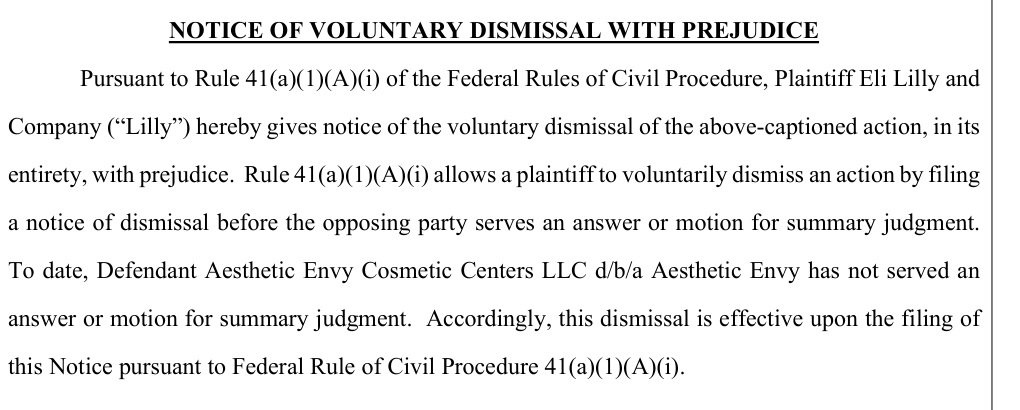
Outcome: Lilly filed on August 12, 2026 and voluntarily dismissed the entire action with prejudice on September 11, a 30-day interval. The notice gives no reason. It establishes no payment, admission, decision on the merits or business closure. Dismissal notice.
Read the Aesthetic Envy case study and timeline.
Prime Peptides: testimonials preserved in an FDA warning
Known as: Prime Vitality, Inc. doing business as Prime Peptides. FDA’s letter is dated December 10, 2024; it describes an October website review and reproduces June customer-testimonial posts and an August weight-loss video. These are evidence dates, not a verified business opening or closure date. FDA letter.
Products and conduct: FDA identified semaglutide and retatrutide offers and cited the seller’s product descriptions, testimonials and video claims as evidence of intended human use. The letter preserves those representations; it does not verify the testimonials or the contents of purchased vials.
Recorded action and limits: FDA requested a written response within 15 working days. The reviewed letter does not establish its later resolution. An absent follow-up in this collection does not mean the business never responded. FDA letter, conclusion.
Read the Prime Peptides warning-letter case file.
Swisschems: product studies and discounts cited by FDA
Known as: Swisschems, the recipient named in FDA’s December 10, 2024 letter. FDA describes an October website review and a September 18 promotion. The letter does not establish a complete operating period. FDA letter.
Products and conduct: FDA cited semaglutide and retatrutide product descriptions, linked clinical studies and the discount promotion. It treated that material as evidence of intended human use despite research-chemical wording. The letter reports no product-specific laboratory assay.
Recorded action and limits: FDA requested a response within 15 working days; the reviewed letter does not establish the later outcome. Missing follow-up is not proof of no response. FDA letter, conclusion.
Separate trade records contain a status conflict: Documents in ITC investigation 337-TA-1377 name Singularity Marketing Limited doing business as Swiss Chems, but give inconsistent accounts of its addition as a respondent. The December 2024 decision records an earlier denial without prejudice and still calls it a proposed respondent; the April 2025 notice describes that same procedural step differently. We have not resolved the discrepancy or verified a Swiss-specific final remedial order. This does not change the independently verified FDA letter, and orders against other businesses should not be assigned to Swisschems. December decision, PDF pp. 10 and 133 · June notice, p. 2 · April notice, p. 2 · Trade case file.
Read the Swisschems warning-letter case file.
Pink Pony Peptides: product codes and injection-use evidence
Known as: Lovega LLC doing business as Pink Pony Peptides. FDA’s March 31, 2026 letter describes a website review in December 2025. These dates do not establish when the business started or stopped trading. FDA letter.
Products and conduct: FDA reproduced text identifying “GLP-2 TZ” as tirzepatide and “GLP-3 RT” as retatrutide. It also cited bacteriostatic water sold alongside injectable peptides as evidence of intended use for injection. The letter’s injectable-risk discussion does not establish contamination of this seller’s batches.
Recorded action and limits: FDA requested a response within 15 working days. The letter does not establish later resolution, and missing follow-up in this collection does not prove the business failed to respond. FDA letter, conclusion.
Read the Pink Pony Peptides warning-letter case file.
Darmerica: customer complaints and partial corrective action
Known as: Darmerica, LLC, an ingredient distributor examined during FDA’s March 3–19, 2025 inspection. The resulting warning letter is dated December 8, 2025. Inspection and complaint dates do not establish its full operating period. FDA letter.
Products and conduct: FDA reviewed supplier qualification, complaint handling, labeling and sampling controls. It described earlier customer complaints about black particles, but the ingredient names are redacted: those complaints cannot be attributed to retatrutide. Separately, it challenged distribution of retatrutide and other ingredients for the cited compounding pathway.
Recorded response and limits: Darmerica’s May 1 correspondence reported stopping retatrutide and cagrilintide importation/distribution and making listing corrections. FDA wrote: “Your corrective actions related to retatrutide base and cagrilintide acetate appear adequate.” That acknowledgement concerned those corrections; other quality-system concerns remained. It was not a blanket closeout. FDA letter, complaint investigation and response discussions.
Read the Darmerica warning-letter case file.
These examples sit inside a broader library of all 89 case studies, searchable by shop, alias, named person, compound and outcome. Each record includes the supported identities and activity dates, products, discovery evidence, challenged conduct, outcome, legal timeline and unknowns. Some grouped matters do not identify a single shop.
Other rulings also matter: Amble was dismissed for lack of standing; Genesis rejected the parties’ insufficiently supported joint request for a consent judgment and injunction; Mochi’s September 8, 2026 ruling dismissed specified claims while another theory survived. These procedural outcomes do not certify products as lawful or safe. Amble · Genesis · Mochi.
What happened to the people and businesses?
People have received prison sentences. Businesses have accepted sales restrictions. Courts have ordered money forfeited and repaid. The examples below show what happened to named defendants, rather than the maximum penalty someone might theoretically face.
| Person or business and products | Documented consequence |
|---|---|
| Brandon Piper / MilestonePurity — semaglutide and tirzepatide | 21 months in prison for a misbranding conspiracy. DOJ announced the sentence on July 23, 2026. The reviewed primary sources do not establish his full financial sentence. DOJ announcement. |
| Matthew Kawa / Paradigm Peptides — a broader peptides, hCG and research-chemical case | 70 months in prison, a $5 million forfeiture order and one year of supervised release. The July 30, 2026 judgment also orders shared restitution and a $200 assessment. It expressly imposes no fine. Judgment, pp. 2, 5 and 11. |
| Jennifer Stechkober / Paradigm Peptides — the related unapproved-drug case | 16 months in prison and one year of supervised release. DOJ reports a $100 assessment and $78,317.52 restitution jointly and severally with Kawa. That is one shared restitution obligation, not two amounts to add together. DOJ case page. |
| Pivotal Peptides — tirzepatide conduct; wider settlement restrictions | Court-approved restrictions on selling tirzepatide, semaglutide and retatrutide. The May 20, 2025 order dismissed the case with prejudice and retained jurisdiction to enforce the agreement. No payment amount is established in this document. Settlement and order. |
| Triggered Brand — semaglutide and tirzepatide allegations | A sales stop and a $300,000 judgment suspended after $18,500, according to Connecticut’s August 5, 2025 announcement. It says the full judgment applies on breach. Payment completion and the underlying signed judgment were not verified. Attorney General announcement. |
| Covered respondents in ITC 337-TA-1377 — tirzepatide or purported tirzepatide | Defined import-exclusion orders and three cease-and-desist orders, issued April 9, 2025. The remedies address specified infringement, false-origin or advertising findings; they are not a blanket exclusion of every tirzepatide product. Commission notice. |
| Aesthetic Envy — retatrutide allegations | Lilly dismissed the entire action with prejudice on September 11, 2026. The notice gives no reason and establishes no payment, admission or merits ruling. Dismissal notice. |
Money ordered is not money proven collected. Kawa’s forfeiture, the defendants’ shared restitution and Triggered’s conditional judgment are different obligations. The documents do not justify presenting them as one total of “fines paid.”
Probation and business closure also appear in the record. Lisa Mahan received three years of probation in the mixed Pinned Aminos research-drug case. Skyler Garman received one year of probation and a $180,000 forfeiture order in a SARMs/SERMs case. Separately, JeffMac Investments LLC, doing business as SARMS Pharm LLC, agreed to forfeit $1.8 million and close its business; the collected plea announcement does not establish a final individual sentence or completed payment. These are separate cases involving different products and conduct. Mahan · Garman · SARMS Pharm.
The collection covers 89 selected matters with activity from October 10, 2024 through October 10, 2026, including older cases with recent outcomes. It includes complaints and warnings as well as concluded cases. Open every case file, or download the CSV or JSON.
Who is being pursued, and for what?
The records reach beyond one kind of peptide store. Private drugmaker litigation and government enforcement have different legal foundations, but the collection shows several recurring targets:
- Online research-product sellers. Piper’s criminal case concerns misleading research-only sales of semaglutide and tirzepatide. Lilly’s LiveWell complaint alleges that a retatrutide business used research language while promoting human use. LiveWell remains an allegation in the collected record. Piper · Our LiveWell complaint analysis.
- Clinics and licensed professionals. Matthew Lewis pleaded guilty over misbranded semaglutide supplied to clinic patients without disclosing its unapproved status. His eventual sentence was not verified here. Justin Watkins was indicted over alleged sourcing and supply of misbranded drugs; the announcement names retatrutide among products allegedly ordered. No later plea or verdict was verified. Lewis · Watkins.
- Ingredient distributors and compounders. FDA says its retatrutide work includes telehealth marketing, ingredient distribution to compounders and repackaging by outsourcing facilities. A warning letter can address manufacturing and testing systems as well as advertising. FDA statement.
The repeated issues are what was supplied, what customers were told and what the seller actually did. The evidentiary status matters: a complaint alleges, a plea can admit and a judgment can determine. A warning letter alone is not a criminal conviction.
What do FDA warnings and complaints reveal about peptide vendors?
FDA letters can preserve product names, dated marketing, inspection findings and company responses without being court judgments. Our selected 89-matter collection includes 25 FDA warning letters; 11 identify retatrutide marketing or supply. These are counts within our fixed October 10, 2024–October 10, 2026 activity window, not a census of FDA warnings or peptide sellers. Browse the 25 warning-letter records.
Read the document type before drawing a conclusion
- Warning letter: FDA identifies what it considers significant violations and requests a response. Later exchanges or corrections can change the regulatory status. A closeout follows FDA’s evaluation of corrective action; it is not simply the company promising to improve. FDA explanation.
- Form FDA 483: observations issued at the end of an inspection, not FDA’s final determination that a violation occurred. FDA guidance.
- Recall: removal or correction of a marketed product. Check the affected product and recall record rather than treating it as a company-wide shutdown. FDA Enforcement Reports.
- Adverse-event report: a reported health event, not proof that a drug caused it. Reports can be incomplete or duplicated; a compound name alone does not establish which webshop supplied it. FDA’s AEMS dashboard, formerly FAERS.
For your own research, start with FDA’s searchable warning-letter archive, which includes response and closeout fields. Search both the trading name and legal entity, then check later documents. FDA’s Reading Room holds additional inspection records and explains how to request releasable material through FOIA; some records are unposted, redacted or withheld. The original letter is a dated record, not a live compliance certificate.
Agency announcements also help connect related actions. FDA’s December 17, 2024 roundup announced warnings involving Xcel, Swisschems, Summit and Prime. Those announcements help with discovery; the individual letters supply the detailed evidence.
A private drugmaker’s letter is another category. Pivotal’s complaint describes Lilly’s July 12, 2024 correspondence; that was a company’s demand, not an FDA warning or court order. Keep the sender and the later court outcome separate. Pivotal complaint, paragraph 37.
What is happening specifically with retatrutide?
Retatrutide is already named across private lawsuits, FDA warnings, overseas actions and a U.S. criminal allegation. Our narrower filter returns 24 matters connecting it to alleged or reported marketing or supply:
| Proceeding | Retatrutide records |
|---|---|
| U.S. civil cases | 7 |
| FDA warning letters | 11 |
| Overseas matters | 5 |
| U.S. criminal record | 1 |
| Total | 24 |
This collection establishes no retatrutide-specific criminal conviction. The criminal connection is Watkins’s indictment announcement. It does not establish which patient received which compound. The overseas records include suspected manufacture, seizures and agency-described sales, which cannot all be treated as completed retail sales or unique sellers. Watkins announcement · Rize Fitness advisory.
The retatrutide case filter shows the individual records. Selecting any documented role increases the count to 28: Pivotal adds settlement scope, and three civil records add uncertain product attribution pending their original complaints.
FDA’s current U.S. position is explicit: retatrutide and cagrilintide cannot be used in compounding under federal law. That agency position is separate from whether a particular defendant has been charged, convicted or sued. FDA statement, reviewed October 10, 2026.
Which compounds appear most often?
Semaglutide, tirzepatide and retatrutide lead this selected collection. These are counts of records, not the probability that a seller will face action. The search began with an emphasis on GLP-1 disputes, so it cannot establish that less frequent compounds receive less scrutiny across the whole market.
| Compound | Sales, supply or testing | Any role |
|---|---|---|
| Semaglutide | 42 | 44 |
| Tirzepatide | 38 | 40 |
| Retatrutide | 24 | 28 |
| BPC-157 | 9 | 9 |
| Ipamorelin | 8 | 8 |
| Bremelanotide / PT-141 | 7 | 7 |
| Tesamorelin | 7 | 7 |
| CJC-1295 | 6 | 6 |
| Elamipretide / SS-31 | 6 | 6 |
The first column includes alleged or reported marketing, orders, imports, supply, seized inventory or testing. It does not mean every completed sale or label was proved. Any role also includes settlement restrictions, background references and uncertain associations. Each matter counts once per compound; rows overlap.
Original product names remain visible in the case files. We merge supported aliases, keep distinct salts and modified compounds separate, and leave unresolved codes unresolved. A label and a test result are also different evidence: FDA’s Warrior Labz order describes products labelled ostarine and ligandrol that both contained ostarine and undeclared clomiphene. FDA order.
How did investigations start, and how long did they take?
Some sources identify the initiating incident; many only describe evidence gathered later. A website screenshot or test purchase does not automatically reveal how investigators first learned about a seller.
Sources describe different pathways. MHRA’s falsified Mounjaro notice identifies faulty pens and a Lilly referral; separate pharmacy-inspection findings should not be assigned that same origin. Australia’s Victorian investigation began with an August 2025 cargo interception. FDA warning letters often describe website reviews, while leaving the original tip or selection process unstated. MHRA · Australian agency announcement · Pink Pony FDA letter.
| Case and documented interval | Calendar days |
|---|---|
| Aesthetic Envy: complaint to voluntary dismissal (2026-08-12–2026-09-11) | 30 |
| Pivotal: complaint to settlement approval (2024-10-21–2025-05-20) | 211 |
| Amble: complaint to filed dismissal opinion (2025-05-21–2026-03-19) | 302 |
| ITC: complaint to final remedies (2023-10-19–2025-04-09) | 538 |
| Fields: indictment to jury verdict (2023-08-08–2026-09-18) | 1,137 |
These intervals measure different events. We do not average a complaint-to-dismissal period with an indictment-to-verdict period, or treat an unresolved case as concluded on the review date. They cannot establish a period in which unlawful activity will escape attention.
What can you do with this information?
If you are assessing a seller or a product
Check the underlying evidence before accepting the claim. Confirm the legal entity, exact product and date in the complaint or order. Check for a later outcome. Open the laboratory’s original report where available and match its sample and batch identifiers to the claim being made. A screenshot, a purity result and a case dismissal answer different questions. The case library and COA verification guide give you the documents and checks to start with.
For medicines used by patients, FDA recommends prescriptions from a doctor and dispensing by a state-licensed pharmacy. Its BeSafeRx guidance explains how to check an online pharmacy. This research does not establish the safety of an individual vial.
If you sell, import, promote or administer products
Review the actual product and activity with qualified regulatory counsel. That includes intended use, approval or compounding basis, licensing, import obligations, prescription requirements and the claims made to customers. A research-use disclaimer does not establish authorization. FDA’s retatrutide position and Pivotal’s settlement show why product-specific obligations matter. FDA · Pivotal.
If you receive a notice or order, preserve relevant records, identify the exact deadlines and document corrective work against its requirements. Pivotal’s agreement reaches future products beyond the conduct it admitted. Triggered’s announced financial terms make compliance consequential after the case settles. These are practical compliance steps, not a legal assessment of a particular business.
If you believe you were misled or harmed
Keep the order, label and exact representations. FDA provides routes for reporting medicine-quality problems and suspected unlawful online sales. For a named criminal case, use the agency’s published victim-information channel; the Paradigm case page provides one. If you have a health concern, contact a qualified clinician. FDA reporting guidance · Paradigm victim information.
What is likely to happen next?
Continued retatrutide scrutiny is a reasonable expectation. The volume of future cases is unknown. This is TitrateLab’s interpretation for the next 6–12 months, based on FDA’s stated work and Lilly’s August announcement of six lawsuits. Lilly also requested action from platforms, payment firms and logistics providers. Those requests justify monitoring service restrictions; they do not establish that an intermediary acted. FDA · Lilly announcement.
The next useful developments are specific: a Fields sentencing judgment, later Watkins and Lewis docket entries, subsequent Mochi rulings, and documented FDA closeouts or corrective action. Settlements and dismissals already show that pending matters will not all end alike. Every case file identifies what to watch next.
Low counts or an empty compound search cannot establish a legal safe zone. This collection has no seller or sales denominator and no view into undisclosed investigations. We can document what has happened; we cannot turn those records into reliable odds of prosecution.
Sources and counting method
The fixed cohort contains 89 matters selected from 91 records with sourced activity inside October 10, 2024–October 10, 2026, within a broader 145-record historical registry. We excluded a provisional complaint with unverified original product allegations and an ancillary telephone/text-marketing case. The included set comprises 37 U.S. civil matters, 9 U.S. criminal matters, 25 FDA letters, 4 state matters, 13 overseas matters and 1 trade investigation. Twenty-eight civil records have filing dates inside the window.
We combined targeted searches of public court and agency records with automated downloads and PDF/HTML text extraction from a reviewed list of source URLs. Sources include CourtListener/RECAP, original court filings on official or mirrored hosts, DOJ, FDA, state agencies and foreign regulators. Documents were archived where downloads succeeded; exact-URL matches through DOJ’s public API recovered some releases that could not be fetched directly. This was a selected collection, not a comprehensive crawl of every court or regulator.
AI-assisted research and extraction were followed by source comparisons and independent checks of counts, dates and interpretations. We recorded business names, compounds, dated events and outcomes, distinguishing allegations from admissions, orders and agency warnings. Supported aliases were normalized for comparison; ambiguous identities and product codes stayed unresolved. A matter counts at most once per compound in each comparison column, and multi-compound matters can appear in several rows. Party statements remain attributed; docket metadata supports only what it records. No expert legal review is claimed.
Coverage is incomplete and geographically uneven, with an initial GLP-1 and English-language focus. Some original complaints, investigation origins and later outcomes remain unavailable. Source-review notes identify these gaps. We also located FDA letters to GLP-1 Solution, ASN-LABS and Gram Peptides outside this frozen cohort; they remain excluded from the 89-record comparison.
The compound figures replace preliminary catalogue tags after individual source review; that correction is not a measured rise in enforcement. Some records group related defendants or actions. The collection is not a count of unique sellers, new lawsuits or convictions. The October 11 business-history and FDA-source reviews add shop identities, activity dates and regulatory context without changing this cohort or the compound counts. On October 13 we reorganized the article by company and checked sources for its 13 featured businesses. We obtained the two redacted FDA reports and company response linked by CBS, archived the PDFs and checked dates and narratives against the originals. We also added Striker’s October 5 defense and scheduling documents and qualified Swiss Chems’ trade-case status because primary records conflict. These document checks do not change the 89-matter cohort or compound counts; downloadable files retain their original coding, with dated clarifications in the case files. Texas Peptides’ signed settlement remains unobtained, so its terms remain attributed to reporting. We established no newer criminal outcome or FDA closeout for the featured firms in this targeted check; that is not proof none exists. Public mirrors were incomplete or stale and some agency searches were inaccessible. This is not a full docket refresh or exhaustive search for subsequent agency action. Operating or conduct periods, corporate formation, dated observations and legal milestones are kept distinct. Historical domains are identifiers, not verified current contacts; no complete current corporate-registry or docket search is claimed.
All screenshots are genuine source-page captures or unaltered PDF crops, with links to the originals. Check a case’s latest docket before reusing its status. Send corrections through our methodology page, identifying the case, document and date. TitrateLab provides tools for examining available evidence; it does not certify a seller’s legality or product quality.
