
We reviewed repeated batch codes across more than 95,000 published lab-result records. Different peptide labs often reported substantially different milligram amounts for the same vendor, peptide, dose and printed code, even while reporting nearly identical purity. Lab choice appears to affect the result.
We found 829 codes tested by more than one lab. We kept 179 stronger matches: one vendor, peptide and dose; a specific code; and tests close in time. A matching code is still a possible match, not proof of one production lot.
The disagreement is not just visible in our data. In an archived industry lab chat, representatives of Janoshik, Vanguard, Chromate, BTLabs and Pacific Coast Biologics openly attacked one another's methods, competence and motives. Janoshik called Chromate a "crook." Chromate accused Janoshik of dishonesty. Vanguard called Chromate's attitude "pompous." The insults prove rivalry, not which result is right. The useful agreement beneath the fight was that one mixed sample must be divided into blind, identical portions to compare labs fairly.
What this does not prove: the public records do not show which lab is closest to the vial's true peptide content. Different vials, code reuse, handling and lab methods can all contribute.
How often two labs disagree on one code
The public COA record was not built for this comparison, so most of the work involved removing weak matches. We began with 69,846 measurements that included a batch field. After combining duplicate measurements from the same physical certificate, 56,241 certificate-and-peptide records remained. We then matched the peptide name, labeled dose and printed code. That produced 829 groups tested by at least two labs.
An earlier count produced 831 groups because it treated Finnrick’s “lab D” and Janoshik as different labs. They are the same laboratory. We corrected that before calculating the results below.
Most of the 829 groups were too uncertain to use. We flagged 545 because the printed code might be reused. Examples include short numbers such as 510005, product numbers, cap-color descriptions, codes used by several vendors, tests more than 180 days apart, and manufacturing dates printed where a batch number would normally appear. Twenty groups used a manufacturing date and would otherwise have qualified. Another 105 groups were too ambiguous.
That left 179 carefully screened groups covering 40 vendors. Of those, 141 were entirely inside Finnrick’s testing program, 58 were tested by at least three labs, and the typical time from the first certificate to the last was 21 days.
| What differed | Groups | Share |
|---|---|---|
| Measured amounts at least 30% of the label apart | 32 | 18% |
| Measured amounts at least 50% of the label apart | 8 | 4% |
| At least 20% apart, with tests no more than 14 days apart | 17 | 9% |
| One result within 10% of the label; another outside that range | 104 | 58% |
| One result at least 10% high; another at least 10% low | 11 | 6% |
One in ten groups differed by at least 35 percentage points, equal to 3.5 mg on a 10 mg vial. In 84 groups, the labs reported purity within one percentage point of each other but differed on measured amount by at least 10 points. Put simply: two labs can both report about 99% purity while disagreeing substantially about how many milligrams are in the vial.
One lab reports lower results against all six others
Finnrick removes the vendor name before a vial reaches the lab, but it prints the laboratory on every record and share card. Its URL letters map consistently to named labs: A for Chromate, B for MZ Biolabs, C for TrustPointe, D for Janoshik, E for Krause Analytical, F for Freedom Diagnostics and G for BTLabs. Three July 2026 records used K for Ichor Life Sciences. We verified the mapping on 50 share cards and against Finnrick’s lab directory. Direct Janoshik and Freedom Diagnostics COAs are counted with those same labs.
Krause dominates this part of the record. It performed 6,155 Finnrick tests, compared with 2,254 for BTLabs and fewer than 700 for each other listed lab. Since December 2025, Krause supplied 55% to 83% of Finnrick’s monthly records. That makes any consistent difference in its readings important to vendor histories and grades.
The table below compares Krause with every other lab that tested the same vendor, peptide, dose and printed code. Cases where a lab did not find the named peptide are excluded here and shown separately later. A negative number means Krause reported less peptide.
| Other lab | Matched groups | Typical gap | Krause read lower |
|---|---|---|---|
| BTLabs | 42 | 10.3 points lower | 35 of 42 |
| Freedom Diagnostics | 30 | 12.4 points lower | 22 of 30 |
| Janoshik | 19 | 12.0 points lower | 16 of 19 |
| Chromate | 19 | 6.1 points lower | 14 of 19 |
| TrustPointe | 6 | 11.8 points lower | 6 of 6 |
| MZ Biolabs | 5 | 10.9 points lower | 5 of 5 |
| All six | 121 | 98 of 121 |
Sample source changes the size of the pattern. In 30 public mail-in groups, Krause’s typical result was 11.1 percentage points lower, and it read lower in 26 of 30. In the six groups Finnrick bought, the typical gap was 3.5 points and Krause read lower in four. Six is too small for a reliable Finnrick-purchase estimate.
That distinction limits the conclusion. Public mail-in records rely on the sender for the vendor name and do not document every handoff. Freedom Diagnostics and Janoshik comparisons can also combine Finnrick-routed tests with COAs those labs published directly. The other four pairings stay inside Finnrick’s program. None is equivalent to dividing one mixed sample among labs under a controlled protocol.
No pairing without Krause had one consistent lower lab. Those typical gaps were 4.1 to 5.1 points. The largest direct comparison was Krause against BTLabs: in 42 groups, Krause’s typical result was 1.2% above the label while BTLabs reported 13.7% above. Krause called 34 groups within 10% of the label; BTLabs called only 14 within that range because it often reported overfill.
Simple checks did not remove the pattern. Krause still read lower whether it tested before or after BTLabs. Among 13 groups tested within 14 days, Krause was typically 11.0 points lower and read lower in 12. Limiting the calculation to one group per vendor left 14 vendors; Krause was typically 11.2 points lower and lower for 12. These checks reduce obvious timing and vendor-mix explanations, but they do not create a controlled comparison.
The pattern also appears outside the matched-code groups. Across every published COA with a numeric result for amount, Krause’s typical result was 0.5% below the label. Every other lab’s typical result was above it.
| Lab | Results | Typical result vs label | More than 10% low | More than 10% high |
|---|---|---|---|---|
| Krause Analytical | 5,920 | -0.5% | 16.2% | 13.7% |
| BTLabs | 2,126 | +7.0% | 9.0% | 38.0% |
| Chromate | 2,290 | +7.4% | 10.6% | 38.1% |
| Janoshik | 10,867 | +6.8% | 5.9% | 38.5% |
| Freedom Diagnostics | 39,352 | +9.7% | 4.2% | 49.1% |
| TrustPointe | 337 | +8.8% | 17.2% | 46.9% |
| MZ Biolabs | 180 | +7.6% | 21.7% | 47.2% |
Labs test different mixes of vendors and products, so the database-wide table is descriptive, not a fair head-to-head ranking. We therefore repeated the comparison within the same vendor, peptide and labeled dose. Krause’s typical result was 8.8 percentage points below BTLabs and 9.2 points below Janoshik. It read lower in 92 of 125 BTLabs matches and 66 of 72 Janoshik matches. BTLabs and Janoshik were within one point of each other.
The direction also appeared within common peptides. For retatrutide, Krause’s typical result was 1.2% below label, versus 4.9% above at BTLabs, 9.6% above at Janoshik and 11.3% above at Freedom Diagnostics. For tirzepatide, Krause was on label while the others were 8.7% to 11.1% above. For BPC-157, Krause was 0.4% below while the others were 12.0% to 16.0% above.
Finnrick says it performs a similar comparison across hundreds of overlapping tests but has not published the results. In May 2026 it described five COAs from one lab that were all wrong by the same proportion after an apparent calibration error, adding, “Nobody was lying.” Finnrick also reported a Krause method update for GHK-Cu in July 2025.
Independent reporting found the same directional question. The graymarket newsletter described a retatrutide batch where Janoshik and Chromate found about 30 mg while Krause found 26 mg in two vials. The pattern is not universal: a Peptide Critic example showed Krause at 59 mg and a Janoshik three-vial average at 58.4 mg. Those examples illustrate the issue; the 121 matched groups above establish its scale.
What does “milligrams found” actually include?
One plausible explanation for a similar gap across many peptides is that the labs do not define “milligrams found” in the same way.
A freeze-dried peptide vial does not contain only the active peptide. The powder can also contain water, salts and other material left from production. A lab therefore has to decide what it counts in the final milligram number.
This is difficult even for national measurement institutes. In the BIPM’s CCQM-K115.2018 comparison, 11 institutes measured the same synthetic peptide powder. Their answers for actual peptide content ranged from 593.5 to 679.5 mg per gram, a 14% difference. They were testing shared material, with no peptide vendor involved.
A milligram is still a milligram. The open question is what material each lab includes in that number. Analytical chemists call this the measurand. In plain language, does the result mean all powder recovered from the vial, powder adjusted for measured purity, or peptide after correcting for water, salts and the known comparison material used to calculate the result?
Three of Finnrick’s seven labs have described at least part of their method:
- BTLabs says it weighs the vial contents and multiplies that weight by the HPLC purity result. It gives an expected margin of error of 2% to 3%. The starting weight can still include water and salts.
- Chromate says it reports the recovered mass without further adjustment. It calculates that amount against known comparison material and gives an expected margin of error of 2% to 5%.
- Krause Analytical says it compares the peptide signal with a known standard and reports the mass recovered from one vial and one instrument run. Its questionnaire says its check standard may vary by plus or minus 10%, which “sets the lower limit of error in the analysis at 10%.”
Freedom Diagnostics prints “Net Peptide Content” on its COAs but does not publicly explain how it calculates that number. Janoshik’s public pages do not explain it either. The available descriptions do not show that all labs use the same definition or method.
This leaves a puzzle, not an answer. BTLabs uses a method that could be expected to produce a higher number, and it does. But Krause and Chromate both describe calculating recovered mass against known comparison material, yet Krause is typically 6.1 percentage points lower on the same codes.
The public cannot inspect the comparison material each lab uses. A multi-lab USP study of oxytocin measurement found that results depended heavily on whether the labs used the same standard and how much actual peptide that standard contained. If one lab treats a standard as 100% peptide when it is really 75%, every result calculated from it can be pushed upward. A lab that corrects for the true peptide content will report less.
For context, analytical chemists have historically expected labs measuring an amount near 100% to differ by about 2% under the Horwitz relation. Labs accredited to ISO/IEC 17025 must estimate their margin of error and report it when it could affect whether a result passes a specification. None of the COAs in this database reports that margin. Krause, the lab behind the largest share of Finnrick records, told Finnrick that its lower limit of error is 10%. That is also the cutoff TitrateLab and much of this market use to call a vial underfilled.
Inside the peptide lab wars: the argument became personal
The missing common standard is not merely our interpretation of the COAs. We reviewed 6,270 messages from the K Hole Reloaded laboratory chat, archived from August 25, 2025 through August 11, 2026. Eight lab-associated accounts wrote 3,117 of them, nearly half the room. The largest voices were Pacific Coast Biologics, Janoshik and Vanguard Laboratory. BTLabs, Chromate and Testides also participated under lab-branded accounts.
This is not peer-reviewed evidence. It is direct evidence of what laboratory operators say about their own practices, their competitors and the experiments they believe would settle a disagreement. It also reveals a market where technical arguments, personal attacks and commercial rivalry are often mixed together.
The central fight concerned Epitalon. Chromate alleged that most laboratories were missing roughly 5% to 10% impurity because their chromatography did not properly retain or separate the compound. It argued that HILIC was required. Vanguard said it had validated HILIC against reverse-phase methods and obtained comparable results. Janoshik agreed that HILIC could be better for Epitalon but rejected Chromate's claim that reverse-phase HPLC could not do the job.
Vanguard repeatedly asked for the exact same material, full method conditions, raw chromatograms and validation data. That was the right question. The archived discussion ends before a blinded same-material comparison was completed. Chromate's broad impurity allegation therefore remains an allegation, and the rebuttal remains an unresolved competing interpretation. Sources: Chromate 98718, Vanguard 98756, Janoshik 98752, Vanguard 100021.
The attacks were direct:
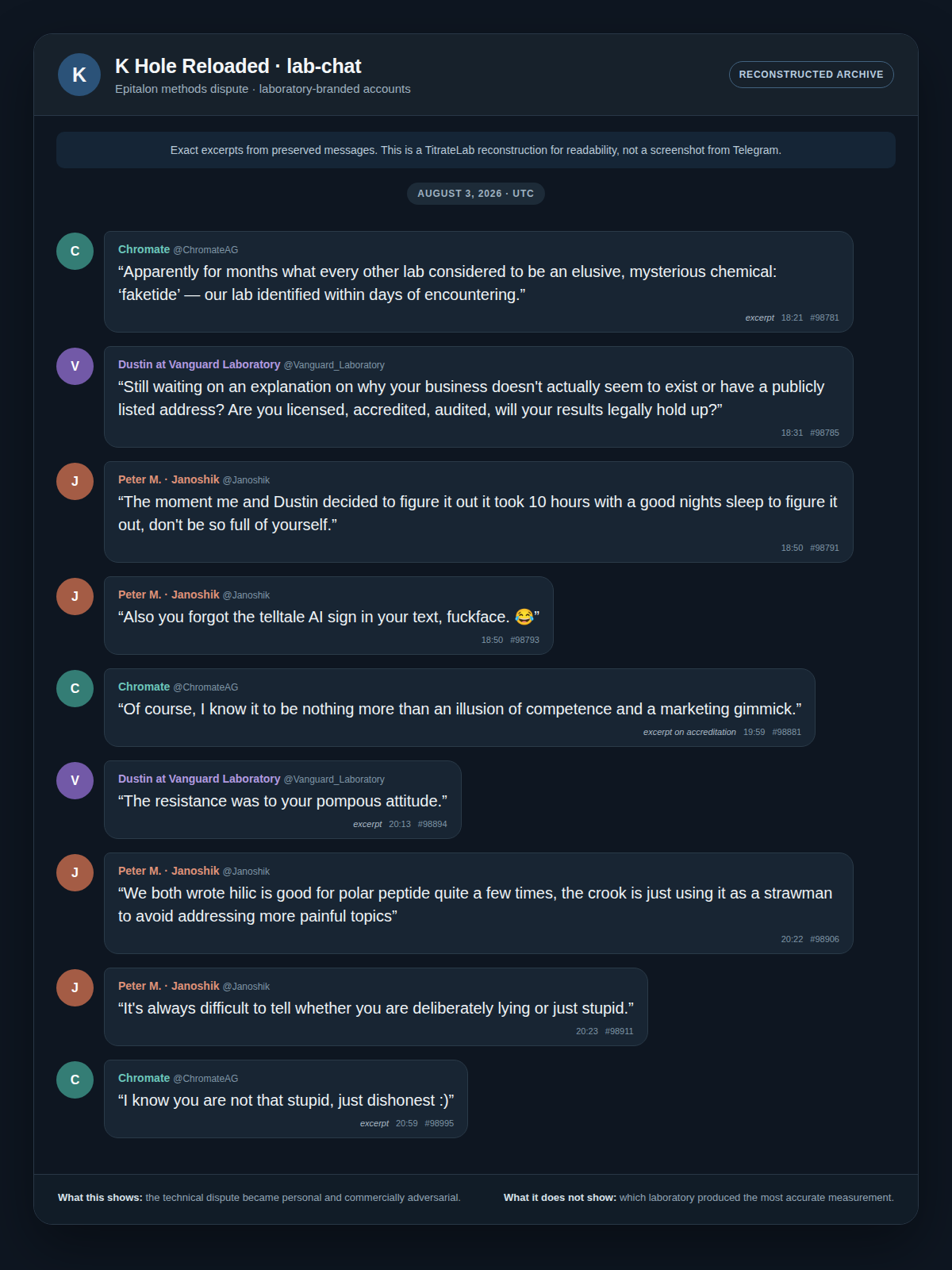
Direct quotes, source links and what each exchange establishes
- Janoshik against ChromateJanoshik told Chromate not to be "so full of yourself," mocked its writing as AI-generated with a profanity, suggested the discussion be limited to "real registered labs," called Chromate a "crook," and said it was difficult to tell whether Chromate was "deliberately lying or just stupid." 98791, 98793, 98835, 98906, 98911.
- Chromate against JanoshikChromate called accreditation "an illusion of competence and a marketing gimmick." It proposed a sample meant to expose what it described as a weakness in Janoshik's GHK-Cu method, then said Janoshik was "not that stupid, just dishonest." The challenge was not completed in the preserved discussion. 98881, 98886, 98995.
- Vanguard against ChromateVanguard questioned Chromate's public address, registration, licensing, audits and accreditation. It called Chromate's attitude "pompous," contrasted the cost of its own quality systems with Chromate's presumed revenue, and later offered method-validation consulting at $400 to $600 an hour. Those remarks combine legitimate accountability questions with status attacks and sarcasm. 98785, 98894, 100021.
- Pacific Coast Biologics against established labsIts founder questioned Janoshik's ISO status and wondered whether the community had been "getting ripped off." He challenged any "self proclaimed scientist at Jano" to compete and said he could not consider Janoshik, Vanguard or Freedom Diagnostics experts in protein chemistry if they were not using SDS-PAGE for certain larger proteins. By August, he and Janoshik were exchanging technical questions, and both had narrowed parts of their earlier positions. 40629, 56827, 56836.
- Janoshik against other competitorsJanoshik called Freedom Diagnostics "amateur" and later said Freedom and Testides were "generally shit at everything." It said MZ Biolabs was misleading readers by presenting each detected peak's share of the chart as the amount of peptide in the sample, expressed pleasure at ILS operating problems, and alleged that many new labs had no real history or operated from residential locations. The MZ criticism identifies a testable reporting issue. The blanket competence judgments and legitimacy claims are opinions or investigation leads, not findings. 85947, 98751, 86136, 87748.
- Attacks on the market's incentivesJanoshik compared label-perfect results from non-blind submissions with "pill mill labs." Pacific Coast Biologics said its biggest fear was resellers choosing laboratories that would pass 99% of tests. Both comments describe a plausible incentive to produce reassuring results. Neither identifies a documented transaction in which a named lab changed a result for a customer. 100479, 105143.
The social structure matters. Janoshik and Vanguard replied directly to one another 129 times and regularly reinforced each other’s positions. Pacific Coast Biologics was the room’s largest lab voice, with 1,537 messages, and moved from attacking Janoshik to collaborating with it. Agreement among aligned operators is not the same as an independent experiment.
Not every disagreement became abuse. BTLabs made a broad claim about filler reporting, narrowed it after Janoshik supplied a counterexample, and ended the exchange cordially. Later BTLabs and Vanguard disagreed over whether a recurring contaminant was 3-hydroxyacetophenone or 4-hydroxyacetophenone. Vanguard responded with reference-standard spikes and overlaid instrument results rather than a character attack. The question was still unresolved when the archive ended, but the exchange showed what evidence-led disagreement can look like. Sources: BTLabs 83973, BTLabs 83989, BTLabs 106475, Vanguard 106965.
The operators also made two unusually candid reporting disclosures. Vanguard said it caps displayed purity at 99.8% because a higher number would imply more certainty than its method supports. Janoshik said it avoids reporting uncertainty to clients because doing so produces hundreds of emails. A certificate can therefore look more or less precise because of a lab’s reporting policy, even before any analytical difference is considered. Sources: Vanguard 101384, Janoshik 101494.
Source note. The cited Telegram links point to the preserved K Hole Reloaded laboratory-chat messages and may require membership in that room. TitrateLab retained the read-only export, message identifiers and surrounding context. Ordinary participants are not identified here. Lab-branded accounts are named because their role is necessary to understand the dispute; account attribution is not cryptographic proof of the individual typing.
Same lab, same code: how much of the gap is the lab?
The 6.6-versus-11.8 figure in the opener comes from 45 groups with similar time between tests. The typical gap was 6.6 percentage points when one lab retested a code on different days and 11.8 points when two labs tested it. Restricting the gap to one to seven days produced the same pattern: 6.0 points within one lab and 10.4 between labs.
The difference grows as the testing conditions change:
- Same lab, same day: a typical gap of 2.4 points. Only 7% of pairs were at least 10 points apart.
- Same lab, different days: 7.1 points.
- Two different labs: 10.2 points. Half of the pairs were at least 10 points apart.
Results also varied by lab when the same lab repeated a code. The typical gap was 1.1 points at Janoshik, 1.4 at TrustPointe, 1.8 at MZ Biolabs and 1.9 at Chromate. It was 5.5 at Freedom Diagnostics, 5.6 at Krause Analytical and 7.7 at BTLabs.
Changing the lab is linked to more variation, but this comparison cannot assign how much to the lab. Same-lab repeats are more likely to come from one purchase than cross-lab pairs.
Lab differences can change vendor grades
A 10-point lab difference can change the verdict a buyer sees. TitrateLab calls a vial underfilled when a lab reports more than 10% less than the label. Across all records, 16.2% of Krause results crossed that line, compared with 9.0% at BTLabs, 5.9% at Janoshik and 4.2% at Freedom Diagnostics. Finnrick uses a wider overall pass range of plus or minus 35%.
This difference also affects any score that averages COAs. TitrateLab’s vendor score includes how far each lab result is from the label. It currently does not adjust for which lab produced the result. One independent-lab result at least 40% below the label can also cap a vendor’s grade at C.
A vendor tested mostly by Krause can therefore receive a different amount-accuracy record than an otherwise identical vendor tested mostly by BTLabs. The public evidence does not tell us which scale is closer to the truth.
The operators warn against treating public lab averages as neutral samples. Vanguard said customer mix can skew a laboratory’s average and that clients sometimes do not publish bad results. Janoshik agreed that vendors with strong results tend to test more often. That selection problem does not create the matched-code conflicts above, but it makes the database-wide lab averages less suitable for declaring a winner. Sources: Vanguard 98533, Janoshik 98534, Vanguard 98537.
We ran two “what if” calculations. These are stress tests, not corrections to the data.
- What if every Krause result were moved 10 points higher? That would remove 649 of its 959 underfilled verdicts and turn 1,920 results now called on-label into overfilled results.
- What if every non-Krause result were moved 10 points lower? That would turn 8,308 results now called on-label into underfilled results.
Together, the two separate scenarios touch roughly 9,000 published verdicts. They must not be combined or read as proof that 9,000 verdicts are wrong. Neither scenario proves which adjustment, if either, is correct.
Krause produced 9.9% of the measured-amount results in the database but 26.7% of its underfilled verdicts. Under the first scenario, 95 of 1,647 vendors with at least five measured-amount COAs would see their underfill rate move by five percentage points or more. Fifty-five would cross below the 10% underfill line, and 17 of the 278 vendors with Krause COAs would change letter grade. The point is simple: lab choice can materially change a vendor rating. This calculation does not identify the correct result.
One more pattern deserves follow-up, but the evidence is too weak to call it a finding. Krause did not find the named peptide in 4.0% of its Finnrick tests, and BTLabs did not find it in 4.7%. After a Krause failure, the next published test of the same vendor product within 120 days passed 77% of the time, or 108 of 140 cases. After a BTLabs failure, the next test passed 45% of the time, or 18 of 40 cases.
These were new purchases, not retests of the same failed vial. The two labs may also have tested different mixes of products. This is a question for Finnrick, not a conclusion about either lab.
When labs disagree on which peptide is present
The Peptide Sciences records are not the largest disagreement in the database. They are the easiest to verify because Finnrick published the purchase date, ship date and lab for each test. No other source in this study provides that much of the testing trail. The conflict is also more serious than a difference in milligrams: the labs disagreed about which peptide was in the vial. Peptide Sciences closed on March 6, 2026; our entry on why Peptide Sciences shut down covers the closure and the rest of its lab record.
Same purchase. Same code. Two peptides.
Testing-trail case study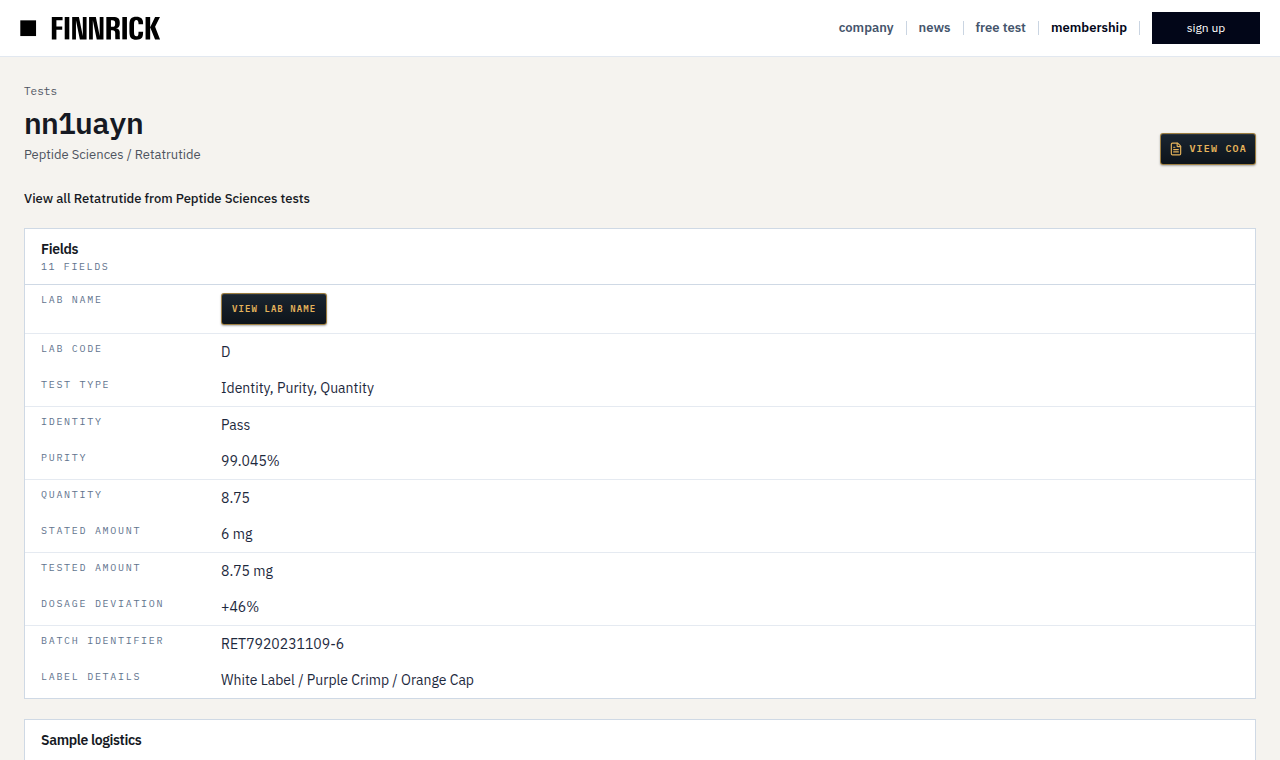
RET7920231109-6. Ordered by Finnrick on February 26, sent to the lab April 3. Open the public record.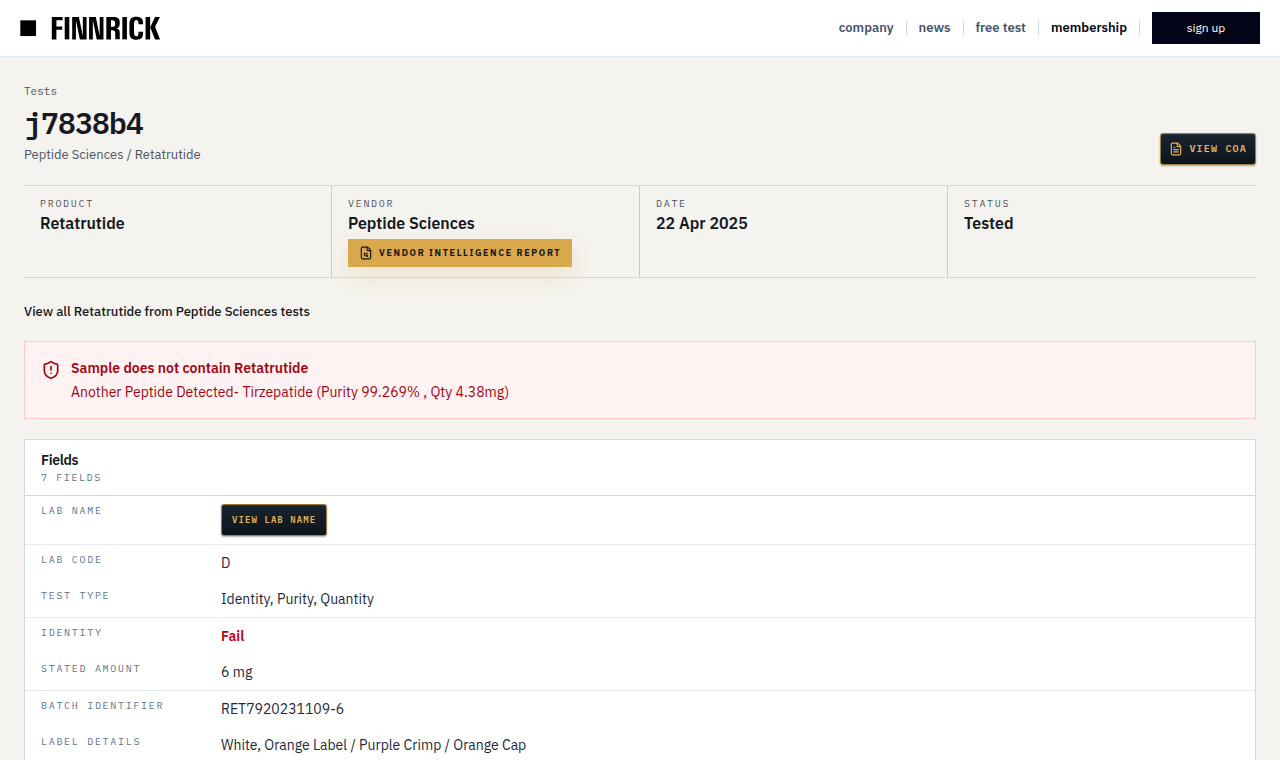
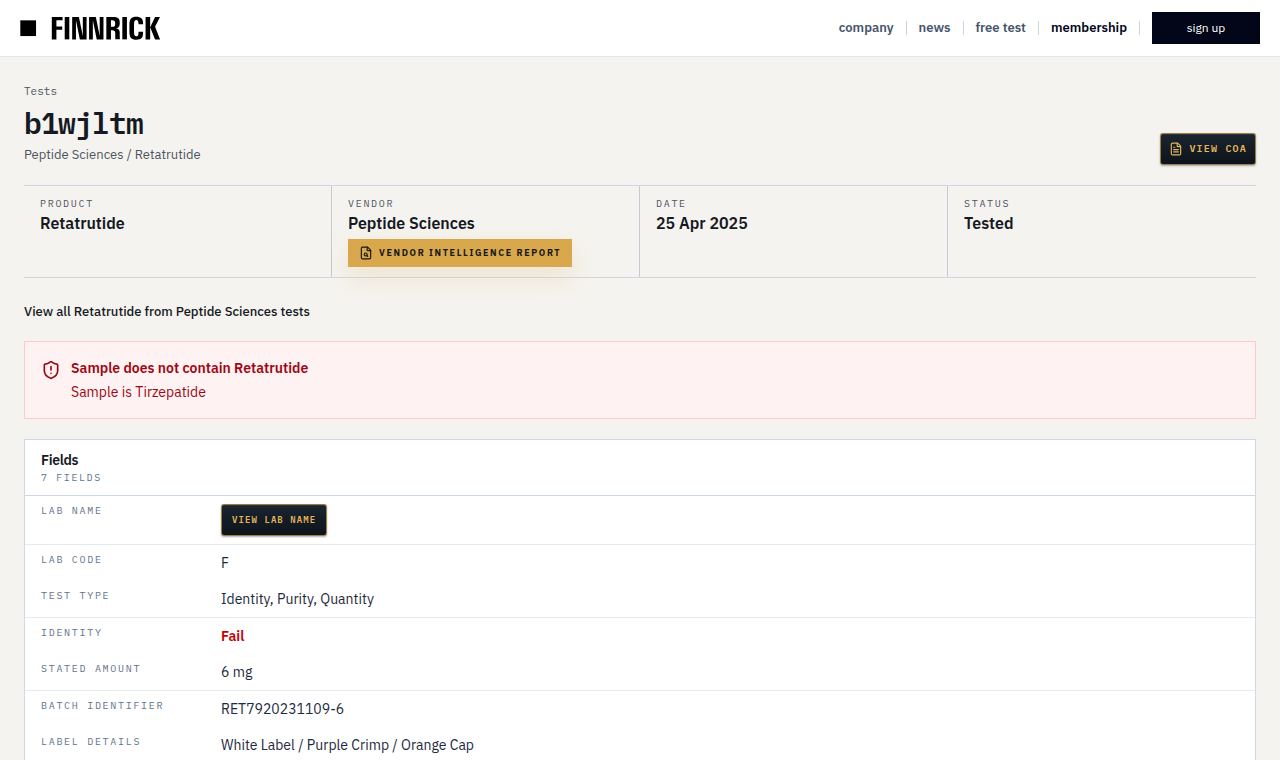
Why this set matters: Finnrick bought all eight samples itself in two orders. From the February 26 order, Janoshik found retatrutide twice while Freedom Diagnostics said a vial contained tirzepatide. From the March 19 order, TrustPointe twice said the vial did not contain retatrutide, Janoshik found tirzepatide twice, and Krause said the instrument pattern matched tirzepatide. Finnrick described the February vials as "White Label" and the March vials as "White, Orange Label," even though the printed code was identical. Normal measurement variation cannot explain one peptide being reported as another. The records cannot show where a substitution or mix-up happened: at the manufacturer, in the vendor's inventory, during shipping, or inside a lab.
| Certificate | Order placed | Sent to lab | Laboratory | Public result | Source |
|---|---|---|---|---|---|
| Mar 28, 2025 | Mar 19 | Mar 24 | TrustPointe (C) | Does not contain retatrutide | Open |
| Mar 28, 2025 | Mar 19 | Mar 24 | TrustPointe (C) | Does not contain retatrutide | Open |
| Apr 18, 2025 | Feb 26 | Apr 3 | Janoshik (D) | Retatrutide, 8.75 mg, 99.045% | Open |
| Apr 18, 2025 | Feb 26 | Apr 3 | Janoshik (D) | Retatrutide, 8.72 mg, 99.087% | Open |
| Apr 22, 2025 | Mar 19 | Apr 3 | Janoshik (D) | Tirzepatide, 4.38 mg, 99.269% | Open |
| Apr 22, 2025 | Mar 19 | Apr 3 | Janoshik (D) | Tirzepatide, 4.29 mg, 99.468% | Open |
| Apr 25, 2025 | Feb 26 | Apr 23 | Freedom Diagnostics (F) | "Sample is Tirzepatide" | Open |
| May 7, 2025 | Mar 19 | May 1 | Krause Analytical (E) | "Not a match for Retatrutide, spectral match for tirzepatide" | Open |
The second code: a pass, then a note that a peak was misread
Second identity reversal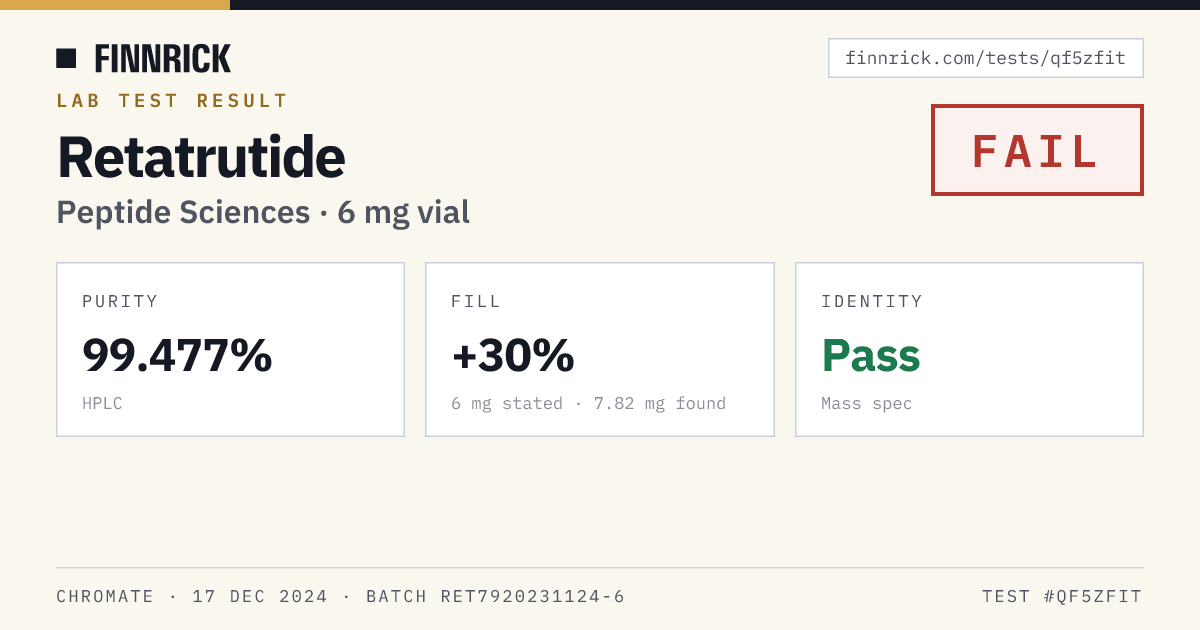
RET7920231124-6. Ordered by Finnrick December 4. Open the public record.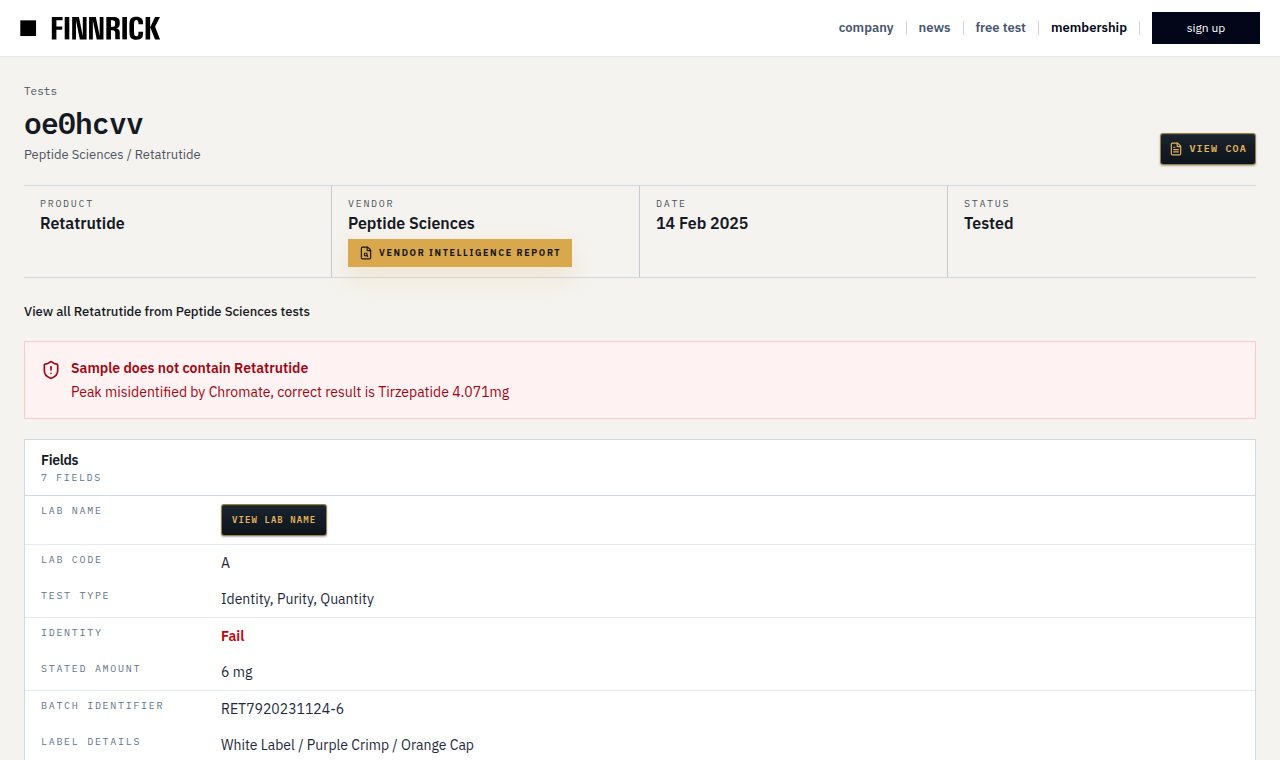
The only place in this record where a misread is admitted. The code appears on five Finnrick certificates. After the December pass at Chromate, TrustPointe reported "an unknown compound that is NOT Retatrutide" twice on February 13, Chromate reported the corrected tirzepatide result on February 14, and MZ Biolabs reported "Identity FAILED: Vial contains Tirzepatide" on February 19. The note is a free-text remark on the record; it does not appear in Finnrick's dated corrections log, and it does not say who caught the misidentification. The FDA's guidance on out-of-specification results is written for regulated manufacturing, not for this market, but its principle travels: "If no laboratory or calculation errors are identified in the first test, there is no scientific basis for invalidating initial OOS results in favor of passing retest results." The reverse question is the one this record raises and nobody has answered. Once a peak on this code was known to have been misread as retatrutide, was the December 17 pass re-examined?
Three more conflicts
The images below show the strongest measured-amount conflict and two identity conflicts. Each uses one vendor and a long, specific code. Finnrick’s shipping history ties all four Purepeps vials to one order. In both identity cases, the failing vial was a public mail-in while the passing COA came from a sample chosen by the vendor. That difference limits what the comparison can prove.
Purepeps: one order, three laboratories, 4.66 mg to 11.31 mg
Labs disagree on amount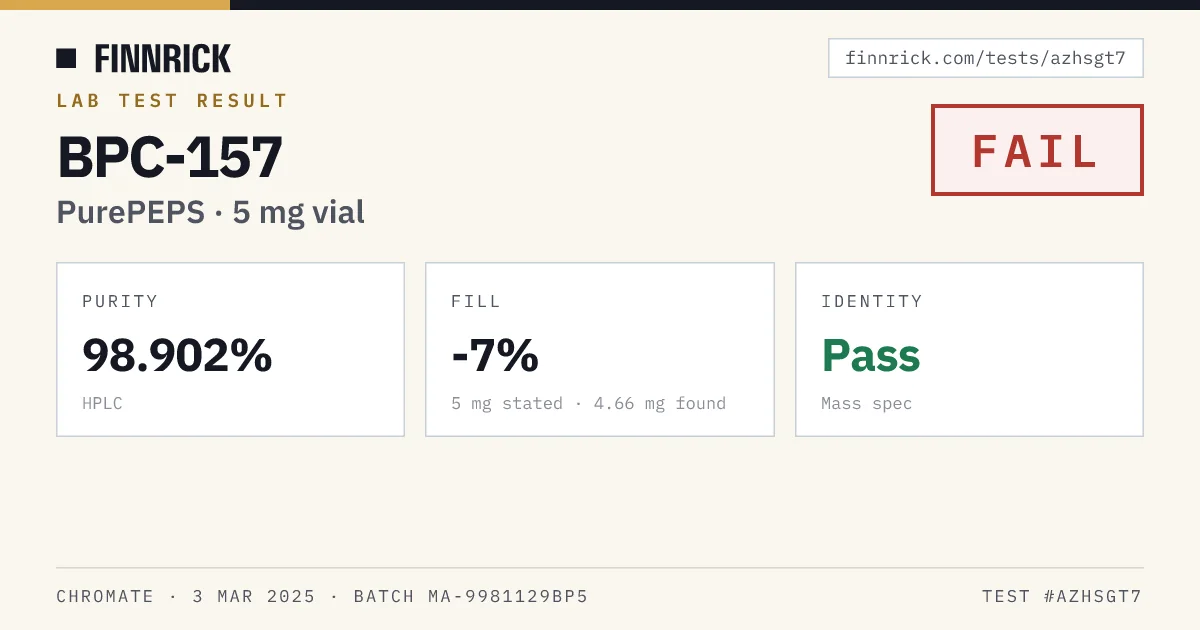
MA-9981129BP5, 98.902% purity. Finnrick's overall stamp reads FAIL because the fill missed its default standard; identity passed. Open the public record.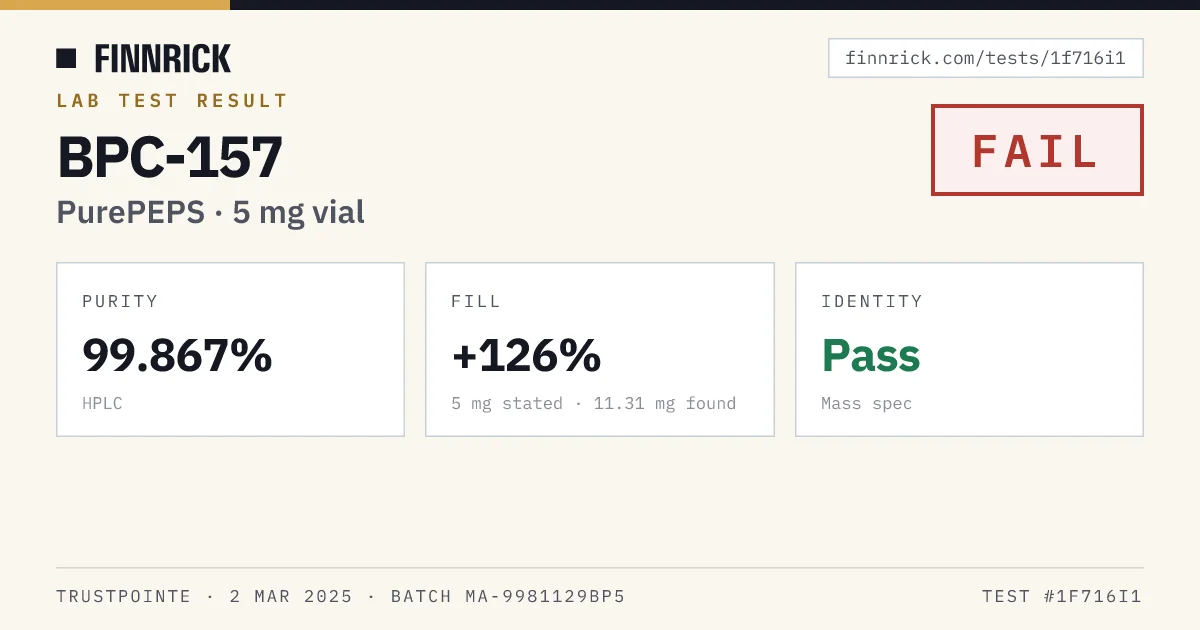
What the records establish: TrustPointe reported 11.15 mg and 11.31 mg, Chromate reported 4.66 mg, and MZ Biolabs reported 5.8 mg. The highest and lowest results were 6.65 mg apart on a vial labeled 5 mg. The vendor, dose, code and laboratory are visible, and Finnrick ties all four vials to one order. What they do not establish: whether those vials came from one sealed lot, or what each lab counts as a milligram.
When one lab finds the peptide and another does not
Two vendor examples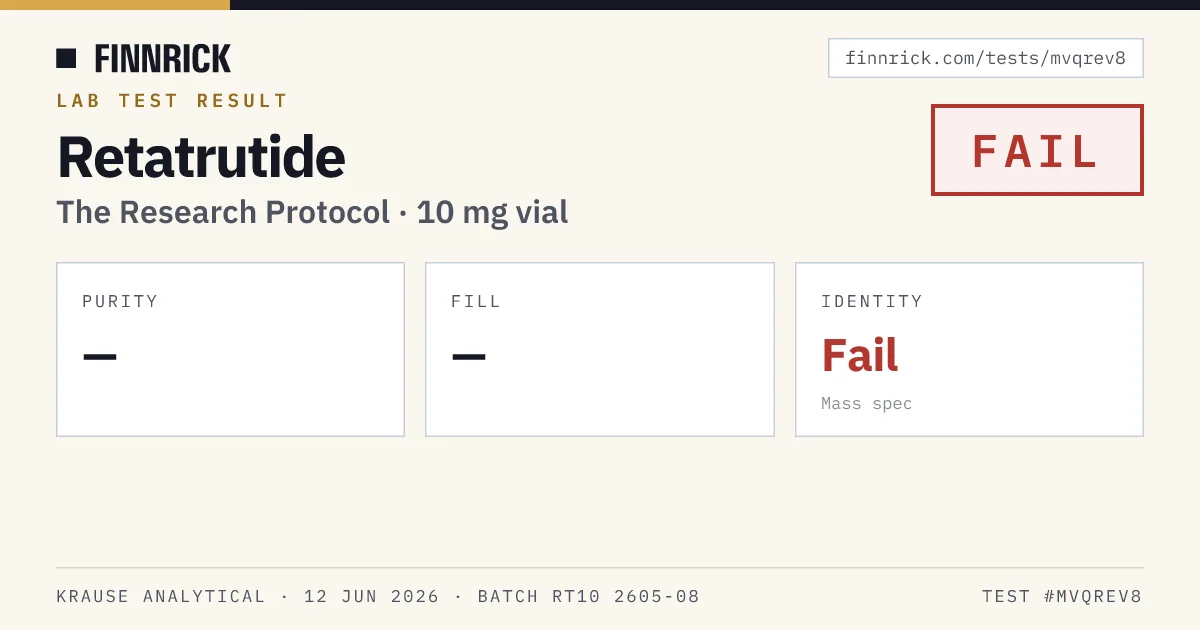
RT10 2605-08. Open the public record.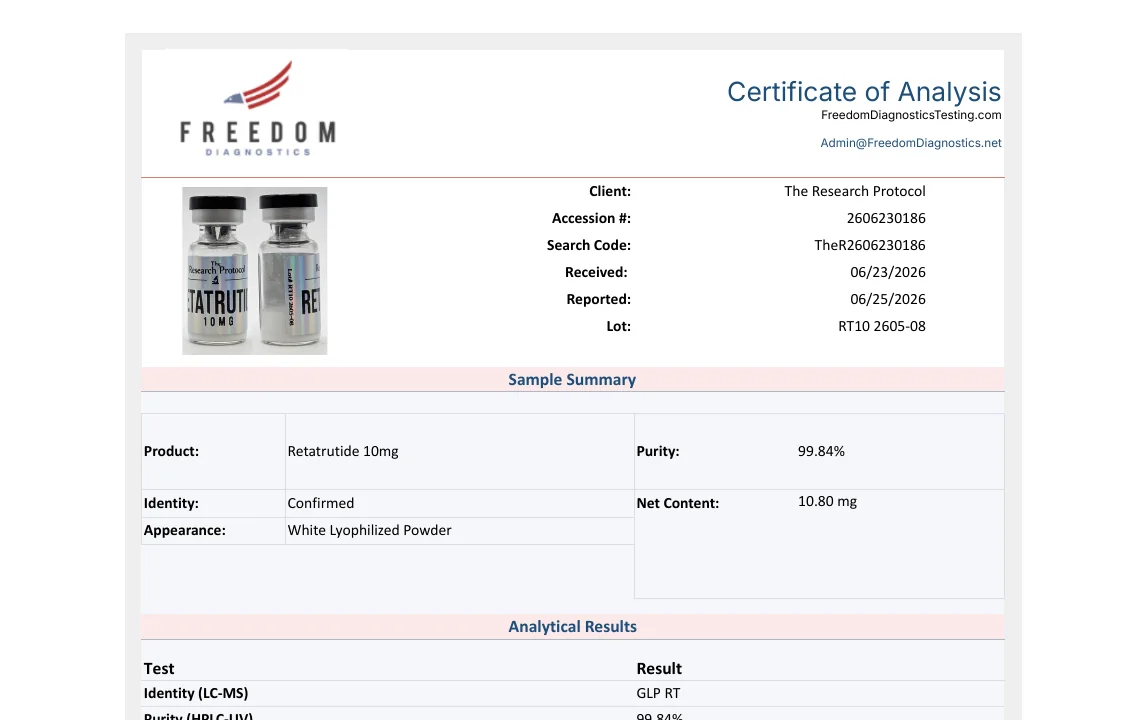
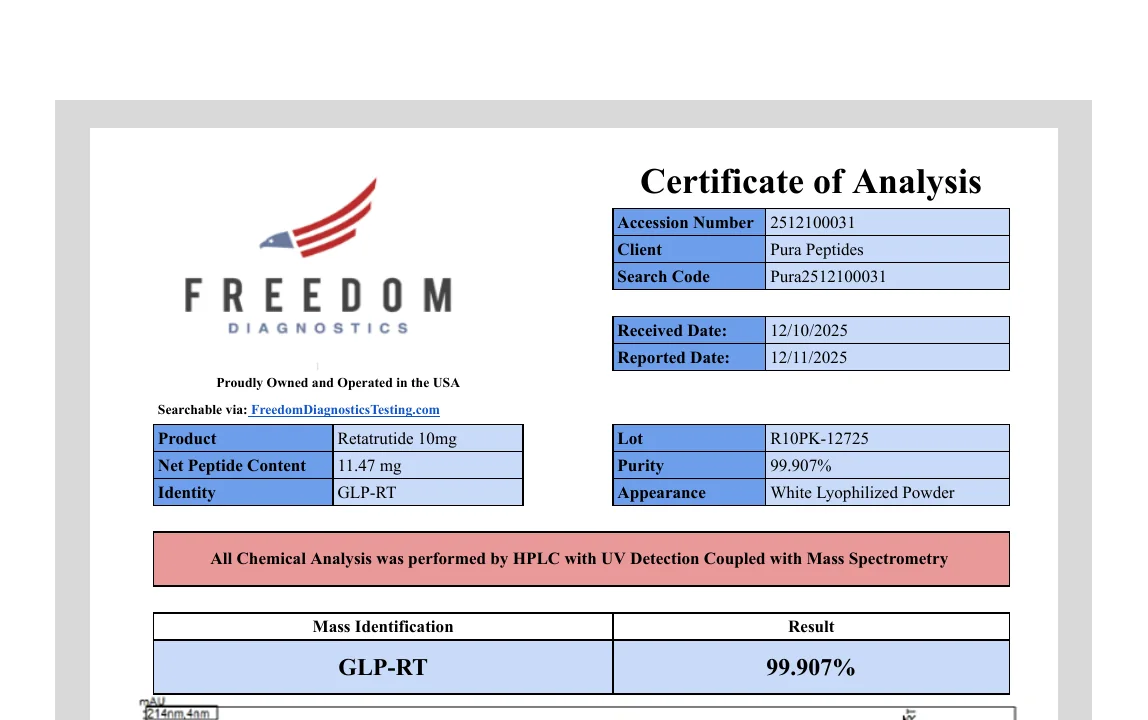
R10PK-12725, reported December 11, 2025. The image is the result panel from the source PDF. Open the full COA.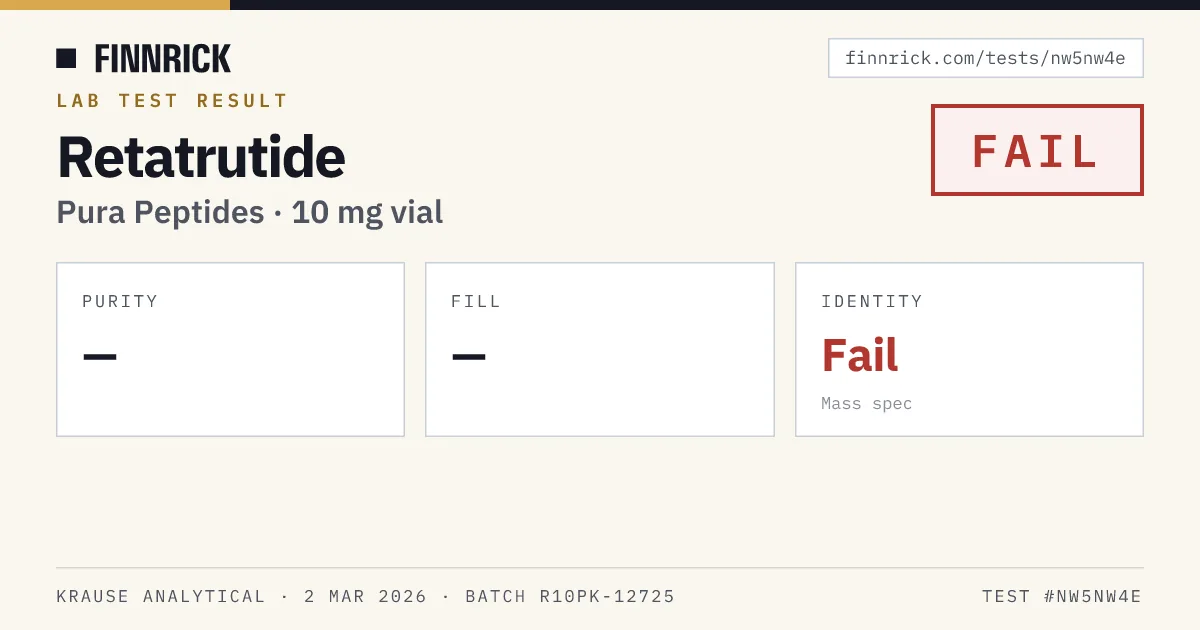
The narrow conclusion: each pair names the same vendor, peptide, labeled dose and printed code, but the labs disagree about which peptide was present. The images prove that the published records conflict. They do not show whether the cause was the submitted vial, who handled it, storage conditions or the lab.
Other causes the records cannot separate
Different lab definitions and comparison materials are the leading method questions. Three possible causes and one selection problem remain open.
510005 appears only in the appendix.What we are changing
Find Your Batch now treats an exact printed-code match as a possible match, not proof of one production lot. Vendor, peptide, labeled dose, packaging, purchase date and COA date can strengthen the match. A short number, a manufacturing date or a code used by several vendors weakens it and triggers a reuse warning. When two COAs carrying one code conflict, both remain visible.
Vendor pages will also show which labs produced their COAs and warn when one lab produced most of the record. The grade stress tests above show why that source mix must be visible.
We will not treat agreement among friendly or commercially aligned laboratory operators as independent confirmation. Claims about a competitor will be labeled as claims unless the underlying certificate, raw data or controlled comparison supports them.
The laboratories themselves described the test needed to settle the central question. TitrateLab will seek one well-mixed sample, split into randomized duplicate or triplicate portions and sent blindly to each lab. The comparison should publish the standard used, method conditions, raw chromatograms and spectra, calculation rules, expected margin of error, and every result under rules written before testing begins. That is more useful than another argument over two vials carrying the same code.
Because lab choice can move a vendor’s grade, TitrateLab is reviewing how laboratory-specific measurement patterns affect the amount-accuracy score. Until that review is complete, vendor grades should be read alongside the named laboratories and underlying COAs, not as stand-alone proof of quality.
How we ran this analysis and what it cannot prove
TitrateLab ran this analysis against a read-only copy of its COA database on August 27, 2026 at 18:03 UTC. We standardized spelling, doses and printed codes. When one physical certificate produced more than one database entry, we counted that certificate once. We also replaced Finnrick’s lab letters with the lab name printed on each record.
A group had to contain at least two physical COAs from at least two labs. Cases where a lab did not find the named peptide were kept separate from comparisons of measured amount. All amount gaps use percentage points of the labeled amount, which allows a 5 mg vial and a 30 mg vial to be compared on the same scale.
TitrateLab retained a fixed research archive for all 179 screened groups. It includes every COA result and source link used in the comparison, the calculation output, Finnrick records, share cards, Freedom Diagnostics PDFs and saved copies of the public source pages. Those dated copies let us identify later changes to the source material. The public links throughout this article let readers inspect the underlying evidence directly.
The laboratory-conflict section uses a separate read-only archive of the K Hole Reloaded laboratory-chat topic. The snapshot contains 6,270 messages through August 11, 2026. We counted only direct statements from strongly attributable lab-branded or public laboratory-representative accounts. Competitor accusations are described as accusations. Self-reported methods and policies are described as self-reported. Neither is promoted to a measured finding without the underlying data.
Important limits:
- These are patterns in public records, not a random sample of the entire market. A two-lab group exists only when a testing program or member of the public sent the same code to two labs.
- Eighty-three percent of Finnrick’s published records are public mail-ins. For those records, the person mailing the vial supplies the vendor name. Finnrick labels its own purchases and provides a shipping timeline, but no public record tracks every handoff for a vial tested by two labs.
- Some comparisons combine COAs routed through Finnrick with COAs published directly by Janoshik or Freedom Diagnostics. The reporting rules may differ between those routes.
- Exact matching can miss a real repeat if a label changes. Standardizing punctuation can also merge two codes that were intended to be different. We checked every named example against its COA image or public record page.
- A certificate describes the submitted sample. It does not describe every vial sold under the same code.
- Laboratory names are as Finnrick and the laboratories publish them. Nothing in this article asserts that any laboratory’s result is wrong.
- Telegram links may require membership in the archived room. TitrateLab preserved message identifiers and surrounding context, but the article does not identify ordinary participants or treat a lab-branded account as cryptographic proof of the person typing.
See TitrateLab’s methodology for the broader evidence rules. Corrections can be sent to [email protected].
Appendix: the 510005 code
Four public COAs name Retatrutide 30 mg and print the code 510005. We excluded them from the 179 screened groups because this code probably identifies a product, not one production lot. It has only six digits, appears under three vendor names, and TitrateLab’s earlier ERP, WBS and JKL investigation found it on retatrutide kits from several sellers. We include it here because readers of that investigation will look for it.
Retatrutide 30 mg · four public certificates
Printed code 510005The lowest result was 27.8 mg and the highest was 34.36 mg. That is a 6.56 mg difference, equal to 21.9% of the 30 mg label. Purity barely moved, ranging from 99.90% to 99.94%. The two Krause results fall on either side of the BTLabs result, so this small set does not show the broader Krause pattern.
The related TitrateLab vendor records are ERP, WBS and Praetorian Peptides. The Freedom Diagnostics COA names its client as “Praetorian Labs.” Our earlier reporting found evidence that ERP and WBS operate inside a shared or closely coordinated sales and supply network, so we do not count their labels here as independent sources. Praetorian remains a separate vendor. A shared product code can be a useful supply clue, but it does not prove a business connection or one physical batch.
For a current comparison of retail prices, methods, sample requirements and accreditation scope across Janoshik, ILS, Vanguard, Chromate and Freedom, read Peptide Testing Labs Compared (2026).
510005The code is useful for tracing a possible shared supply network, but it is weak evidence that two vials came from one production lot. It appears across several months, COAs and delivered kits. The four results raise a consistency question inside a connected supply network. They are not a controlled comparison of one verified batch.
