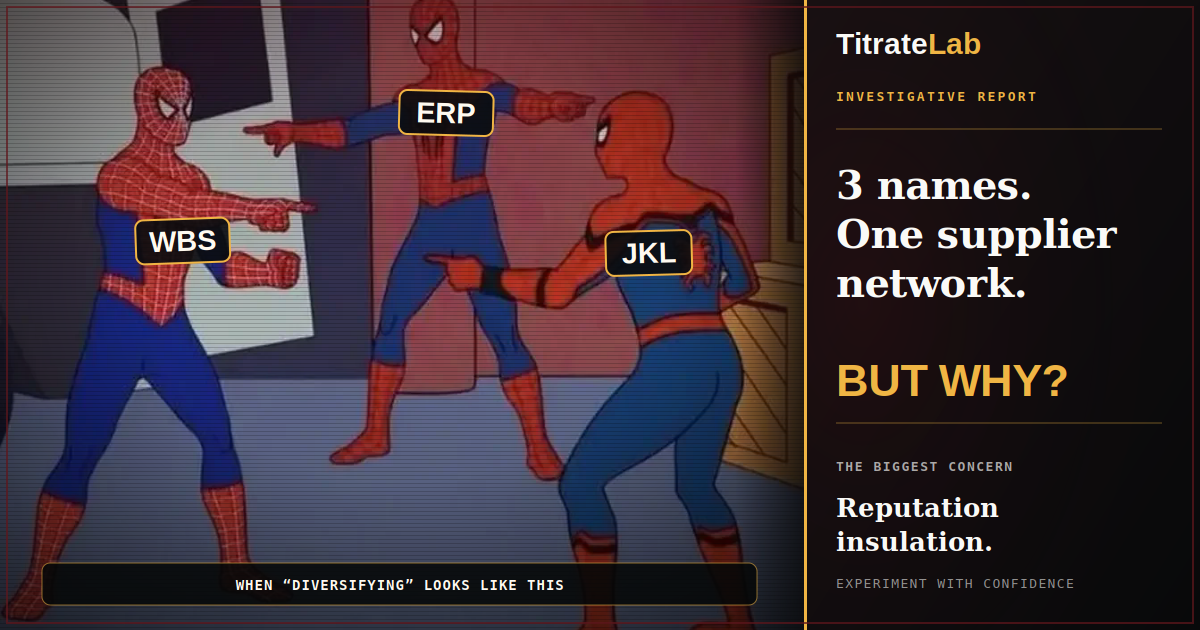
ERP, WBS and JKL are one connected Chinese peptide supply network.
Three names. One supplier network.
Because three names can do what one name cannot: give the same network more storefronts, price positions and fallback channels while preventing one bad COA, refund dispute or wave of complaints from defining the entire operation.
That is reputation insulation. It does not mean every product is bad or every order fails. It means the supply risk can stay connected while the reputation damage is split three ways.
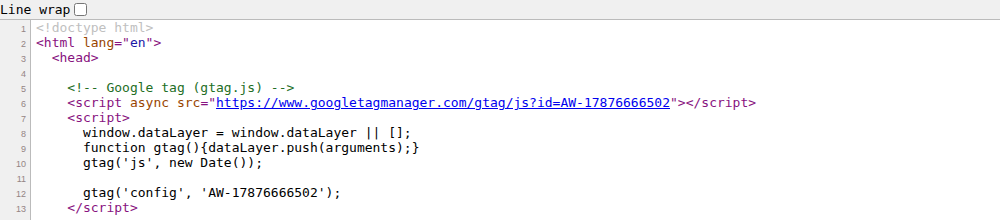
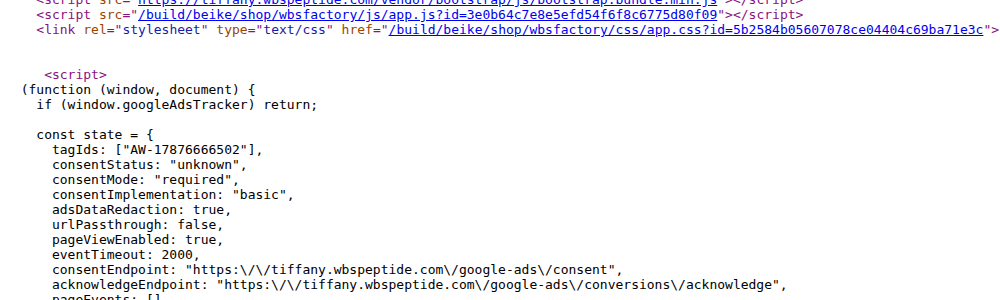
ERP and WBS both use AW-17876666502.
11 SKU keys match exactly. 47 of 143 WBS keys reuse an ERP base or prefix.
31 delivery images produced at least 9 exact product-and-code matches to the ERP/WBS system.
27 of 31 products followed JKL $x, ERP $x + 1, WBS $x + 2. WBS was ERP + $1 in all 31.
A bad COA, shipping failure, refund dispute or wave of complaints can collect under one name while connected names keep selling with cleaner public records. Buyers who research only one name see only one slice of the history. Parallel branding does not erase the damage. It separates the damage from the next sale.
A buyer can divide orders across all three names and still depend on the same stock, packer, fulfillment system or upstream source. One quality failure, shipping disruption or inventory problem can affect what looked like three separate bets.
More search visibility, more price tiers, backup websites and payment channels, and another name that remains usable when one reputation is damaged. The network gets more ways to keep selling while the buyer sees less of the whole picture.
Reviewed Aug. 22, 2026 · 251 published COAs · 31 JKL delivery images · 2 live storefronts · 31 three-way price comparisons · public forum chronology
What TitrateLab will do: map the three names together and show the network context. Their individual records stay separate, but we will not present them as independent supply alternatives or let their COAs, complaints and service failures be read in isolation.
 WBSERPJKL
The clue that changed the investigation: one Google Ads ID
rechecked Aug. 22, 2026
Three names. One connected supply picture.
Aug. 22, 2026
One supplier network. But why three names?
Because three names buy flexibility. They create more storefronts, more search results, more price positions and more backup routes for selling. Buying once from ERP, once from WBS and once from JKL can look like three separate bets even when a quality problem, packing failure, inventory shortage or shipping disruption may still travel through one connected supply network.
The darker advantage is that three names also divide the public record. A poor lab result can be filed under ERP, a refund dispute under WBS and a shipping complaint under JKL. A buyer who checks only one name sees only one part of the network’s history. One identity can absorb the damage while the others remain available for the next sale. That is why reputation insulation matters more than the fact that the storefronts look different.
The price comparison is also less independent than it appears. In the frozen
cohort, WBS was exactly $1 above ERP in 31 of 31 comparable rows, and 27 also
followed the complete JKL $x / ERP $x + 1 / WBS $x + 2 ladder. Three
price lists can still reflect one rate-card system.
This does not make every vial bad, and one vendor’s COA cannot be transferred to another vendor’s product. It means TitrateLab should show the relationship before a buyer compares supply, price or reputation. We map the network together while keeping every individual COA, review and service record under the name that produced it.
We did not build this case from one matching cap color
The Aug. 22 snapshot contains more than 80,000 published COAs. Of those, 251 are attributed to the three core names: 131 to Shanghai ERP Peptide Biotechnology, 91 to Shanghai Wibson Biotechnology/WBS and 29 to JKL Chemical Technology. We also reviewed both public storefronts, retained price lists and promotions, public forum posts, domain records and 31 dated JKL customer-delivery images.
Each source answers a different question. A lab report can connect a vendor name, compound and identifier. Storefront code can expose shared advertising or catalog infrastructure. A delivery photo can preserve a kit code that never appeared on the lab report. A customer post can show an experience, but it is not proof of how every order ends.
This is a relationship finding. It is not a finding that any particular vial is safe, sterile, authentic or suitable for use.
Each name still owns its own history
The connection does not let us blend three reputations into one. ERP’s lab reports belong to ERP. WBS’s shipping complaints belong to WBS. JKL’s review history belongs to JKL. We keep those records separate because one certificate or one customer report cannot define an entire vendor.
But buyers should still see the rocky parts of each history. The public record is not uniformly favorable under any of the three names.
One detail connects the three histories. ERP and WBS both have adverse BPC-157
reports carrying code 990007. A retained JKL delivery image shows that same
code on BPC-157 10 mg packaging.
shared code
The quality histories intersect through one product-code system. That matters.
It is not proof that the two laboratory samples came from one manufacturing
lot. The reports are nearly two months apart, and the wider record shows that
these codes get reused. Code 510004 makes the problem clear: ERP reports under
that code ranged from 10.1 mg to 23.2 mg against a 20 mg reference, while WBS
reports under the same code measured 20.2 mg, 20.4 mg and 22 mg. The code connects a
product family. It does not make one seller’s result transferable to another.
The same qualification applies to 990007. WBS also has reports under that
code measuring 10.4 mg and 12.5 mg. The selected 8.74 mg result is a real
adverse record, but it is not the only WBS result tied to that product code.
That also changes how we talk about a possible “rinse and repeat” strategy. WBS’s documented complaint cluster came after ERP already existed, so the timeline does not show ERP being created to escape WBS’s record. But once parallel brands exist, complaints can be split across names while another storefront stays cleaner. That is reputation insulation as a structural effect, not a proven motive.
WBS was visible first. That does not tell us why ERP appeared.
Here is what the timeline can tell us. WBS is the earliest of the three public vendor identities in our captured record. Its earliest currently attributed certificate is dated Feb. 27, 2025. Its first captured forum introduction is dated Apr. 9, 2025.
ERP’s forum introduction followed on September 8, 2025, where the account described ERP as a new partner; its earliest currently attributed certificate is dated September 30. JKL’s earliest currently attributed certificate is dated October 1, 2025, while its captured forum activity begins in April 2026.
So, WBS was visible first. That is all the timeline proves. We found no contemporaneous announcement of a split, staff departure, ownership dispute or asset transfer. We cannot call ERP a WBS spinout, a renamed WBS operation or a response to a reputation problem.
The storefront timeline points in the other direction: ERP’s current shop domain and public launch predate WBS’s present shop domain. A storefront build may have moved from ERP to WBS. Or the same contractor may have reused it. A domain date is not a company formation date, and it cannot identify the operator.
ERP and WBS are where the case becomes hard to dismiss
The case does not depend on one clue. Five different evidence families connect ERP and WBS.
Both storefronts exposed the exact Google Ads conversion identifier AW-17876666502 on August 18–19, and still did when rechecked August 22. A shared contractor or copied configuration is possible; the identifier still ties their advertising measurement infrastructure together.
The same publicly advertised business number moved from an ERP representative to a WBS representative within seven days, while ERP began publishing a replacement number. The dated posts are retained in TitrateLab's evidence archive.
Corresponding products reused exact or extended storefront tokens such as BKSKU-D6AF-929 and BKSKU-HBFJ-994. A common platform explains the prefix; it does not readily explain repeated identical random suffixes on matching products.
Codes such as 510002, 510004, 510005, 510006, 990007 and 990025 recur on corresponding ERP- and WBS-attributed reports.
-W5-F13019The Aug. 19 storefront snapshot made the overlap measurable. Eleven of 143
active WBS SKU keys were byte-for-byte identical to ERP keys. Forty-seven
shared an ERP base or prefix. A shared shopping platform can explain the
generic BKSKU prefix. It does not neatly explain the same random suffix on the
same product.
The same product identifiers cross both vendor names
These are not duplicate certificate files. They are different tests with different dates and measurements. The product codes point to one shared namespace or supply family. They do not prove that either certificate client manufactured the material.
Then we checked price. Thirty-one product, strength and kit-size combinations
could be compared cleanly across all three brands. WBS was exactly $1 above
ERP in all 31. Twenty-seven formed the exact ladder JKL $x, ERP $x + 1,
WBS $x + 2. The observations were not all captured on the same day, so
we are calling this a rate-card fingerprint, not synchronized pricing.
vendor_pricelists evidence ledger. Selection required US origin, US delivery, a positive product price, direct ERP and WBS storefront captures, and retained JKL vendor-published text prices. Attachment OCR and zero-dollar placeholders were excluded. Rows were joined on normalized product, strength and kit quantity. The observations are asynchronous, so this exhibit shows a repeated price structure, not a same-day market snapshot. Download the frozen 31-row comparison (CSV).That exact three-brand ladder appeared in 27 of 31 comparable rows, and the WBS-equals-ERP-plus-$1 relationship held in 31 of 31. Price lists do not usually line up that neatly by accident. The complete source rows are available above so the pattern can be checked rather than taken on faith. The ladder still cannot tell us who set the prices.
JKL is the harder connection, and the physical evidence matters
JKL does not share the Google Ads and storefront fingerprint that makes the ERP/WBS link so strong. Its bridge comes from physical product labels, pricing and promotion patterns.
We manually reviewed 31 dated customer-delivery images retained from JKL
discussions. They exposed at least 30 distinct numeric codes. At least nine
compound-and-code pairs were already present in the ERP/WBS or wider connected
certificate record. Examples included 410003 for
Tirzepatide 15 mg; 510002, 510004, 510005 and 510006 across the
Retatrutide range; 990007 for BPC-157 10 mg; 990009 for TB-500 10 mg;
990025 for Tesamorelin 10 mg; and 990045 for GHK-Cu 100 mg.
We are not publishing the delivery images. They came from a private community archive and may expose contributor or shipment context. We retained the dated observations for audit and kept the media, usernames and account identifiers out of the public article.
The code system is messy. The certificate corpus has strength conflicts for
510004 and 510006, and some codes persist across multiple test dates. That
is why we treat them as product, catalog, stock or warehouse identifiers, not unique manufacturing-lot numbers. A code with the same compound, strength and
time context can be useful evidence. A code by itself is not.
JKL and ERP also published July promotions with the same unusual time window, three exact China-warehouse prices and the same $598 free-shipping threshold. All three brands later listed Eloralintide 5 mg at $175 and 10 mg at $330. The offers were not identical, so we are not calling the price lists clones. The uncommon parts that do repeat still point toward a shared rate card, common upstream source or coordinated commercial operation.
Once we followed the codes, the map got bigger
The same product-code family appears under other client and seller names. The public certificate record gives us four code matches for Modus Club, three for QNTM Research, one for Praetorian Peptides and one for Vis-Impact. Retained private ERP delivery evidence adds two more Vis-Impact code observations.
Those are possible downstream or common-source relationships, not aliases. A certificate client may be a reseller, test group, buyer or company paying for independent testing. We keep each name separate. A reused code does not tell us who sold to whom.
One upstream-facing lead is Shanghai Baoju, whose Retatrutide 10 mg certificate
uses 510002. Baoju publicly presents itself as a lyophiliser. That makes the
record worth investigating, but one shared code cannot tell us whether Baoju
packed, sourced, distributed or merely submitted the sample. View the Baoju certificate.
This is why some lines on a supply map must remain unresolved. A neat arrow can look satisfying and still be wrong.
BUT WHY? Because reputation is easier to divide than supply
False diversification affects what a buyer chooses. Reputation insulation affects what a buyer can see. A buyer may split orders across ERP, WBS and JKL believing they have spread risk across three suppliers while the representative and price change but the underlying catalog, inventory pool, packer or upstream source does not.
The public record then splits too. A poor lab result can sit under ERP, a refund dispute under WBS and a shipping complaint under JKL. Each name gets a partial history. The connected network gets no single reputation page. One name can absorb the damage while the others remain available for the next sale. That is reputation insulation, and it is the largest buyer risk in this story.
So this is how TitrateLab will handle them. ERP, WBS and JKL stay separate in our database. Each keeps its own reviews, COAs, prices and customer-service record. But we will also show the connected history. We will not present them as independent upstream alternatives or make a buyer reconstruct the network from three separate reputation pages.
We will use the same standard everywhere else. A shared cap color is weak. Similar purity or fill is weak. Even a six-digit code can mislead when it appears across different compounds. The map gets stronger when several things agree: dated product identifiers, storefront or business-account fingerprints, aligned inventory, public relationship statements and verified fulfillment records.
If a kit carries a batch, catalog or cap identifier, buyers can use Find Your Batch to search TitrateLab’s published certificate corpus. A result is a lead to inspect, not proof of upstream attribution unless the compound, strength, date and other available identifiers also align.
Three names give one network more room to move
The commercial logic is not mysterious. Three names mean three sales pitches, three sets of search results and three reputations. Separate names can divide regions, sales teams, warehouses and price tiers. They can also keep another storefront available when one website, payment channel or reputation is damaged. Reviews, COAs, refund disputes and complaints accumulate under separate names instead of one shared public history. That gives the network more ways to keep selling and fewer chances for one bad history to follow the entire operation.
The evidence fits three operating models:
- One commercial or back-office network with separate sales brands. This best fits the shared ERP/WBS advertising account, business-contact handoff, inherited SKUs and copied commercial material.
- Independent sales organizations using one upstream supplier, catalog or warehouse system. This fits separate current contacts and deployments while explaining shared product codes and price structure.
- A common web, marketing and fulfillment contractor. This can explain some digital overlap, but it does not explain the full identifier, delivery, pricing and promotion record as easily.
We found no evidence that ERP was originally created in response to a specific WBS crisis. But the structure now provides reputation insulation whether that was the original plan or not: a problem can collect under one name while the other names remain available to sell from the connected network. The original motive may be private. The buyer-facing effect is visible.
How this changes the TitrateLab map
We will map ERP, WBS and JKL together whenever a buyer is comparing supply risk. Their individual vendor pages, COAs, reviews, prices and service records stay separate. The connected history will sit above those separate records so a buyer can see both the seller-level evidence and the network-level risk.
Moving from one of these names to another will not count as proven supply diversification. A comparison can still show differences in price, warehouse, service or testing, but the buyer will not have to discover the shared infrastructure, code system and pricing pattern from scratch.
How we did this, and where it can be wrong
We matched published certificate records by vendor, compound, strength, normalized identifier and test date. We removed duplicate artifacts, inspected public storefront code and historical price lists, compared US-domestic offers, reviewed dated delivery photos and checked public forum and domain timelines.
The limits matter. The public COA corpus is voluntary and nonrandom. One certificate describes one submitted sample. The client or manufacturer printed on it may be the person paying for the test rather than the original producer. A certificate date is not a manufacture date or purchase date. Independent businesses can share catalogs and warehouses. Resellers can preserve an upstream code or replace it.
We label community reports as reports. We do not republish private-community text or media. Public customer reports are examples, not a complaint rate, and a public thread may not show a later private resolution. Every named brand stays separate. This map records connections and uncertainty. It is not a ruling on corporate ownership or product safety. The evidence supports a connected supply environment; it does not require one legal company, one beneficial owner or one physical factory.
Evidence was reviewed through August 22, 2026. To submit a correction, vendor response or primary document, email [email protected]. Material changes will be recorded with a date rather than silently overwritten.