What the coroner found
Norton collapsed after an injection on March 28, 2025, and died in hospital two days later. His doctor said the medication came from a licensed compounding pharmacy in Queensland. The coroner’s finding, signed on October 28, 2026, records the pharmacy source, Norton’s disclosure of double dosing, and the fatal allergic reaction in paragraphs 6, 10 and 48.
The published finding does not give an assay of his vial, establish a pharmacy overfill, or quantify the final injected amount. It does not identify which constituent triggered the reaction. Describing the case as a proven pharmacy overfill causing a fatal overdose would go beyond that evidence.
The laboratory reports below involve other samples and are not linked to Norton’s medication. They show a separate problem: the measured amount of a peptide can differ substantially from the amount stated on its label or report. Testing can detect those differences, but it cannot rule out a severe allergic reaction.
What the wider database screen found
An all-date search of TitrateLab’s records identified 2,430 candidate CJC-1295/ipamorelin blend records. Checking the available quantities flagged 200 records, grouped into 199 distinct report groups, with at least one potential comparison more than 30% above stated content. Multiple components and vials can appear in one report.
Those 199 groups have different levels of evidence:
- 3 reports: original certificates and photographed labels independently checked; these supply the four sample/vial examples below.
- 150 reports: comparisons extracted from original PDF text, awaiting the same visual and label review.
- 5 report groups: six imported records with stored extraction results that have not been verified against the originals.
- 41 reports: held because the stated amount, identity or source quality needs clarification.
The full internal catalogue preserves all these candidates and their review status. It contains 280 above-threshold comparisons, including components and totals; that is not a count of independent samples or verified overfills.
Another 833 records could not be assessed from the available source material and quantities. The remaining 1,397 produced no above-threshold comparison in the fields we could parse, which does not establish that every component was within range. The screen therefore cannot supply an exhaustive verified list or a market-wide overfill rate. The illustrated findings below have the stronger certificate-and-label checks described above.
Read the component amounts, not just the blend total
The examples below come from three original Freedom Diagnostics reports. Their printed clients are MetBio Peptides, TWYN Wellness and Research 1 Peptides. These names identify the clients on those reports; they do not establish who manufactured the samples.
Each example has at least one component more than 30% above its stated amount. We selected them to show three different comparisons, not to rank companies or estimate the frequency of overfills across the market.
| Report / sample | CJC-1295: stated → measured | Ipamorelin: stated → measured |
|---|---|---|
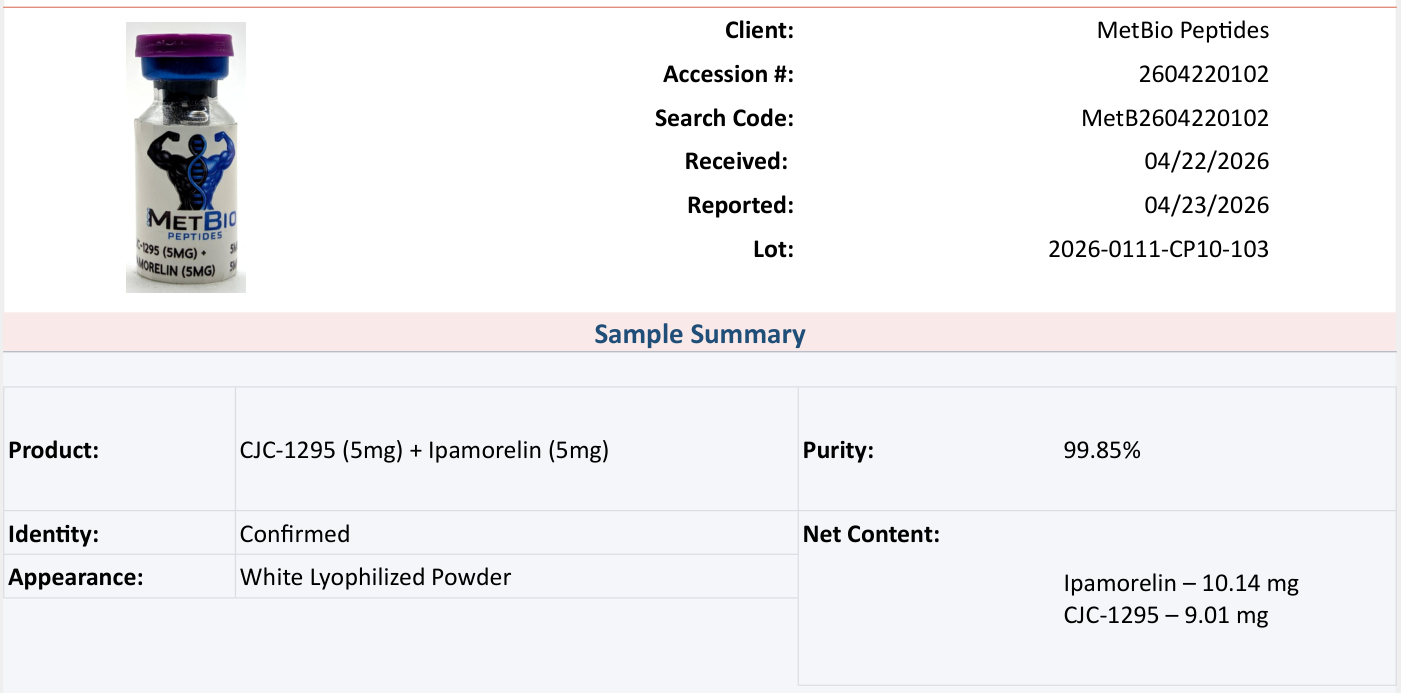
| MetBio PeptidesApril 23, 2026 · one reported sample | 5 → 9.01 mg+80.2% | 5 → 10.14 mg+102.8% |
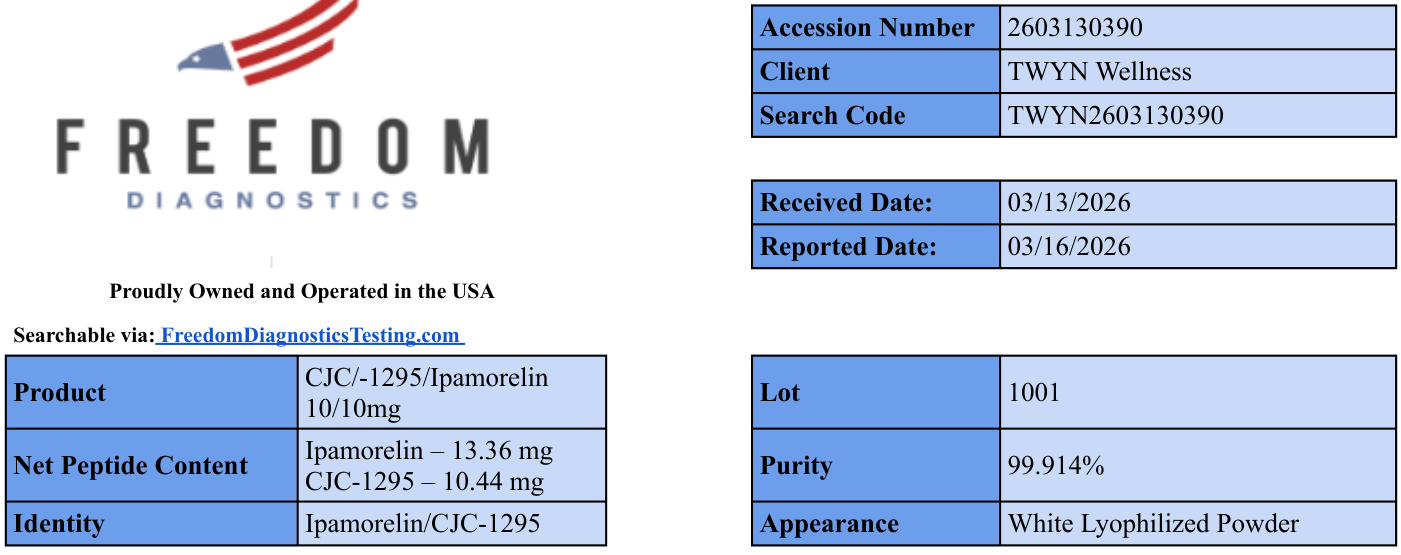
| TWYN WellnessMarch 16, 2026 · one reported sample | 10 → 10.44 mg+4.4% | 10 → 13.36 mg+33.6% |
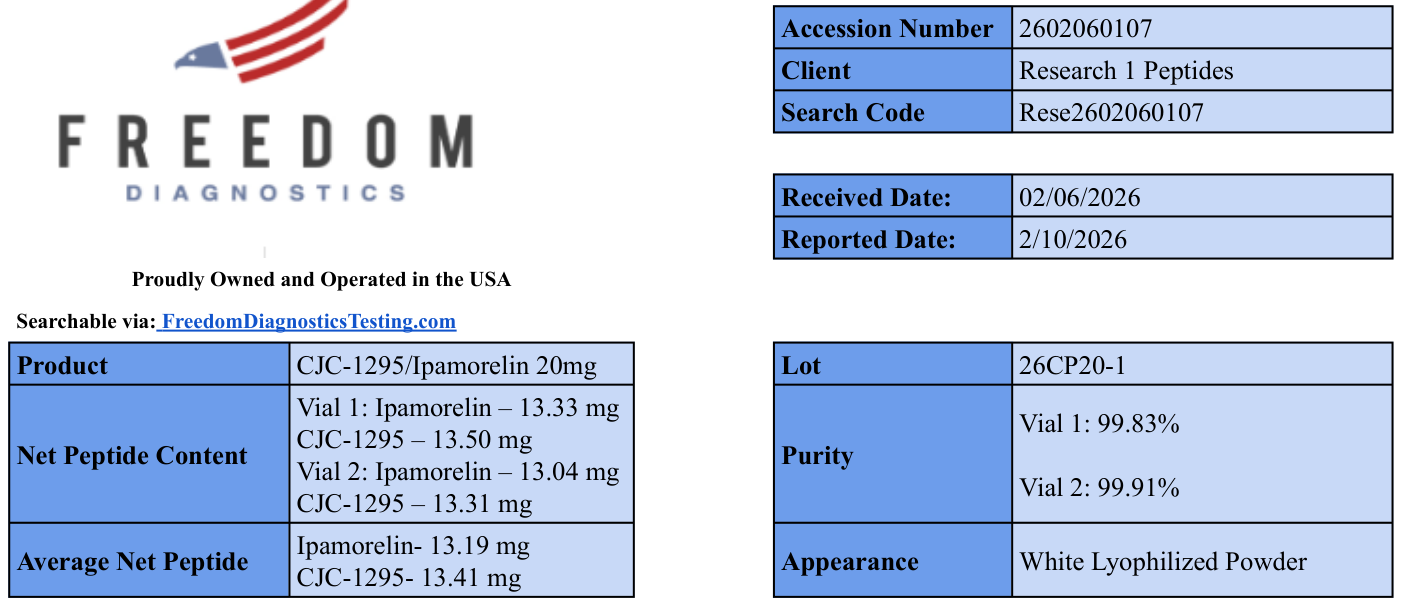
| Research 1 PeptidesFebruary 10, 2026 · vial 1 | 10 → 13.50 mg+35.0% | 10 → 13.33 mg+33.3% |
| Research 1 PeptidesSame report · vial 2 | 10 → 13.31 mg+33.1% | 10 → 13.04 mg+30.4% |
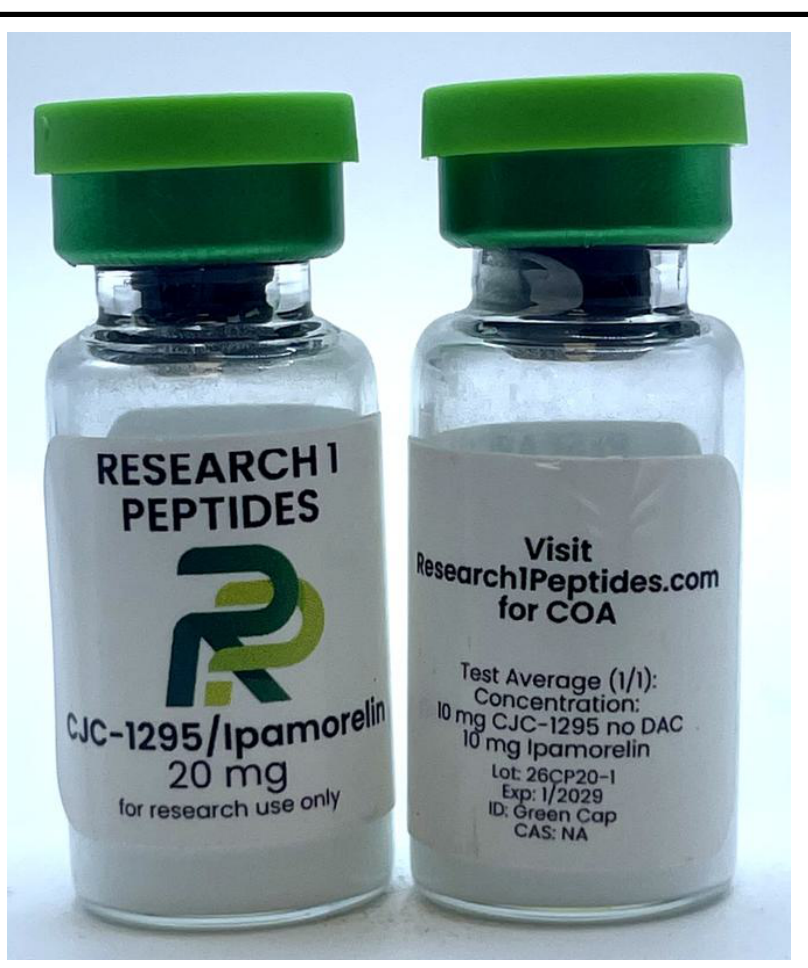
Research 1’s photographed label supplies the component claims and specifies CJC-1295 without DAC; the laboratory names only CJC-1295. The other reports leave DAC status unspecified.
MetBio Peptides: high reported purity and excess content coexist
This report states 5 mg of each peptide and measures 9.01 mg CJC-1295 and 10.14 mg ipamorelin. The ipamorelin measurement is more than twice its stated amount. The same report gives a purity result of 99.85%. Purity and content are separate measurements; a high purity percentage does not establish that the stated quantity is correct.
TWYN Wellness: the total can hide a component discrepancy
The two measurements add to 23.80 mg against 20 mg stated, which is 19% above the stated total. A screen that only checks for total blend content more than 30% above stated would miss this example. Ipamorelin alone is 33.6% above its 10 mg claim, while CJC-1295 is 4.4% above its separate claim.
Research 1 Peptides: two vials, not two independent reports
Both components exceed their claims by more than 30% in each vial. The table preserves individual results instead of counting the report’s average as another sample.
These certificates establish reported content differences in the submitted samples. They do not establish a clinical overdose, typical batch content, the cause of a discrepancy, or product safety. No identified link connects these clients or samples to the pharmacy-supplied preparation in Norton’s case.
A prescription and a quality report answer different questions
The TGA’s April 2026 advisory explains that unapproved peptide products have not been evaluated by the regulator for safety, quality or effectiveness. It identifies uncertain contents, inaccurate labels and injectable-product contamination among the concerns. A pharmacy dispensing a compounded preparation does not turn it into a TGA-approved medicine.
A laboratory can investigate the identity or amount in a submitted sample. Those results do not answer whether a treatment benefits a particular person, how that person will react, or whether the material they receive is the same as the tested sample.
| Evidence | What it can help establish | Important boundary |
|---|---|---|
| Identity testing | Whether the tested material matches the analyte under the method used | It does not establish a treatment's clinical benefit. |
| Content testing | The measured amount in the submitted sample | It does not establish the amount in every other vial or the dose someone administered. |
| Purity testing | A method-specific picture of detected components | A high purity percentage is not a sterility or endotoxin result. |
| Separate microbiological or endotoxin results | Findings for the specific hazards and samples tested | They do not exclude every possible adverse reaction. |
This is a practical distinction, not just a wording preference. In its December 2024 compounding review, slide 51, FDA staff described a CJC-1295 acetate certificate with a purity result but missing information about individual impurities and aggregates. The review also identified gaps concerning bioburden and endotoxins. That was a separate regulatory review, not an analysis of Norton’s medication or the samples in our table.
Make due diligence specific
Use the evidence to prepare concrete questions for a qualified clinician and pharmacist:
- What clinical evidence supports this exact substance, formulation and intended use? What approved alternatives are available?
- What is the exact ingredient identity, including the CJC form, and how is it documented?
- Does the original laboratory report match the product and batch? Does it report each blend component separately, and which tests were actually performed?
- What adverse reactions require prompt care, and who should be contacted if symptoms occur?
The Victorian health advisory issued October 27, 2026 warns that anaphylaxis can occur after earlier doses caused no apparent problem. It advises people not to use unapproved peptide products and to discuss approved alternatives with a medical practitioner. Difficulty breathing, throat swelling or collapse require emergency care; in Australia, call 000.
Testing can uncover a discrepancy that would otherwise remain hidden. It is one part of evaluating evidence, and it cannot guarantee a safe outcome or justify changing a prescribed dose yourself.
Evidence and method
We searched TitrateLab’s available records without a six-month cutoff, using a snapshot taken October 30, 2026. CJC-1295/ipamorelin combinations form the primary cohort. We kept 47 additional-ingredient blend records separate and excluded single-compound products from this comparison. CJC variant wording is retained where stated, and unspecified identity stays unspecified.
A qualifying comparison requires 100 × (measured mg ÷ stated mg − 1) > 30. Exactly 30% is excluded. Component quantities are compared with their own stated amounts. A combined mass is compared only with a stated combined amount. We do not invent an equal split when only a total is available.
Original report text, labels, units and sample counts take priority over stored percentage fields. A report may contain several vials and a rounded average; those are not independent certificates. Repeated imports of the same source are grouped, while different reports on the same batch remain distinguishable. Unresolved baselines and unavailable source material are retained as review limitations, not treated as passing results.
The three illustrated reports were checked against their original PDFs and available vial photographs. The images are faithful crops of those originals. Reported percentages use the displayed values and do not incorporate measurement uncertainty that the certificates do not specify.
The sample set is nonrandom. A discrepancy can arise from filling, labeling, submission or reporting; these documents alone do not determine which. Report clients are not automatically manufacturers. The analysis does not establish typical product content, a clinical dosing error, or the cause of Norton’s reaction.
For more detail on inspecting certificates, read how to verify a peptide COA. Our five-report overfill comparison illustrates additional compounds using a different selection window.
Prepared by the TitrateLab Research Desk with AI-assisted analysis and editorial tools. Sources reviewed October 30, 2026. TitrateLab collected the reports and did not perform the assays. Methodology · Send a source or calculation correction, including the original report reference.
