The six checks
Run them in this order. The first two need no lab report and catch two ways to lose a whole payment: paying an impersonator, or paying a seller that has already closed.
| Check | Where to look | A pass shows | It cannot show |
|---|---|---|---|
| 1. Exact domain and ordering channel | The seller’s own long-running announcements; the impersonator records in our archive | You are paying the business you meant to pay | That the business is honest |
| 2. Closures and enforcement | The Vendor Graveyard, FDA warning letters, Justice Department releases | No public shutdown, warning letter or court case on record | Problems that are not yet public |
| 3. Certificates on the lab’s own site | The lab’s report check, listed on our lab pages | The report exists and matches the copy you were shown | Who chose the sample |
| 4. Your batch | Find Your Batch | Reports that print the code on your vial | That your vial came from the tested production run |
| 5. Tests the seller did not commission | Finnrick’s sender label; the client name on a report | How product tested when someone else picked the vial | A random sample of the seller’s stock |
| 6. Buyer reports | Seller pages and forum threads | Patterns in delivery, refunds and support | What is in the vial |
Our seller pages gather dated lab records and buyer reports for several of these checks. Where a page summarizes them, the summary describes those records, not a seller’s honesty or future conduct.
1. Confirm the exact domain and ordering channel
Start by confirming who you are paying. Impersonators copy a seller’s name and logo, and they copy its claims about testing too.
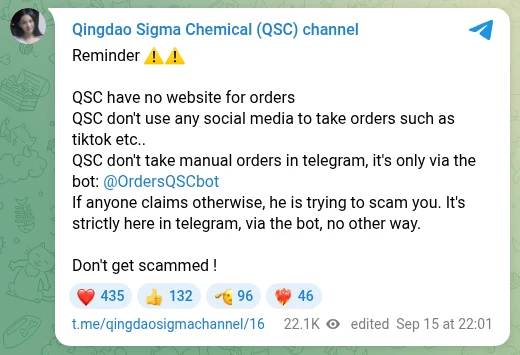
QSC, a Chinese vendor, tells buyers that it takes orders only through a Telegram bot. A post on its announcement channel, edited September 15, 2026, reads: “QSC have no website for orders” and “If anyone claims otherwise, he is trying to scam you.”
When we captured it on September 21, a storefront at qscpeptide[.]com carried QSC’s name and logo, a banner claiming verified purity of at least 99% and a “COA on Every Product”, and a note that all orders must be placed on that website.
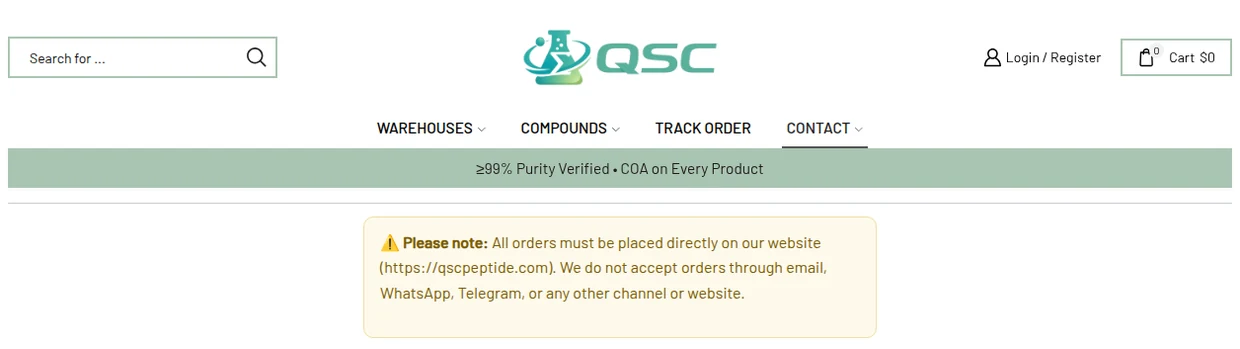
TitrateLab’s publisher identifies that storefront as an impersonation of QSC, on the basis of the channel’s announcements. Our full account of the case shows ChatGPT sending a user to the same storefront with a price list.
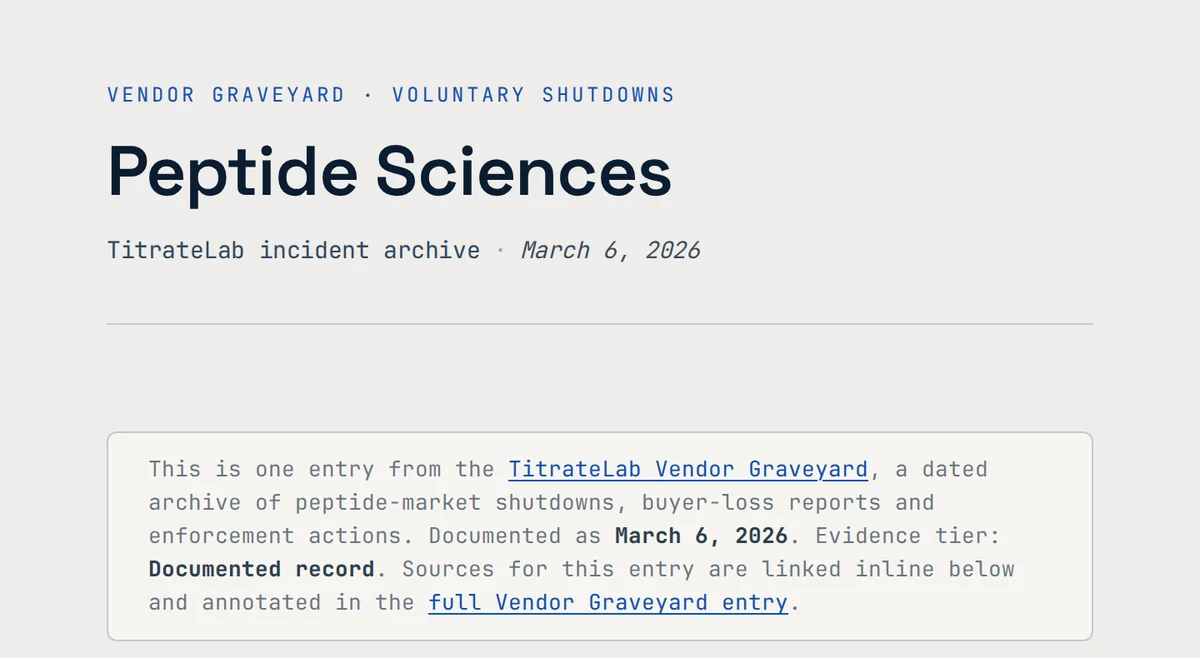
A closed seller’s name can be reused too. Peptide Sciences shut down on March 6, 2026. Its .com registry record shows peptidescienceslabs[.]com registered on April 16, 41 days later. The only Internet Archive capture of that domain, from May 16, shows a storefront titled “Home - Peptide sciences” selling peptides under the name (archived page). Since at least March 21, before that domain was registered, Peptide Sciences’ closing notice has called anyone claiming to sell its products fraudulent and unauthorized (notice as archived May 17, 2026).
In Semrush data we pulled on October 5, 2026, a Trustpilot page for peptidescienceslabs[.]com ranked eighth in Google’s US results for “peptide sciences review”. A reader checking the closed company’s reputation could land on reviews of a different site. Our graveyard entry on the closure records the company’s notice.
QSC and Peptide Sciences are not the only targets: GYC’s official announcement on GLP-1 Forum, posted March 3, 2026, warns that scammers impersonate it on Discord, Telegram and fake websites, and names one official website.
To run the check:
- Find where the seller states its official channels, in a place it has controlled for a long time, such as a forum vendor account or an announcement channel. Type that domain yourself.
- Do not rely on a search ad, an AI answer or a link someone sends you. The FBI warned in December 2022 that criminals buy search-engine ads impersonating real brands.
- Look up when the domain was registered. A public registry lookup (RDAP) gives the date. A domain registered after the seller closed, or a few weeks before you found it under a name that has traded for years, needs an explanation.
- Treat a site’s claim to be official, and its warnings about other fakes, as claims. The QSC-branded storefront above made both.
- Do not read the padlock as a trust signal. As Chromium’s developers explain, it shows that the connection is secure, not that the site is trustworthy.
Limit: a long-running channel can change hands. The QSC channel’s current and older identifiers differ, and we have not independently confirmed that the same people run both.
2. Check closure and enforcement records
Find any closure, FDA warning letter or prosecution under the seller’s name before you pay. A closed seller should not be taking orders, and a warning letter or court record states what regulators or prosecutors alleged. Search the seller’s name and domain in three places:
- TitrateLab’s Vendor Graveyard. After its October 1, 2026 review it held 18 dated entries: shutdowns, buyer-loss reports, FDA and trade actions, and federal criminal cases. Each entry states its evidence tier.
- FDA’s warning letter database. Letters dated December 10, 2024, for example, told four online sellers of research-labelled GLP-1 products that their products were unapproved new drugs; the graveyard entry names them.
- Justice Department press releases and federal court dockets.
These records can also test a seller’s own claims. In the Paradigm Peptides case, the Justice Department says the business falsely claimed FDA registration, US manufacturing and product testing while importing from China and India without testing, and kept selling after FDA warning letters in 2020 and 2022. Its owner was sentenced on July 30, 2026 to 70 months in prison (Justice Department release).
A closure notice may also leave buyers without answers. Peptide Sciences’ three-sentence closing notice gave no reason and said nothing about pending orders or refunds. Its two later versions, in place by March 21 and April 15, 2026, still did not.
Limit: absence from these records clears no one. Enforcement is slow and selective, and a rumour is not a record. On October 1, 2026 we withdrew a graveyard entry about a reported warehouse raid because no FDA, Justice Department or court record supported it.
3. Verify the seller’s certificates on the lab’s own site
Open the report on the issuing laboratory’s website yourself. A PDF or screenshot from the seller is the seller’s copy. Of the 20 testing labs and services profiled on TitrateLab’s lab pages, reviewed October 9 and 10, 2026, 19 offer a way to check a report on their own domain. MZ Biolabs delivers reports only through a client login, and Krause Analytical checks a report only when you upload the original file.
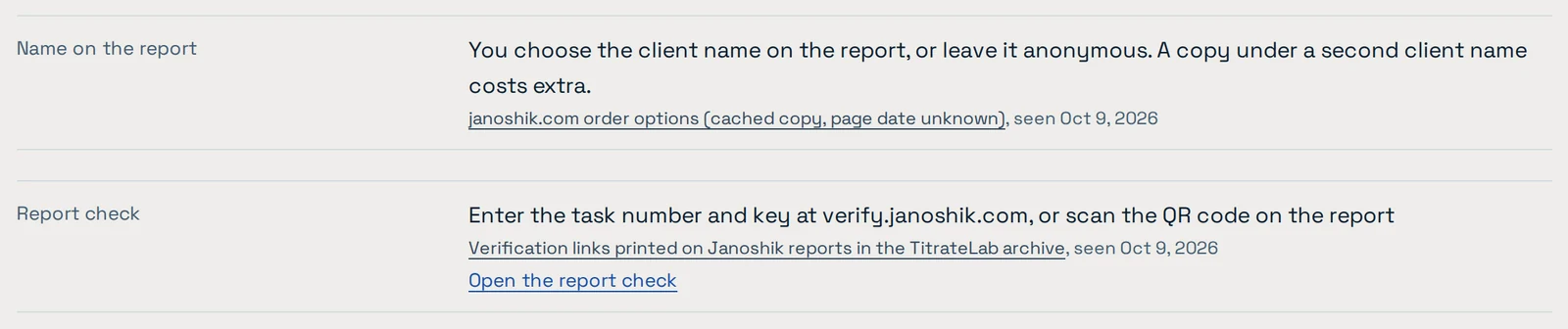
At Janoshik, enter the task number and the unique key printed at the foot of the report on its verification site, or scan the report’s QR code. The same profile records a less obvious fact, taken from a cached copy of Janoshik’s order options whose date we could not establish: the person who orders a test chooses the client name printed on it, and a copy under a second client name costs extra. A seller’s name on a Janoshik report shows what the orderer chose to print. It does not prove who bought or sent the vial.
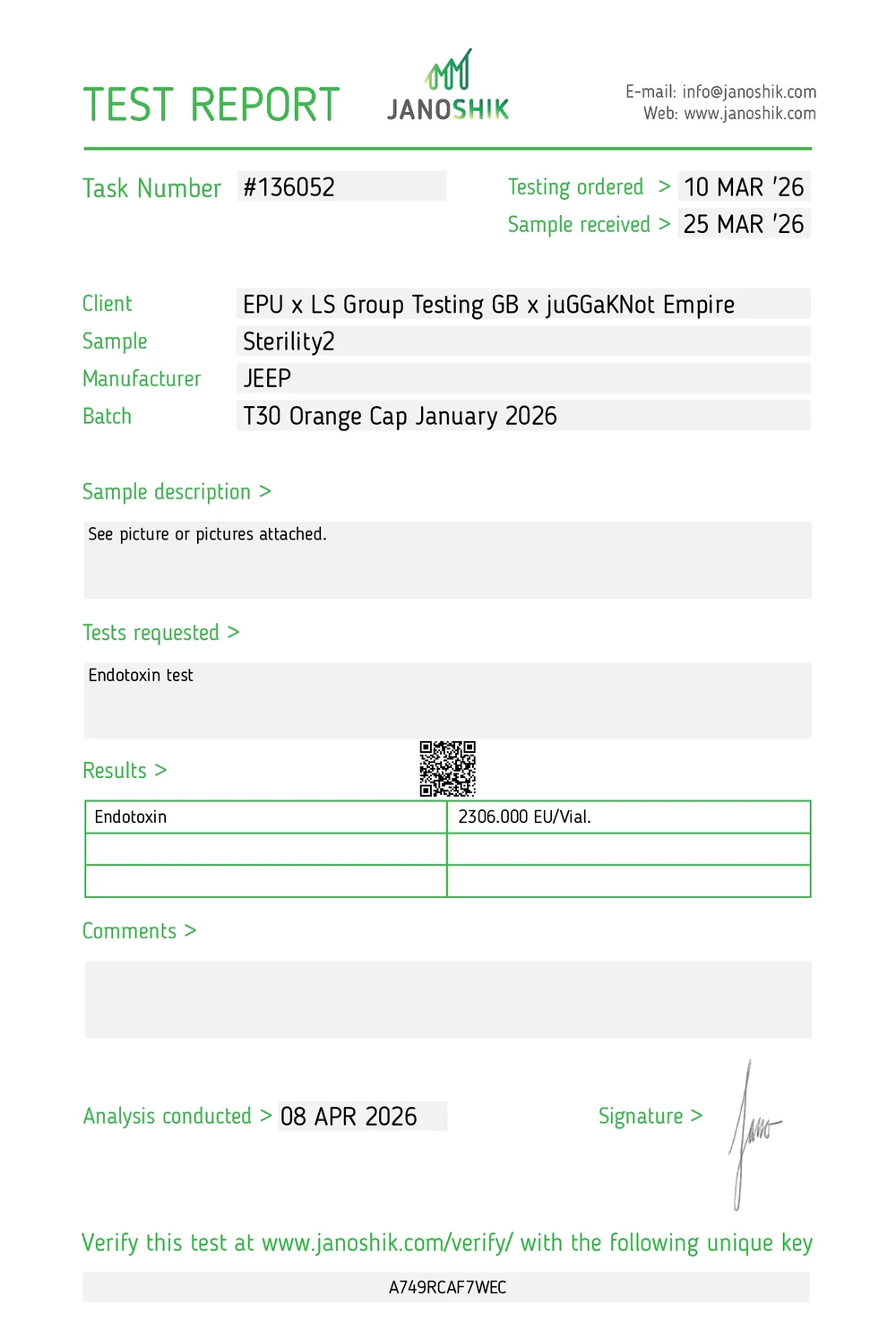
Read the fields one at a time. This report names a community group-buy testing cohort as client and JEEP as manufacturer, describes the batch as “T30 Orange Cap January 2026”, and lists one test: endotoxin, 2,306 EU per vial. It reports nothing about purity or dose. The graveyard entry on this batch puts the result in context.
Our COA verification guide covers the field-by-field checks. TitrateLab’s report lookup tells you free of charge whether a Janoshik test number or report ID is in our archive and how many certificates share it; the archived values require a paid plan. It does not search batch codes and will say a code is not in the archive even when it is, so search codes in Find Your Batch (check 4).
Limit: a genuine, lab-hosted report proves that the lab tested a sample. It does not show who chose that sample or that later batches match it.
4. Look up the batch you hold
A certificate helps you only if it connects to your vial, and that connection is usually a printed code. In TitrateLab’s archive on October 10, 2026, 89,220 of 116,041 published lab records (76.9%) carried a batch or lot identifier. The rest cannot be matched to a vial through that field.
Enter the compound and the code from your vial, box or kit in Find Your Batch. On October 10, 2026, a search for BPC-157 and code 990007 returned 10 exact code matches among 4,745 BPC-157 reports. Eight are Finnrick results for vials filed under ERP and WBS, two supplier names our records connect. The other two are certificates that US sellers commissioned.
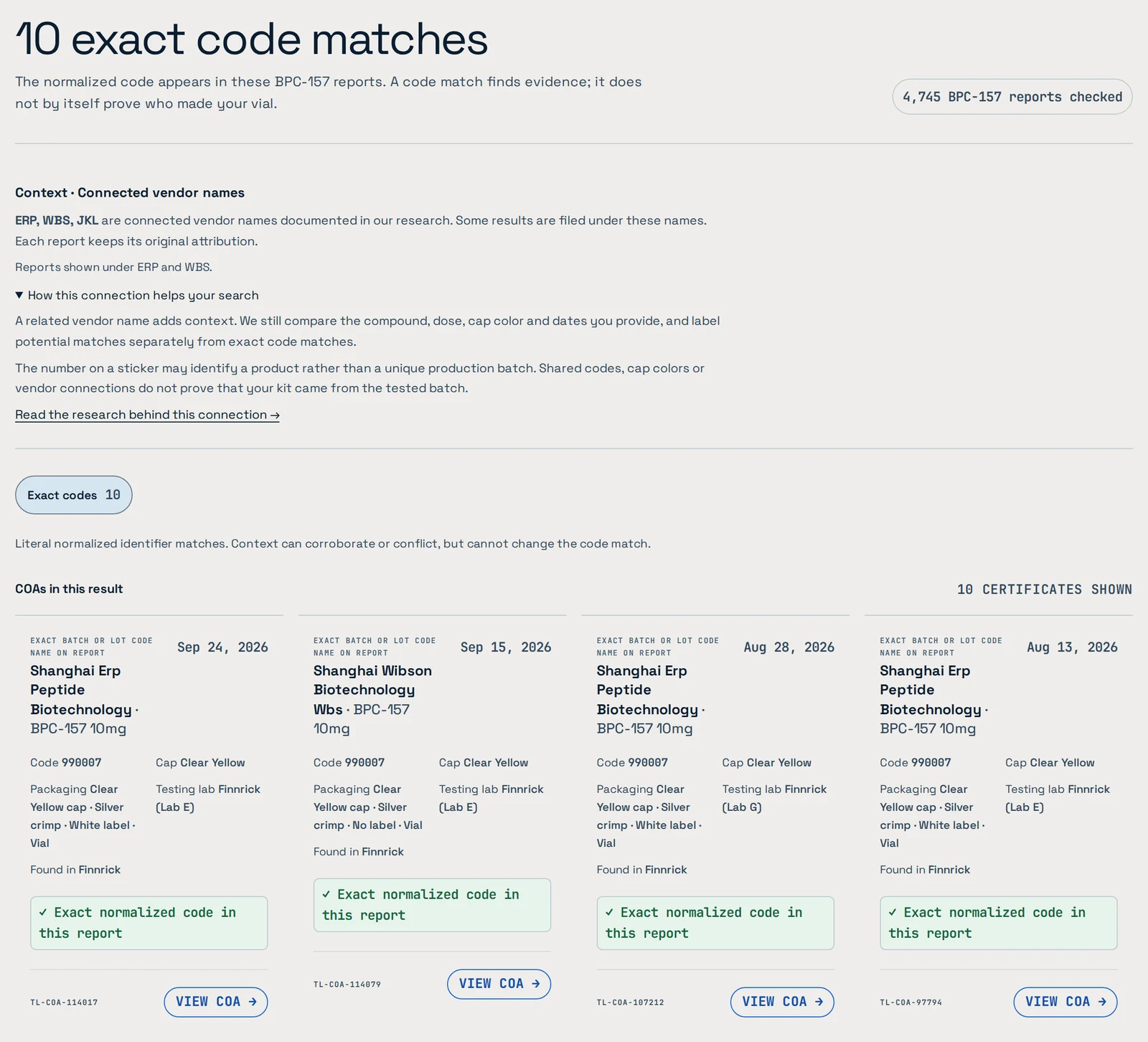
The result carries its own warning: the number on a sticker may identify a product rather than a single production run. Code 990007 is such a case. Our September analysis of US sellers found it on vials from several sellers and on supplier stock, with very different results over time (see check 5).
To use a match, compare everything else the report prints: strength, cap colour, label and test date against your purchase. A match is a lead to investigate. No match means no public report for that code in our archive, not a failed product. If your vial has no matching report, our lab pages show how to send one for testing.
Limit: a shared code or cap colour does not prove that your vial came from the tested batch.
5. Look for tests the seller did not commission
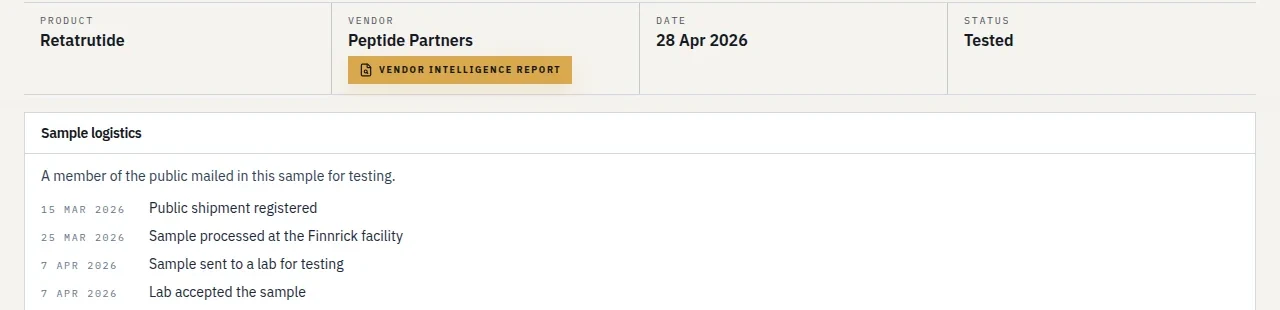
A seller’s own certificate tests a vial the seller chose. Give more weight to results from vials someone else picked. Finnrick, a testing service, labels who sent each sample, which makes the difference measurable.
| Who sent the vial (Finnrick’s label) | Results | Below 98% purity | Recorded as 0% |
|---|---|---|---|
| Vendor: “The vendor submitted this sample for testing.” | 232 | 6 (2.6%) | 0 |
| Public: “A member of the public mailed in this sample for testing.” | 10,169 | 1,066 (10.5%) | 598 (5.9%) |
| Finnrick: “ordered by Finnrick directly from the vendor” | 1,547 | 278 (18.0%) | 65 (4.2%) |
Finnrick records in TitrateLab’s certificate archive with a sender label and a purity value, read on October 10, 2026. Test dates run from September 9, 2025 to September 24, 2026 for vendor-sent vials, March 28, 2025 to September 25, 2026 for public-sent vials and December 17, 2024 to September 20, 2026 for vials Finnrick bought. Our archive records a vial in which the laboratory did not find the labelled compound as 0% purity and zero amount; that is an identity result, not proof of an empty vial. Quantity results are otherwise not counted.
Vials mailed in by the public fell below 98% purity about four times as often as vials vendors sent, and vials Finnrick bought itself about seven times as often. The gap holds within the same sellers. Ten sellers had at least three vendor-sent and three public-sent results: 1 of their 115 vendor-sent results fell below 98%, against 31 of 468 public-sent results (6.6%), 16 of them at 0%.

Three explanations compete, and the data cannot separate them fully:
- Sellers choose what they send. Finnrick’s Launch with Finnrick page, read on October 10 and again on October 11, 2026, tells vendors they “can review and approve the test results before publishing”. The same page says samples are anonymized and processed with other samples “to minimize bias”, and that published results cannot be withdrawn.
- Buyers may test vials that already look wrong, which would raise the public rate. The published public results are also filtered. Finnrick publishes a public submission only when it has other tests of the same product to compare against, and says about a third of the tests it has completed stay unpublished because it cannot establish where the sample came from. We cannot tell which way that filter moves the rate.
- The groups cover different sellers, compounds and partner laboratories. Our September analysis found that failure rates differed between the labs Finnrick uses.
One code shows the pattern in a single product. In our September analysis of BPC-157 code 990007, customer-sent vials ordered between February 28 and May 20, 2026 tested at 99.5% to 99.8%, and three ordered from June 18 to August 3 read 81.5%, 81.9% and the wrong substance. Four seller-commissioned certificates for the same code, received between April 28 and September 8, read 99.16% to 99.38% (full timeline). Finnrick records added to our archive on September 30 hold three more public-sent results for the code. Two, tested September 15 and 24, read 78.0% and 76.9%. The third, tested September 24 and recorded as “990007, yellow caps”, read 99.9%. A code match alone could not tell a buyer which of these results their vial resembles.
To run the check:
- On a Finnrick record, read the sender label or the “Sample logistics” box.
- On Janoshik and similar reports, read the client field, remembering that the orderer chooses it. A testing group or an individual buyer as client, as on report #136052 above, suggests the seller did not commission the test.
- Search our seller pages or Find Your Batch for results from vials the seller did not send. Our September analysis found that 2,463 of 2,531 US sellers with certificates they commissioned had no customer-sent vial in Finnrick’s public record.
Limit: independent results are still a selected sample, not a random audit of a seller’s stock.
6. Read buyer reports for conduct, not chemistry
Buyer reports are the only check here that speaks to delivery, refunds and how a seller treats customers. They say little about what is in the vial, and they can be shaped.
QSC is the clearest case in our records of the two questions coming apart. Across 100 certificates QSC did not commission, its product tested at a median 99.72% purity (August 1, 2026 investigation). Its conduct record is different. The graveyard timeline records buyer reports of paid orders left unfilled from December 2024, an April 13, 2026 message saying “No refunds, no order changes, no credits” until tracking numbers arrived, and a permanent MESO-Rx ban on June 8, 2026 after posts that let a complaining customer’s home be identified.
On July 28, 2026, QSC told its channel that promotional prices would depend on whether customers posted public reviews. On October 10, 2026, QSC’s TitrateLab seller page counted 233 approved reviews: 222 labelled positive, 9 neutral and 2 negative.

We have not measured how many of those reviews followed the pricing announcement, and a lopsided count is not proof of rewarded reviews. It does mean that a tally of positive reviews cannot settle the question.
To read buyer reports:
- Read the neutral and negative reports first, and look for repeated specifics: missing tracking, refused refunds, substitutions.
- Check the dates. QSC paused its operation in January 2025 and did not return for nearly seven months; a good record from one year says little about the next.
- Keep the seller and its impersonators apart. A buyer who says they were scammed “by” a brand may have paid someone posing as it (check 1).
- On TitrateLab seller pages, review counts and tone labels are public; the full text of each review requires a paid plan. Our guide to reading forum threads covers claims made in community discussions.
Limit: reviews come from people who chose to post. Satisfied buyers, rewarded buyers and angry buyers post at different rates.
What no check can show
- That your vial is safe. Certificates describe tested samples, usually for identity, purity and amount. On October 11, 2026, only 10,917 of the 116,339 published records in our archive (9.4%) carried an endotoxin result, and a purity result says nothing about endotoxin or sterility. Nothing here is medical advice.
- That the seller will stay honest. A seller’s chemistry and conduct can diverge (check 6), a closure notice can leave orders unresolved (check 2), and a business can claim testing it never did (the Paradigm case, check 2).
- That buying is lawful where you live. These checks do not address it.
Method and sources
Finnrick comparison. We read TitrateLab’s certificate archive read-only on October 10, 2026 at 17:04 UTC and repeated the queries on October 11, with identical results. It held 12,146 published Finnrick records, discovered up to September 30, 2026. We excluded 125 with no purity value and 73 carrying the rarer “Pulse” (72) and “Incentive” (1) sender labels, whose meaning we have not confirmed, leaving 11,948. “Below 98% purity” includes 0% results and matches the threshold of our September analysis. The same-seller comparison uses TitrateLab’s seller identities and includes every seller with at least three vendor-sent results and at least three sent by the public or bought by Finnrick; all ten qualifying sellers’ non-vendor results were public-sent, with test dates from June 11, 2025 to September 24, 2026. The sender wording quotes Finnrick’s record pages as captured on September 18, 2026.
Archive coverage. The batch-identifier share counts all 116,041 published records in the same October 10 snapshot, with test dates through October 9, 2026. The archive keeps growing; the share was unchanged at 76.9% when we rechecked on October 11. The endotoxin share counts published records on October 11, 2026 whose endotoxin field holds a result rather than N/A.
Code 990007. The Find Your Batch result is the tool’s own count on October 10. The same search on October 11 returned the same 10 exact matches among 4,757 BPC-157 reports. The breakdown by supplier name and the three later Finnrick results come from the published records carrying that code, read on October 11, 2026.
Lookalike domain. We queried the .com registry record for peptidescienceslabs[.]com and the Internet Archive’s capture index on October 11, 2026. The registry gave a registration date of April 16, 2026 and a “client hold” status; the index held one capture, from May 16, 2026. We read the March 18, March 21, April 15 and May 17, 2026 captures of the Peptide Sciences notice the same day: the warning about sites claiming to sell its products is absent on March 18 and present on March 21, and the April 15 capture carries the current wording. The Semrush result list is the October 5, 2026 pull for “peptide sciences review” used in our keyword research.
Lab pages. Counts come from the 20 published profiles on TitrateLab’s lab pages, whose sources were checked on October 9 and 10, 2026.
Figures. TitrateLab pages were captured from our own server on October 10, 2026, between 16:59 and 17:01 UTC, in one browser session. The QSC images are captures first published with our ChatGPT impersonation case; the Finnrick images come from our September 18, 2026 captures. Every figure is a crop of a real capture, with no retyped, highlighted or added text. Sources, capture times, processing and the exact queries are recorded in the figure and query manifest.
Scope. This guide describes checks a buyer can run. It does not rate the sellers named in it. QSC appears because our published records document both its lab results and its conduct; Peptide Sciences and Paradigm Peptides appear because official or documented records cover them. We have not established who operated peptidescienceslabs[.]com, and nothing we hold connects it to the closed company.
Prepared with AI-assisted retrieval and drafting, with claims checked against the cited records. See TitrateLab’s methodology. Send corrections with supporting sources to [email protected].
